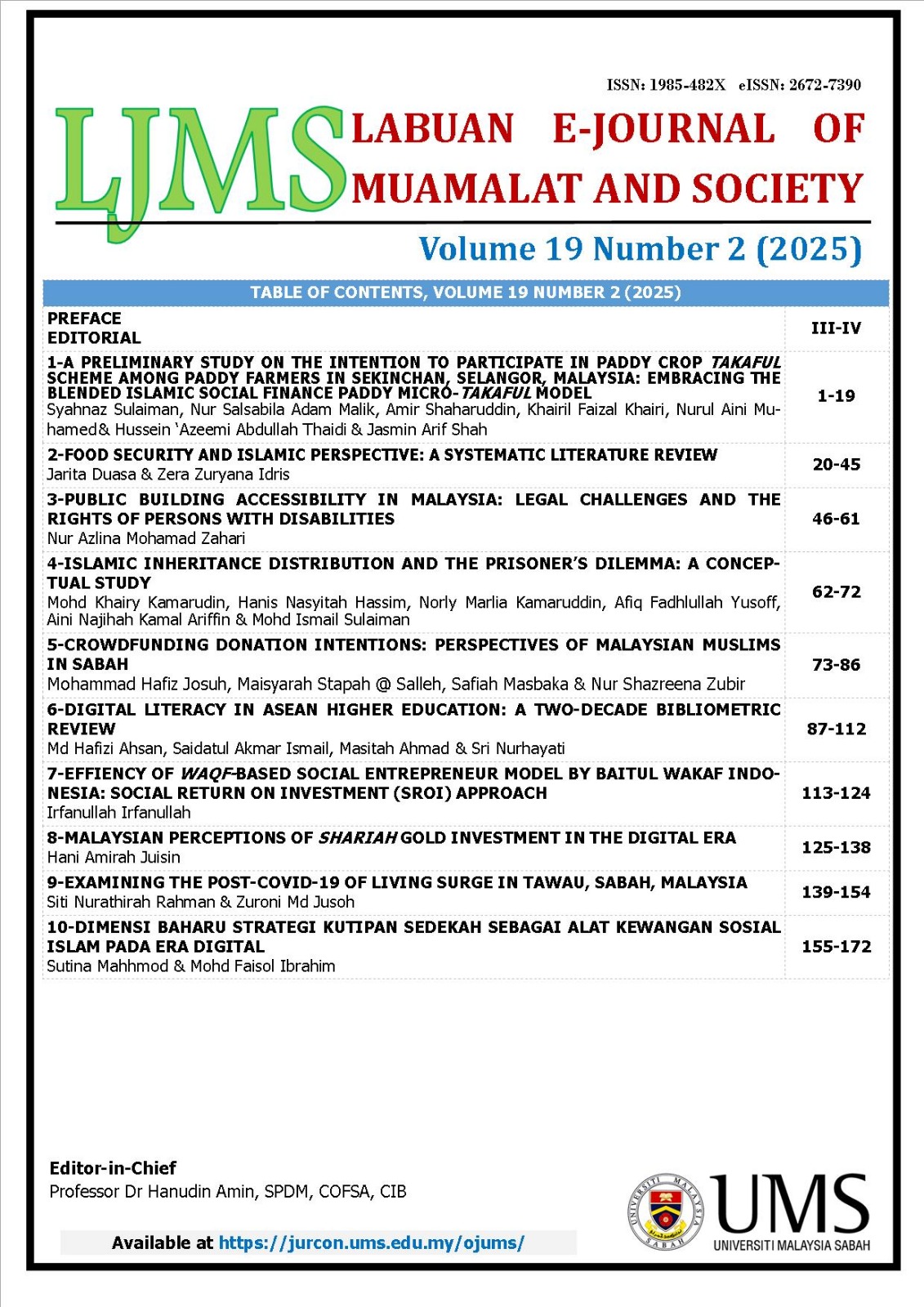
PUBLIC BUILDING ACCESSIBILITY IN MALAYSIA: LEGAL CHALLENGES AND THE RIGHTS OF PERSONS WITH DISABILITIES
DOI:
https://doi.org/10.51200/ljms.v19i2.6616Keywords:
Accessibility, Persons with disabilities, Public buildings, Disability, Inclusive societyAbstract
The growing proportion of persons with disabilities in Malaysia has underscored the urgent need for accessible public buildings, as access is intrinsically tied to the exercise of fundamental rights. This article examines the legal challenges that impede persons with disabilities' access to public buildings in Malaysia and proposes legal reforms to enhance compliance with international standards. A qualitative research design was employed, utilising a doctrinal legal methodology supported by content analysis. Primary data sources included statutory instruments such as the Persons with Disabilities Act 2008 [Act 685], the Uniform Building By-Laws 1984 (UBBL), the Convention on the Rights of Persons with Disabilities (CRPD), and relevant case law. The findings reveal several deficiencies within the current legal framework: inconsistencies between domestic legislation and CRPD, vague or narrow legal definitions, the absence of mandatory access audits, and limited enforcement powers of the National Council for Persons with Disabilities. These shortcomings hinder the realisation of accessibility rights for persons with disabilities. This study highlights the need for legislative amendments to Act 685 and the UBBL to align Malaysia’s legal framework more closely with the CRPD. While the study is limited to a doctrinal analysis without empirical fieldwork, it offers a timely and original contribution by identifying specific legal reforms necessary to advance accessibility rights. The findings carry significant implications for policymakers, legal practitioners, and disability advocates seeking to ensure inclusive development through legal means.
Downloads
Published
How to Cite
Issue
Section
License
Copyright (c) 2025 Labuan e-Journal of Muamalat and Society (LJMS)

This work is licensed under a Creative Commons Attribution 4.0 International License.




 Total Views: 386
|
Total Views: 386
|  Total Downloads: 326