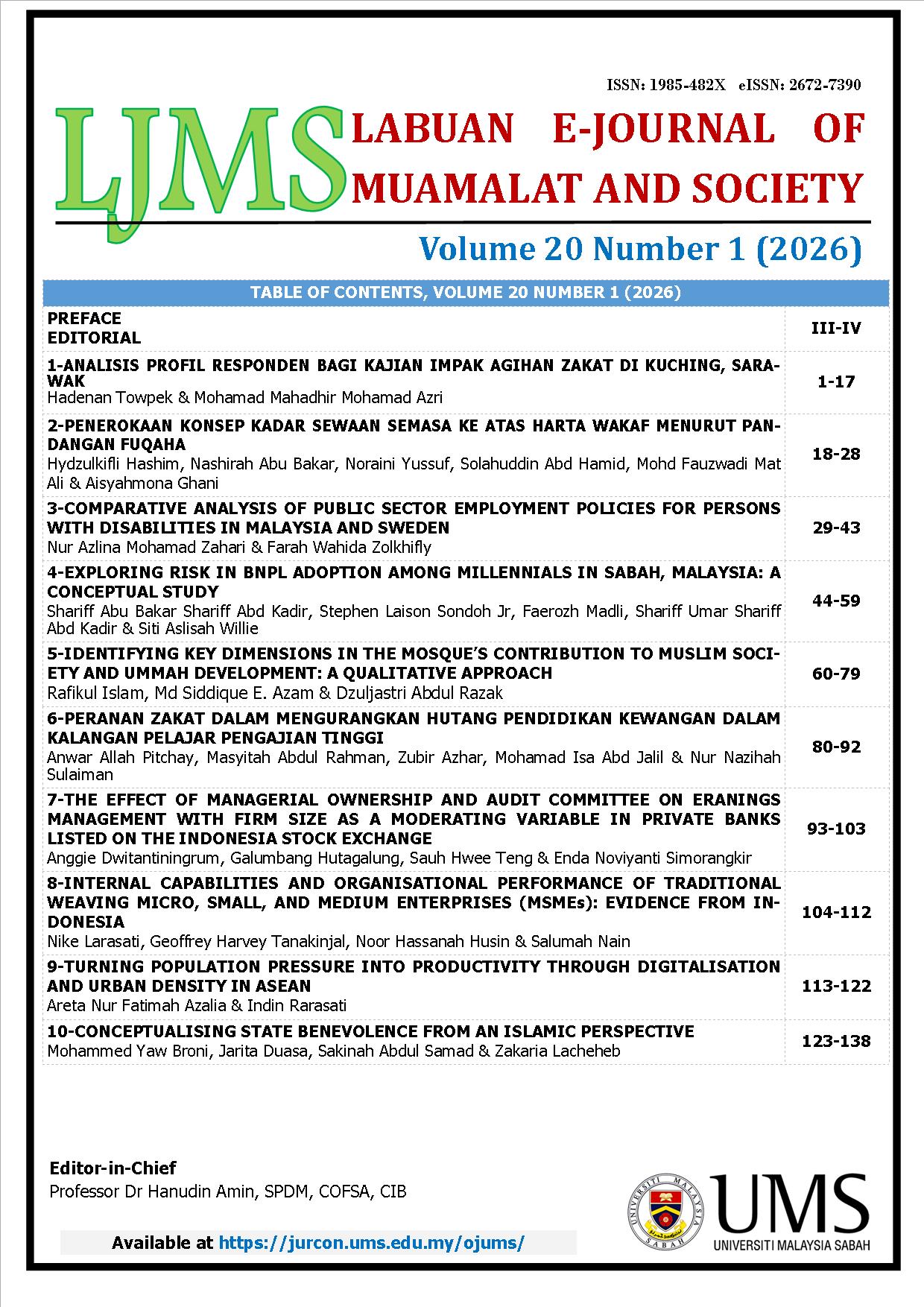
EXPLORING RISK IN BNPL ADOPTION AMONG MILLENNIALS IN SABAH, MALAYSIA: A CONCEPTUAL STUDY
DOI:
https://doi.org/10.51200/ljms.v20i1.7300Keywords:
Perceived risk, BNPL, Second-order construct, First-order construct, Millennial, SabahAbstract
This study investigates the role of perceived risk in the adoption of Buy Now Pay Later (BNPL) services by conceptualising perceived risk as a hierarchical construct composed of multiple dimensions. Despite the rapid growth of BNPL usage in Malaysia, particularly following accelerated digitalisation during the COVID-19 pandemic, the influence of perceived risk on adoption remains underexplored, largely because prior studies have treated perceived risk as a single-dimensional concept and focused primarily on users in Peninsular Malaysia, leaving millennials in Sabah understudied. Guided by perceived risk theory, this study proposes a multidimensional framework comprising financial, performance, psychological, privacy, security, time, social, and delivery risks as first-order constructs that together form a second-order perceived risk construct. The framework highlights the relative importance of different risk dimensions and offers theoretical insights into hierarchical risk perceptions. By focusing on millennials in Sabah, the study contributes to theory and provides practical guidance for BNPL providers and policymakers in designing strategies to mitigate risk and support a well-being-oriented digital financial ecosystem in emerging markets.
Downloads
Published
How to Cite
Issue
Section
License
Copyright (c) 2026 Labuan e-Journal of Muamalat and Society (LJMS)

This work is licensed under a Creative Commons Attribution 4.0 International License.




 Total Views: 199
|
Total Views: 199
|  Total Downloads: 183