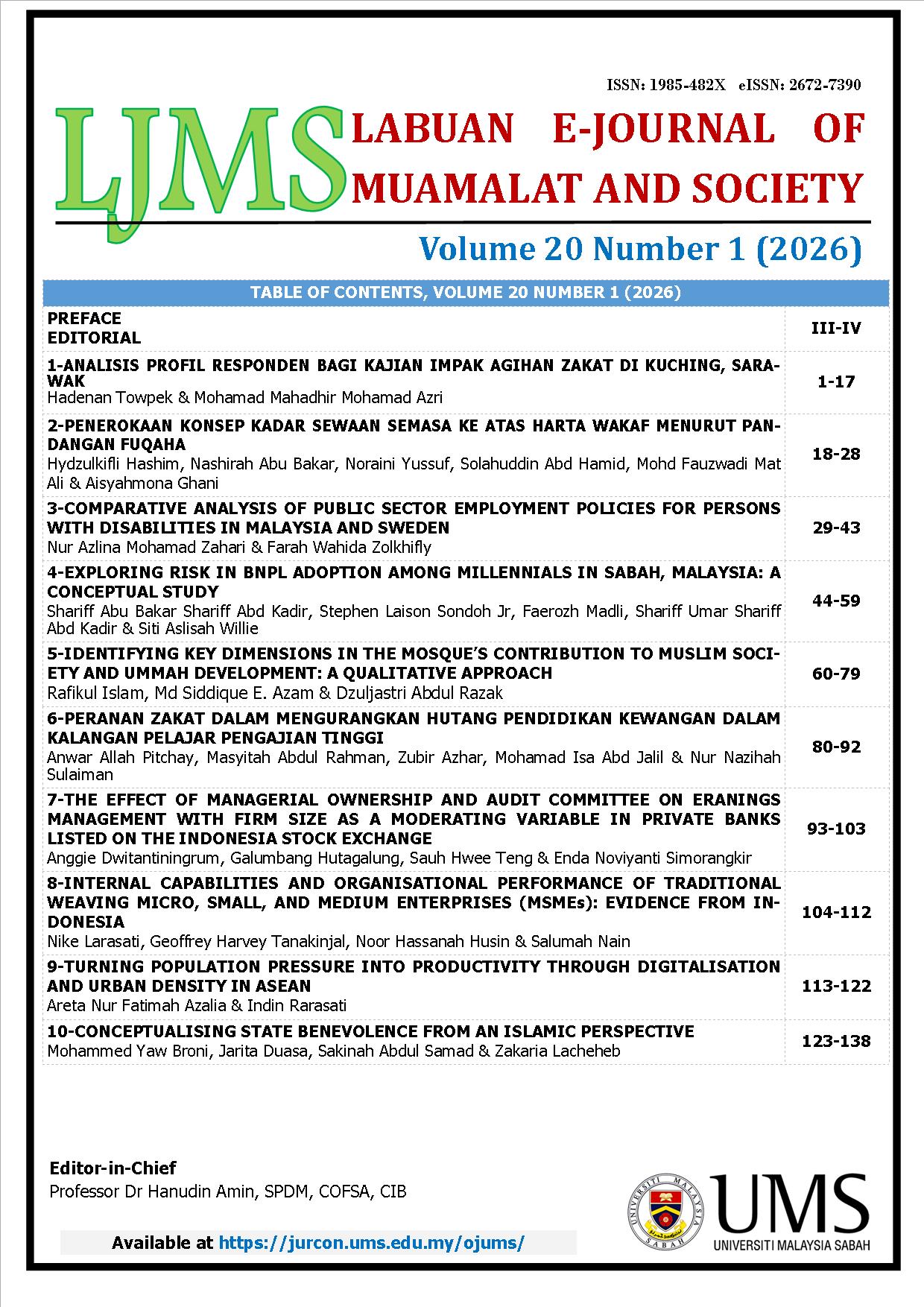
TURNING POPULATION PRESSURE INTO PRODUCTIVITY THROUGH DIGITALISATION AND URBAN DENSITY IN ASEAN
DOI:
https://doi.org/10.51200/ljms.v20i1.7395Keywords:
Economy, Density, Population, Digitalisation, ASEANAbstract
This study examines the impact of digitalisation on the economic performance of ASEAN countries from 2015 to 2024, focusing on GNI per capita as a measure of welfare and income. It highlights the growing role of digital platforms, online labor markets, and demographic changes in shaping ASEAN's economy. Using panel data and Two-Stage Least Squares (TSLS), the study addresses endogeneity by instrumenting variables like urban population, growth rates, and youth unemployment for population density, while controlling for demographic and labor factors. Findings indicate that higher population density and increased service-sector employment significantly boost GNI per capita. Internet access further raises income levels, emphasizing the importance of digital infrastructure. In contrast, mobile phone penetration correlates negatively with income, potentially because basic access supports low-wage gig work and informal competition. Inflation reduces welfare, whereas HDI has a positive impact. Overall, digitalisation plays a vital role in increasing income across ASEAN.
Downloads
Published
How to Cite
Issue
Section
License
Copyright (c) 2026 Labuan e-Journal of Muamalat and Society (LJMS)

This work is licensed under a Creative Commons Attribution 4.0 International License.




 Total Views: 135
|
Total Views: 135
|  Total Downloads: 133