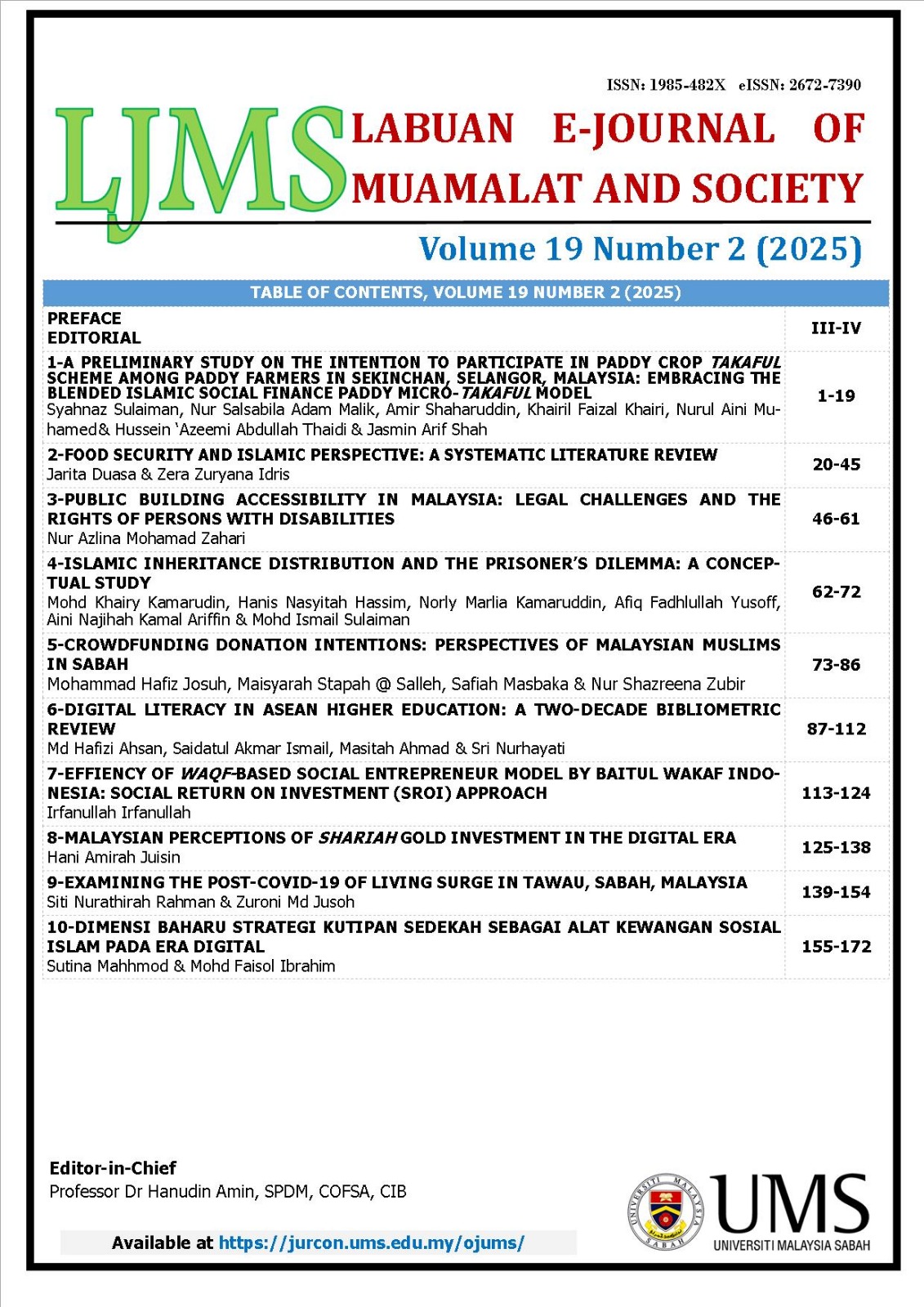
A PRELIMINARY STUDY ON THE INTENTION TO PARTICIPATE IN PADDY CROP TAKAFUL SCHEME AMONG PADDY FARMERS IN SEKINCHAN, SELANGOR, MALAYSIA: EMBRACING THE BLENDED ISLAMIC SOCIAL FINANCE PADDY MICRO-TAKAFUL MODEL
DOI:
https://doi.org/10.51200/ljms.v19i2.6433Keywords:
Paddy crop micro-takaful scheme, Planter's intent, Islamic social finance, Food security, Islamic financeAbstract
Paddy farming in Malaysia is highly vulnerable to risks such as climate change, pest infestations, and crop diseases, threatening both farmers’ livelihoods and national food security. To mitigate these challenges, the Malaysian government introduced the Paddy Crop Takaful Scheme, supported by an initial grant of RM50 million from the Government. This study examines paddy farmers’ intention to participate in the scheme, focusing on key influencing factors such as price, risk exposure, attitude, subjective norms, and perceived behavioural control, using the Theory of Planned Behaviour (TPB) as its analytical framework. A quantitative methodology was employed through a pilot survey involving 30 paddy farmers from Sekinchan, located within the Integrated Agricultural Development Area (IADA) Barat Laut Selangor. Data analysis included descriptive statistics, reliability tests (Cronbach's alpha), validity assessments, and crosstabulations to determine patterns in farmers’ decision-making. Findings reveal that attitude and risk exposure are the strongest predictors of participation, while perceived behavioural control had the least influence. Notably, only 13 per cent of farmers received financial support from Islamic social finance institutions such as zakat and waqf, indicating an untapped opportunity to enhance affordability and inclusivity for low-income farmers (B40 group). The novelty of this research lies in the discourse on agriculture risk management by proposing a blended Islamic social finance paddy micro-takaful model, aligned with Malaysia’s Value-Based Intermediation Takaful (VBIT) framework. Despite the small sample size, the findings provide valuable insights for policymakers and takaful operators, advocating for greater integration of Islamic social finance mechanisms to strengthen farmers’ financial security and support national food resilience strategies.
Downloads
Published
How to Cite
Issue
Section
License
Copyright (c) 2025 Labuan e-Journal of Muamalat and Society (LJMS)

This work is licensed under a Creative Commons Attribution 4.0 International License.




 Total Views: 305
|
Total Views: 305
|  Total Downloads: 216