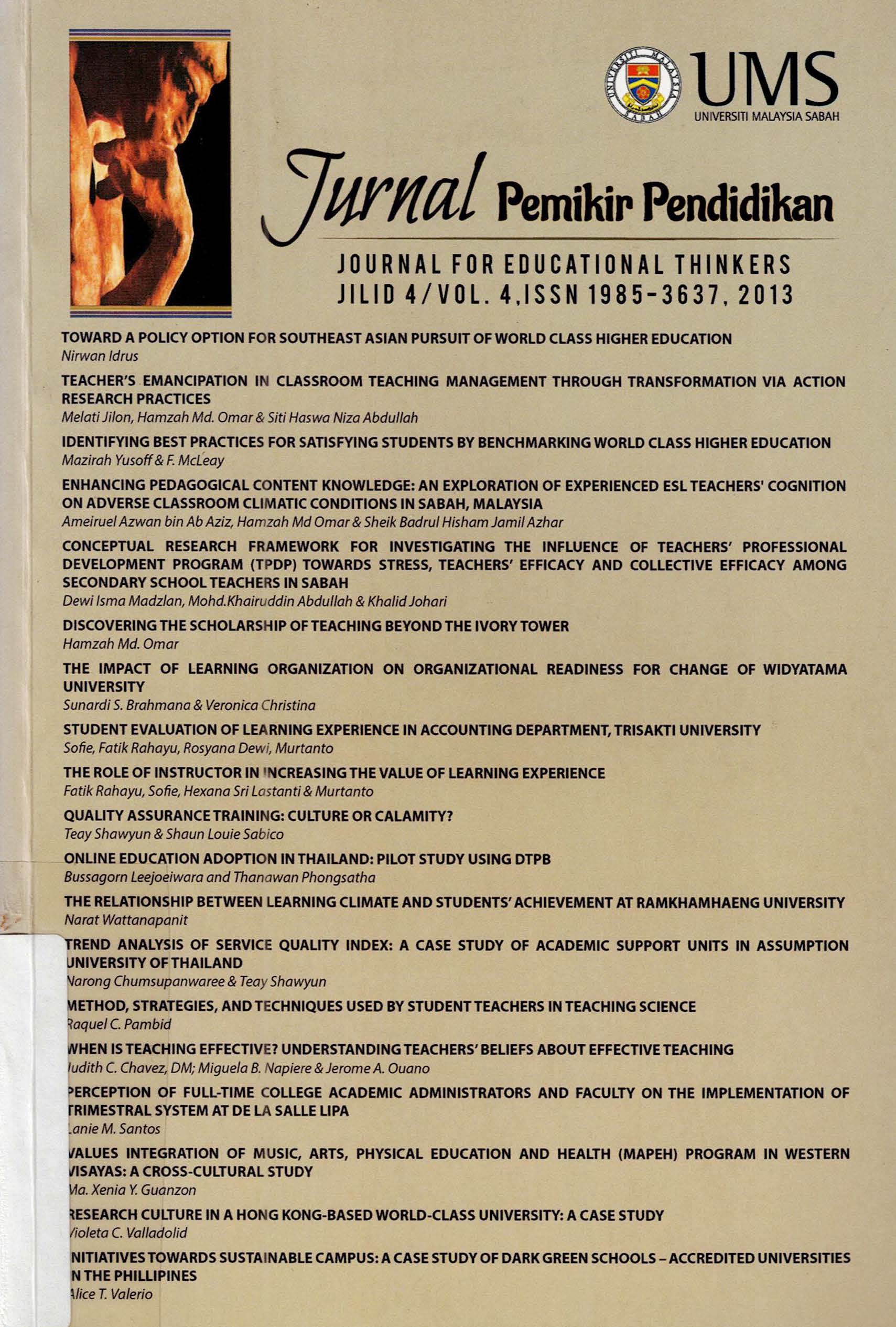
Toward a policy option for Southeast Asian pursuit of world class higher education
DOI:
https://doi.org/10.51200/jpp.v4i1.8172Keywords:
higher education, Southeast Asia, policy option, world class, generation gapAbstract
Aspiring to become world class appears to be a preoccupation of many Southeast Asian universities. Measures of achievement are normally through internationally recognized rankings. The wordings used to enshrine this desire can be read from the Visions and Missions Statements showcased by these universities. However, only a few of them has made it through the ranking barrier of top 200. They could be considered as being World Class and the aspiration of the Asian or Southeast Asian universities'. Having aspirations and desires is obviously a necessary but not sufficient condition to achieving World Class status. This paper proposes a conceptual model based on many years of personal and vicarious experiences in higher education in several countries involving World Class and non-World Class universities. The model considers Management, Technolo-gy, Generational Gap and Curricula (MTGGC) as the fundamental dynamics to move universities towards global recognition and World Class ranking. These dynamics are constantly interactive in a planetary cluster with Management in the focal location. Each of these dynamics has its own elements which trigger innovation in pedagogy, education technology and even in educational structure and philosophy. Examples are given to show these innovations. The paper concludes by suggesting the need to consider reforming the structure of higher education in order to ensure its effectiveness in the midst of continuous change. This will provide inputs to and simultaneously guide the development of policies on higher education in Southeast Asia in particular.
References
Aruna, P. (2012). Employers: Fresh graduates not suitable and are “liabilities”. The Star, 16 May.
Beanland, D. (2012). Need for change in engineering education. Engineers Australia, August 2012, 66–67.
Bernama News Service. (2012). Local grads not up to mark. The Star, 5 March.
De Ridder-Symoens, H. (1992). A history of the university in Europe: Volume 1, Universities in the Middle Ages. Cambridge University Press, 1992, ISBN 0-521-36105-2, pp. 47–55.
Idrus, N. (2002a). Dilemmas in open learning in developing countries – a case in Indonesia. The Second Pan-Commonwealth Forum on Open Learning “Transforming Education for Development”, Durban, South Africa, 29 July–3 August, 2002.
Idrus, N. (2002b). Challenges to sustaining quality in alternative learning methodologies. Keynote Paper, South East Asian Association for Institutional Research (SEAAIR) 2nd Annual Conference, Legend Hotel, Kuala Lumpur, Malaysia, 23–26 October 2002.
Idrus, N. (2002c). Transforming quality for development. Higher Education, 9(2), 141–150.
Idrus, N. (2003). Indonesia: A blueprint for strategic survival. Center for Strategic and International Studies (CSIS), ISBN 979-8026-80-2.
Idrus, N. (2004a). Education reform – A look at Asian perspectives. Journal of Institutional Research in South East Asia (JIRSEA), 2(2), 5–17.
Idrus, N. (2004b). Raising the standard: Towards educational excellence and innovation in East Asia. Invited Panel Discussant Paper presented at the Second East Asia Congress, Session #5, Institute of International and Strategic Studies (ISIS), Kuala Lumpur, Malaysia, 21–23 June 2004.
Idrus, N. (2004c). A starting point towards a quality and enterprising university – perception gaps identification. Proceedings of SEAAIR 2004 Conference, 21–23 September 2004, Wenzhou, PR China, 61–76. Available on http://www.seaairweb.info
Idrus, N. (2004d). Transformational requirements of becoming an enterprising university – A predictive review. Proceedings of SEAAIR 2004 Conference, 21–23 September 2004, Wenzhou, PR China, 143–152. Available on http://www.seaairweb.info
Idrus, N. (2008). Quality learning in higher education: A book about practical qualityimprovement. Assumption University Press, Bangkok, ISBN 978-975-615-295-2.
Idrus, N. (2011a). Challenges facing higher education as a service organization in a developing country. International Journal of Services, Economics and Management, 3(1), 104–121.
Idrus, N. (2011b). USR – A pedagogy dilemma in Asia. Proceedings SEAAIR Annual Conference 2011, 2–4 November 2011, Chiang Mai, Thailand, 351–355. Available on http://www.seaairweb.info
Idrus, N. (2012). Introduction to opinion note: Quo Vadis Malaysian higher education? International Journal of Services, Economics and Management, 4(2), 167–168.
Idrus, N., Buchara, U., Sukisno, Jones, M. (2000). Quality assurance handbook (3rd ed.). Directorate General of Higher Education, Ministry of National Education, Jakarta, Indonesia –Package II ADB Loan No. 1432-INO.
Idrus, N., & Dyah, K. (2001). In search of lecturers’ characteristics that guarantee educational quality. Proceedings of the SEAAIR Inaugural Conference, Kuching, Malaysia, 23–25 October 2001.
Idrus, N., & Koh, Y. Y. (2007). Piloting transformative learning in teaching engineering. Proceedings of SEAAIR Annual Conference 2007, 5–7 September 2007, Bangkok, Thailand, 341–349. Available on http://www.seaairweb.info
Idrus, N., Koh, Y. Y., & Ni, L. W. (2007). Towards a globalized Southeast Asian university through reformation and transformation. Proceedings of ASAIHL Conference 2007, 5–7 December 2007, Perth, Australia.
Mazur, E. (1995). Eric Mazur’s physics class at Harvard. http://www.columbia.edu/cu/gsapp/BT/RESEARCH/mazur.html
Oblinger, D. (2003). Boomers, Gen-Xers and millennials: Understanding the new students. EDUCAUSE Review, 38(4), 37–47.
Oblinger, D. G., & Oblinger, J. L. (2005). Educating the Net Generation. Retrieved 17 May 2012, from http://net.educause.edu/ir/library/pdf/pub7101.pdf
Ross, A. (2009). The rise of the global university. In Toward a global autonomous university – The Edu-factory Collective. New York: Autonomedia.
Tapscott, D. (1998). Growing up digital: The rise of the Net Generation. New York: McGraw-Hill.
Tapscott, D. (2008). Grown up digital: How the Net Generation is changing your world. New York: McGraw-Hill.
Downloads
Published
How to Cite
Issue
Section
License
Copyright (c) 2013 Nirwan Idrus

This work is licensed under a Creative Commons Attribution-NonCommercial-ShareAlike 4.0 International License.




 Total Views: 27
|
Total Views: 27
|  Total Downloads: 23