
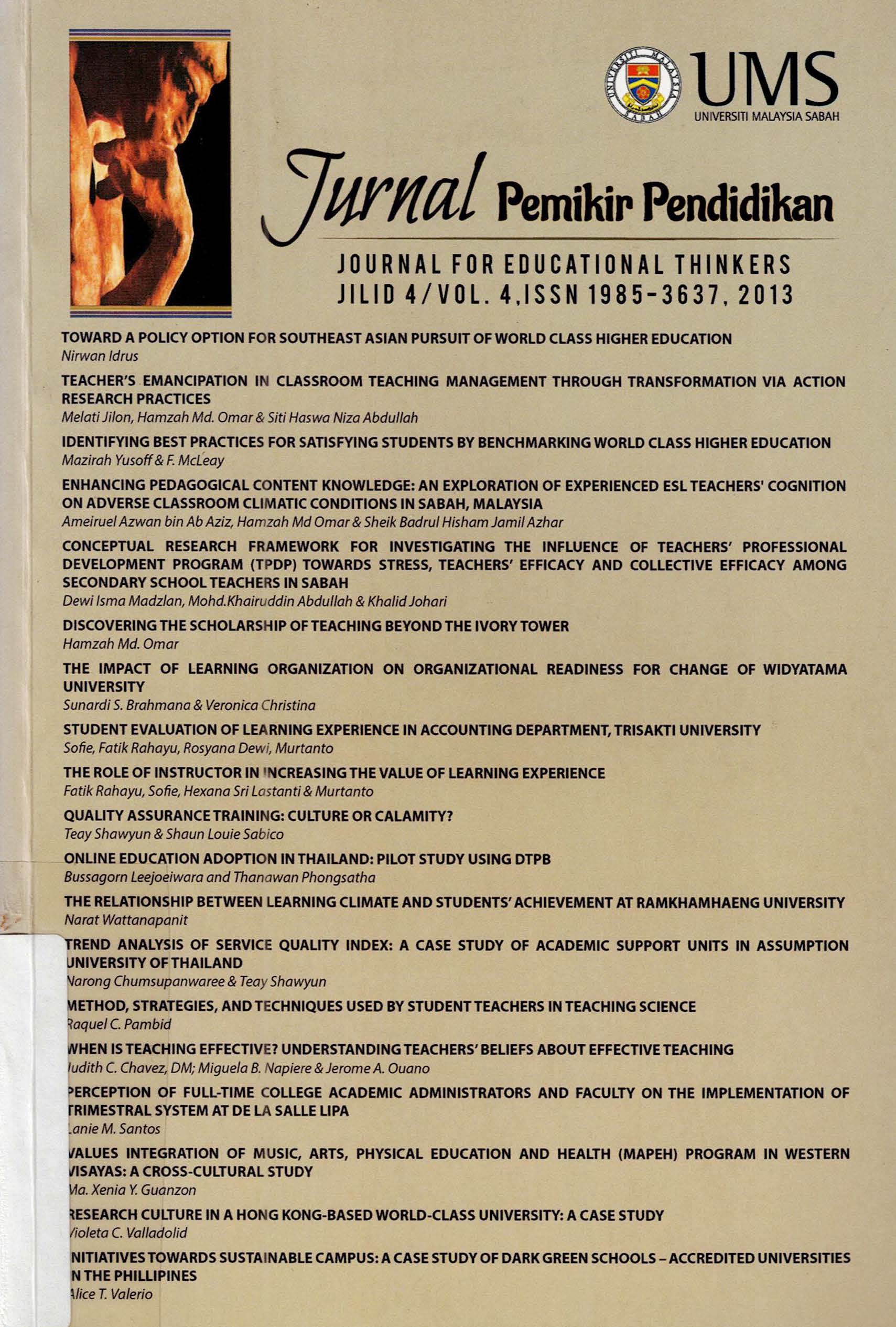
Identifying best practices for satisfying students by benchmarking world class higher education
DOI:
https://doi.org/10.51200/jpp.v4i1.8176Keywords:
world class, best practices, benchmarking, student satisfation, managing resourcesAbstract
Achieving "World Class" status is an aspiration of any organisation including education providers such as Universities. Excellence in education requires an outstanding faculty, high quality teaching, the provision of strong student support facilities, and a comfortable professional environment, as well as highly prepared and motivated students. Benchmarking, which involves searching for practices that lead to superior performance should also be important. This research seeks to explore areas for best practices in higher education by benchmarking student satisfaction using importance-performance (quadrant) analysis to identify areas where resources could be more efficiently allocated. More specifically, we evaluate the satisfaction level of students, measure their perceptions of the factors that are important when receiving education services and identify areas of service priority. A total of 832 responses were received from a survey of 1200 undergraduate business students at four private educational institutions in Malaysia. Using factor analysis we identify 12 factors from an original set of 53 satisfaction drivers. The 12 factors are professional comfortable environment; student assessments and learning experiences; classroom environment; lecture and tutorial facilitating goods; education requires an outstanding faculty, high quality teaching, the provision of strong student support facilities, and a comfortable professional environment, as well as highly prepared and motivated students. Benchmarking, which involves searching for practices that lead to superior performance should also be important. This research seeks to explore areas for best practices in higher education by benchmarking student satisfaction using importance-performance (quadrant) analysis to identify areas where resources could be more efficiently allocated. More specifically, we evaluate the satisfaction level of students, measure their perceptions of the factors that are important when receiving education services and identify areas of service priority. A total of 832 responses were received from a survey of 1200 undergraduate business students at four private educational institutions in Malaysia. Using factor analysis we identify 12 factors from an original set of 53 satisfaction drivers. The 12 factors are professional comfortable environment; student assessments and learning experiences; classroom environment; lecture and tutorial facilitating goods; textbook and tuition fees; student support facilities; business procedures; relationship with teaching staff; knowledgeable and responsive faculty; staff helpfulness; feedback; and class sizes. Service priority areas are also identified which could help educational institutions to more effectively and efficiently achieve and sustain a "World Class" status.
References
Alstete, W. J. (1995). Benchmarking in higher education: Adapting best practices to improve quality. George Washington University.
Alves, H., & Raposo, M. (2009). The measurement of the construct satisfaction in higher education. The Services Industries Journal, 29(2), 203–218.
Camp, R. C. (1989). Benchmarking: The search for industry best practices that lead to superior performance. Quality Progress, January, 61–68.
Consortium for Excellence in Higher Education. (2003). Benchmarking methods and experiences. Sheffield Hallam University.
Cotton, S. J., Dollard, M. F., & De Jonge, J. (2002). Stress and student job design: Satisfaction, well-being and performance in university students. International Journal of Stress Management, 9(3), 147–162.
Deros, B. M., Yusof, S. M., & Salleh, A. M. (2006). Benchmarking implementation framework for automotive manufacturing SMEs. Benchmarking: An International Journal, 13(4), 396–430.
Dillon, W. R., Madden, T. J., & Firtle, N. H. (1993). Essentials of marketing research. Irwin.
Douglas, J., Douglas, A., & Barnes, B. (2006). Measuring student satisfaction at a UK university. Quality Assurance in Education, 14(3), 251–267.
Duque, L. C., & Weeks, J. R. (2010). Towards a model and methodology for assessing student learning outcomes and satisfaction. Quality Assurance in Education, 18(2), 84–105.
Elliot, K. M., & Healy, M. A. (2001). Key factors influencing student satisfaction related to recruitment retention. Journal of Marketing for Higher Education, 10(4), 1–11.
Ford, J. B., Joseph, M., & Joseph, B. (1999). Importance-performance analysis as a strategic tool for service marketers: The case of service quality perceptions of business students in New Zealand and USA. The Journal of Services Marketing, 13(2), 171–186.
Gruber, T., Fub, S., Voss, R., & Zikuda, M. G. (2010). Examining student satisfaction with higher education services-Using a new measurement tool. International Journal of Public Sector Management, 23(2), 105–123.
Hair, J. F., Black, W. C., Babin, B. J., & Anderson, R. E. (2010). Multivariate data analysis: A global perspective (7th ed.). New Jersey, Pearson, Prentice Hall.
Hatcher, L., Kryter, K., Prus, J. S., & Fitzgerald, V. (1992). Predicting college student
satisfaction, commitment and attrition from investment model constructs. Journal of Applied Social Psychology, 22(16), 1273–1296.
Hawes, J. M., & Rao, C. P. (1985). Using importance-performance analysis to develop healthcare marketing strategies. Journal of Health Care Marketing, 5(4), 19–25.
Hurreeram, D. H. (2007). Manufacturing strategy auditing for garment making companies. Benchmarking: An International Journal, 14(3), 272–288.
Joseph, M., & Joseph, B. (1997). Service quality in education: A student perspective. Quality Assurance in Education, 5(1), 15–21.
Martilla, J. A., & James, J. C. (1977). Importance-performance analysis. Journal of Marketing, 41(1), 77–79.
Mostafa, M. (2006). A comparison of SERVQUAL and I-P analysis measuring and improving service quality in Egyptian private universities. Journal of Marketing for Higher Education, 16(2), 83–103.
O’Neil, M. A., & Palmer, A. (2004). Importance-performance analysis: A useful tool for directing continuous quality improvement in higher education. Quality Assurance in Education, 12(1), 39–52.
Rowley, J. (2003). Designing student feedback questionnaires. Quality Assurance in Education, 11(3), 142–149.
Schuh, J. H., & Bender, B. E. (2002). Using benchmarking to inform practice in higher education. New Directions for Higher Education, No. 118. San Francisco: Jossey-Bass.
Tapp, A., Hicks, K., & Stone, M. (2004). Direct and database marketing and customer relationship management in recruiting students for higher education. International Journal of Non-profit and Voluntary Sector Marketing, 9(4), 335–345.
Vermeulen, W. (2003). Benchmarking as an enabler of business excellence in South African financial sector. Benchmarking: An International Journal, 10(1), 65–72.
Wiers-Jenssen, J., Stensaker, B., & Grogaard, J. B. (2002). Student satisfaction: Towards an empirical deconstruction of the concept. Quality in Higher Education, 8(2), 183–195.
Zairi, M. (1996). Effective benchmarking: Learning from the best. Chapman & Hall.
Downloads
Published
How to Cite
Issue
Section
License
Copyright (c) 2013 Mazirah Yusoff, F. Mcleay

This work is licensed under a Creative Commons Attribution-NonCommercial-ShareAlike 4.0 International License.




 Total Views: 34
|
Total Views: 34
|  Total Downloads: 13


