
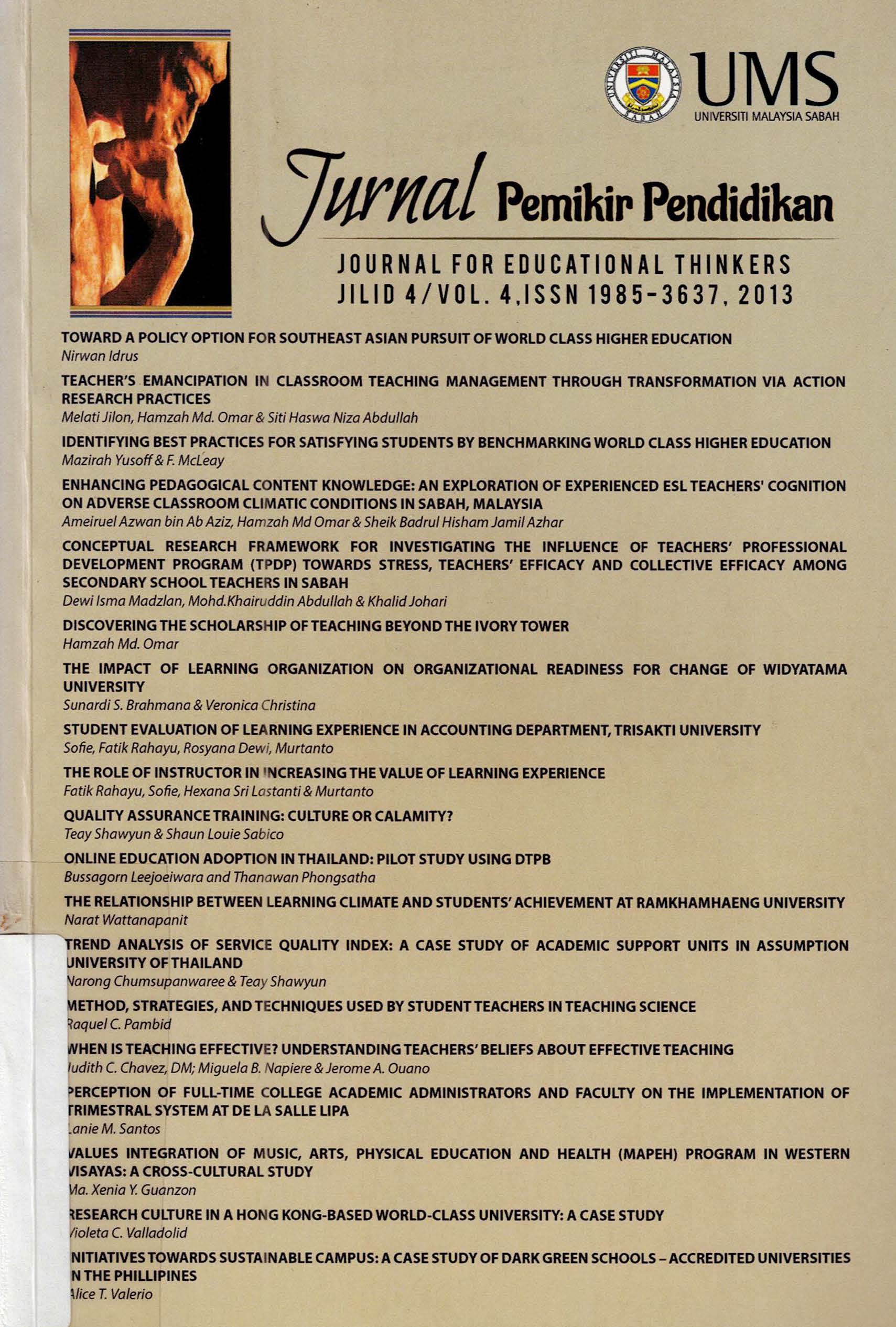
The impact of learning organization on organizational readiness for change of Widyatama University
DOI:
https://doi.org/10.51200/jpp.v4i1.8185Keywords:
learning organization, organizational readiness for change, UTamaAbstract
The success of an organization essentially reflects the organization's ability to adapt to environmental changes. In the uncertain environment, what is certain is the change itself. Organization's ability to change with the changing environment will be largely determined by the readiness of the organization itself to change. Readiness for change will determine the organization's ability to still exist in the future. One of the factors that determine organizational readiness for change is the knowledge possessed by the organization. The necessary organizational knowledge should be gained from learning and the learning process performed by the organization. Scholars argued organization that learns will have more readiness to follow and make changes than organizations that do not learn. Therefore, one of the biggest challenges is to create a learning culture within the organization. Survey was conducted at Widyatama University (UTama). Population and sample of this study are the lecturers of UTama. Of the 150 questionnaires distributed, a total of 106 questionnaires returned and processed. The results showed that the instruments are valid and reliable. This study found out that learning organization is positively and significantly influenced organizational readiness for change. Weaknesses of this study and some suggestions for future research are also disclosed.
References
Antonacopoulou, E. P., & Gabriel, Y. (2001). Emotion, learning and organizational change: Towards an integration of psychoanalytic and other perspectives. Journal of Organizational Change Management, 14(5), 435–451.
Appelbaum, S. H., & Wohl, L. (2000). Transformation or change: Some prescriptions for health care organizations. Managing Service Quality, 10(5), 279–298.
Argyris, C. (1982). How learning and reasoning processes affect organizational change. In P. S. Goodman (Ed.), Change in organizations: New perspectives on theory research and practice (pp. 46–86). Jossey-Bass.
Armenakis, A. A., & Bedeian, A. G. (1999). Organizational change: A review of theory and research in the 1990s. Journal of Management, 25(3), 293–315.
Armenakis, A. A., & Harris, S. G. (2002). Crafting a change message to create transformational readiness. Journal of Organizational Change Management, 15(2), 169–183.
Armstrong, A., & Foley, P. (2003). Foundations for a learning organization: Organization learning mechanisms. The Learning Organization, 10(2/3), 74–82.
Armstrong-Stassen, M. (1994). Coping with transition: A study of layoff survivors. Journal of Organizational Behavior, 15, 597–621.
Baker, W. E., & Sinkula, J. M. (1999). The synergistic effect of market orientation and learning orientation on organizational performance. Academy of Marketing Science Journal, 27(4), 411–427.
Balogun, J., & Hailey, V. H. (2004). Exploring strategic change (2nd ed.). Prentice Hall.
Beer, M. (1980). Organization change and development: A systems view. Goodyear.
Beer, M., & Walton, A. (1987). Organizational change and development. Annual Review of Psychology, 38, 339–367.
Beer, M., & Nohria, N. (2000). Breaking the code of change. Harvard Business School Press.
Berry, W. (1983). Overcoming resistance to change. Supervisory Management, 28, 26–30.
Bierly, P. E., III, Kessler, E. H., & Christensen, E. W. (2000). Organizational learning, knowledge and wisdom. Journal of Organizational Change Management, 13(6), 595–618.
Block, P. (2000). Flawless consulting: A guide to getting your expertise used (2nd ed.). Jossey-Bass/Pfeiffer.
Bogler, R., & Somech, A. (2005). Organizational citizenship behavior in school. ournal of Educational Administration, 43(5), 420–438.
Bovey, W. H., & Hede, A. (2001). Resistance to organizational change: The role of defense mechanisms. Journal of Managerial Psychology, 16(7/8), 534–548.
Brahmana, S. Sunardi, & Sofyandi, H. (2007). Transformational leadership dan organizational citizenship behavior di UTAMA. Laporan
Penelitian Kelompok, Fakultas Bisnis dan Manajemen, Universitas Widyatama.
Bridges, W. (1986). Managing organizational transitions. Organizational Dynamics, 15(1), 24–34.
Burnes, B. (1996). No such thing as...a “One best way” to manage organizational change. Management Decision, 34(10), 11–18.
Chonko, L. B., Dubinsky, A. J., Jones, E., & Roberts, J. A. (2003). Organizational and individual learning in the sales force: An agenda for sales research. Journal of Business Research, 56(12), 935–946.
Chreim, S. (2006). Postscript to change: Survivors’ retrospective views of organizational changes. Personnel Review, 35(3), 315–335.
Coch, L., & French, J. (1948). Overcoming resistance to change. Human Relations, 1, 512–532.
Confessore, S. J., & Kops, W. J. (1998). Self-directed learning and the learning organization: Examining the connection between the individual and the learning environment. Human Resource Development Quarterly, 9(4), 365–377.
Cummings, T. G., & Worley, C. G. (2001). Essentials of organization development and change. South-Western College Publishing.
Cyert, R. M., & March, J. G. (1963). A behavioral theory of the firm. Prentice-Hall.
Daft, R. L., & Weick, K. E. (1984). Toward a model of organizations as interpretation systems. The Academy of Management Review, 9(2), 284–295.
Dixon, N. M. (1994). The organizational learning cycle: How we can learn collectively. McGraw-Hill.
Dodgson, M. (1993). Organizational learning: A review of some literatures. Organization Studies, 14(3), 375–394.
Duberley, J., Johnson, P., Cassell, C., & Close, P. (2000). Manufacturing change: The role of performance evaluation and control systems. International Journal of Operations & Production Management, 20(4), 427–441.
Duncan, R., & Weiss, A. (1979). Organizational learning: Implications for organizational design. In B. M. Staw (Ed.), Research in organizational behavior (pp. 75–123). JAI Press.
Dunham, R. B., Grube, J. A., Gardner, D. G., Cummings, L. L., & Pierce, J. L. (1989). The development of an attitude toward change instrument. Paper presented at the Academy of Management Annual Meeting, Washington, DC.
Elving, W. J. (2005). The role of communication in organisational change. Corporate Communications: An International Journal, 10(2), 129–138.
Fiol, C. M., & Lyles, M. A. (1985). Organizational learning. The Academy of Management Review, 10(4), 803–813.
Garvin, D. A. (1993, July–August). Building a learning organization. Harvard Business Review, 71, 78–91.
Hair, J. F., Anderson, R. E., Tatham, R., & Black, W. C. (2006). Multivariate data analysis (6th ed.). Prentice-Hall.
Haque, M. M. (2008). A study of the relationship between the learning organization and organizational readiness for change.
Dissertation, Pepperdine University, Graduate School of Education and Psychology.
Holt, D. T. (2002). Readiness for change: The development of a scale. Dissertation Abstracts International, 63(11), 4006.
Hyatt, L., & Haque, M. M. (2007). May the force be with you: Toward the theory of learned change. Published proceedings of the Society of Management International Business Conference, Las Vegas, NV.
Jacobson, E. H. (1957). The effect of changing industrial methods and automation on personnel. Paper presented at the Symposium on Preventive and Social Psychology, Washington, DC.
Jansen, K. J. (2000). The emerging dynamics of change: Resistance, readiness, and momentum. Human Resource Planning, 23(2), 53–55.
Judson, A. S. (1991). Changing behaviors in organizations: Minimizing resistance to change. B. Blackwell.
Khadra, M. F. A., & Rawabdeh, I. A. (2006). Assessment of development of the learning organization concept in Jordanian industrial companies. The Learning Organization, 3(5), 45.
Kim, D. H. (1993). The link between individual and organizational learning. Sloan Management Review, 35(1), 3.
Klein, S. M. (1996). A management communication strategy for organizational change. Journal of Organizational Change Management, 9(2), 32–46.
Kotter, J. P. (1995). Why transformation efforts fail. Harvard Business Review, 73(2), 59–67.
Lawrence, P. R. (1954). How to deal with resistance to change. Harvard Business Review, 32(3), 49–57.
Lewin, K. (1947). Frontiers in group dynamics. Human Relations, 1, 541.
Lewin, K. (1951). Field theory in social science—Selected theoretical papers. Harper & Row.
Lewin, K. (1997). Resolving social conflicts: And, field theory in social science. American Psychological Association.
Mabin, V. J., Forgeson, S., & Green, L. (2001). Harnessing resistance: Using the theory of constraints to assist change management. Journal of European Industrial Training, 25(2), 168–191.
Ma, Hao. (1999). Anatomy of competitive advantage: A SELECT framework. Management Decision, 37(9), 709–718.
Mariotti, J. (1998). 10 steps to positive change. Industry Week, 247(14), 82.
Macdonald, S. (1995). Learning to change: An information perspective on learning in the organization. Organization Science, 6(5), 557–568.
Maurer, R. (1996). Using resistance to build support for change. The Journal for Quality & Participation, 19(3), 56–63.
McNabb, D. E., & Sepic, E. T. (1995). Culture, climate, and total quality management: Measuring readiness for change. Public Productivity & Management Review, 18(9), 369–385.
Michael, J. (1973). Learning to plan and planning to learn. Miles River Press.
Morrow, J. (1999). Making change irresistible: Overcoming resistance to change in your organization. Personnel Psychology, 52(3), 816–819.
Narver, J. C., & Slater, S. F. (1990). The effect of market orientation on business performance. Journal of Marketing, 54, 20–35.
O’Connor, C. (1993). Managing resistance to change. Management Development Review, 6(4), 25–29.
Palmer, B. (2004). Overcoming resistance to change. Quality Progress, 37(4), 35.
Pasmore, W., & Fagans, M. (1992). Participation, individual development, and organizational change: A review and synthesis. Journal of Management, 18(2), 181–212.
Peak, M. H. (1996). An era of wrenching corporate change: New challenges and opportunities arise for American businesses, according to the members of AMA’s councils. Management Review, 85(7), 45–49.
Pellettiere, V. (2006). Organization self-assessment to determine the readiness and risk for a planned change. Organization Development Journal, 24(4), 38.
Powell, G., & Posner, B. Z. (1978). Resistance to change reconsidered: Implications for managers. Human Resource Management, 17(1), 29–34.
Recardo, R. F. (1995). Overcoming resistance to change. National Productivity Review, 14(2), 5–12.
Redding, J. C., & Catalanello, R. F. (1994). Strategic readiness: The making of the learning organization. Jossey-Bass.
Schein, E. H. (1992). Organizational culture and leadership: A dynamic view (2nd ed.). Proquest Info & Learning.
Schein, E. H. (1993, Winter). How can organizations learn faster? The challenge of entering the green room. Sloan Management Review, 24, 85–92.
Schein, E. H. (1999). Process consultation revisited: Building the helping relationship. Addison-Wesley.
Schneider, B., & Rentsch, J. (1988). Managing climates and cultures: A futures perspective. In J. Hage (Ed.), Futures of organizations (pp. 181–200). Lexington Books.
Self, D. R. (2007). Organizational change—overcoming resistance by creating readiness. Development and Learning in Organizations, 21(5), 11–13.
Senge, P. M. (1990). The fifth discipline: The art & practice of the learning organization. Doubleday.
Senge, P. M. (1993). Transforming the practice of management. Human Resource Development Quarterly, 4(1), 4.
Slater, S. F., & Narver, J. C. (1995). Market orientation and the learning organization. Journal of Marketing, 59(3), 63–74.
Smith, I. (2005). Achieving readiness for organizational change. Library Management, 26(6/7), 408–412.
Spiker, B. K., & Lesser, E. (1995). We have met the enemy.... The Journal of Business Strategy, 16(2), 17–21.
Staniforth, D. (1996). Understanding levers for organizational change: The case of AB Ltd. Management Decision, 34(10), 50–55.
Sutoko, Mame S. (2005). Makalah. Widyatama, Bandung.
Szamosi, L. T., & Duxbury, L. (2002). Development of a measure to assess organizational change. Journal of Organizational Change Management, 15(2), 184–201.
Taylor, R. E. (1988). Reducing resistance to new marketing strategies. Business Forum, 13(2), 12.
Templeton, G. F., Lewis, B. R., & Snyder, C. A. (2002). Development of a measure for the organizational learning construct. Journal of Management Information Systems, 19(2), 175.
Tsang, E. W. K. (1997). Organizational learning and the learning organization: A dichotomy between descriptive and prescriptive research. Human Relations, 50(1), 73–89.
Val, M. P. D., & Fuentes, C. M. (2003). Resistance to change: A literature review and empirical study. Management Decision, 41(1/2), 148.
Waddell, D., & Sohal, A. S. (1998). Resistance: A constructive tool for change management. Management Decision, 36(8), 543.
Washington, M., & Hacker, M. (2005). Why change fails: Knowledge counts. Leadership & Organization Development Journal, 26(5/6), 400–411.
Watkins, K., & Marsick, V. (1993). Sculpting the learning organization: Lessons in the art and science of systemic change. Jossey-Bass.
White, M. (1994). Creativity and the learning culture. The Learning Organization, 1(1), 4–5.
Zajac, G., & Bruhn, J. (1999). The moral context of participation in planned organizational change and learning. Administration & Society, 30(6), 706.
Downloads
Published
How to Cite
Issue
Section
License
Copyright (c) 2013 Sunardi S. Brahmana, Veronica Christina

This work is licensed under a Creative Commons Attribution-NonCommercial-ShareAlike 4.0 International License.




 Total Views: 32
|
Total Views: 32
|  Total Downloads: 16


