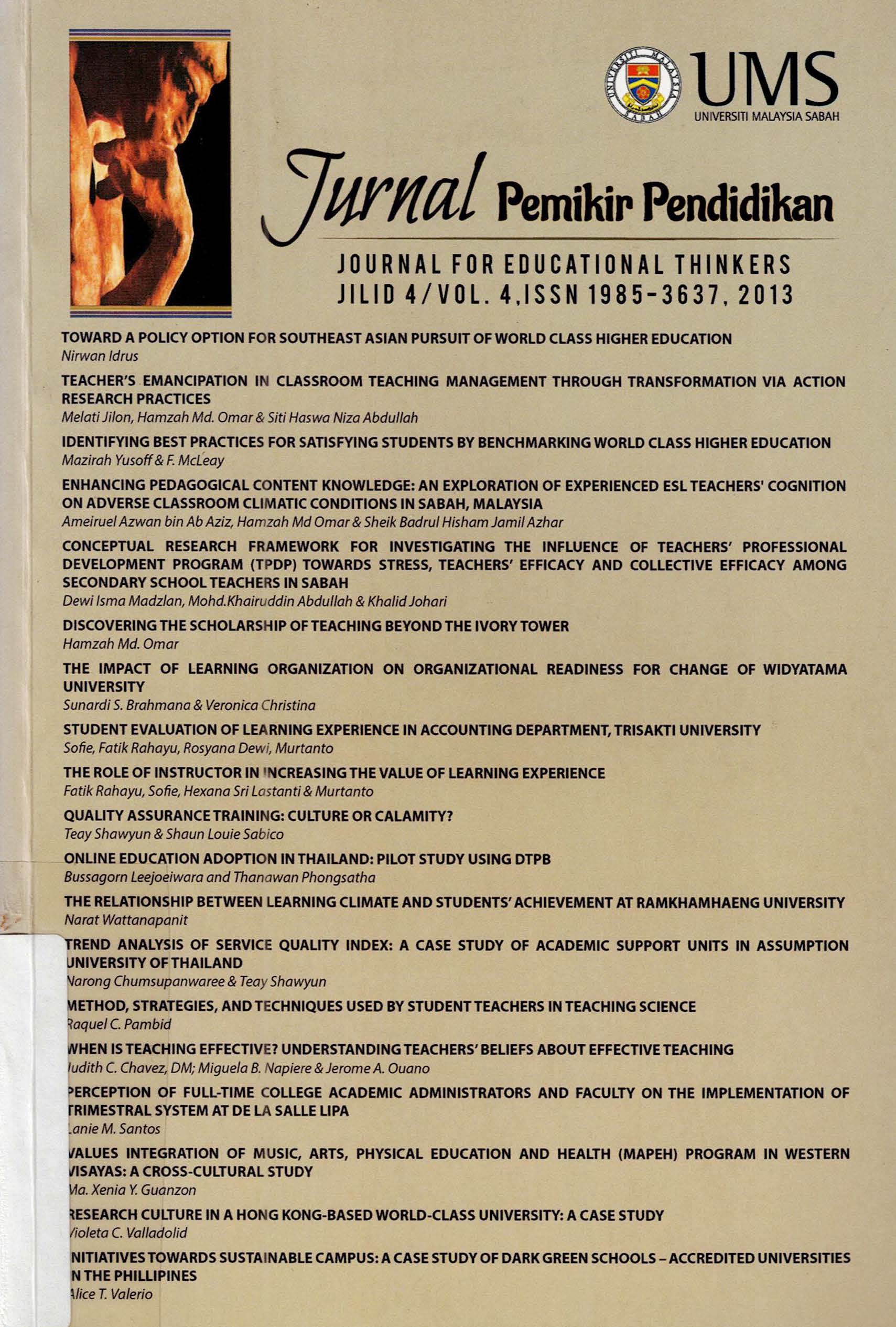
Quality assurance training: Culture or calamity?
DOI:
https://doi.org/10.51200/jpp.v4i1.8189Keywords:
training, performance, quality assurance, culture and human factorsAbstract
Pandemics of quality normally call for building a quality culture that ensures quality to be successful. Building quality culture, though a key factor of successful quality practices, should be an inherent predisposition of academics, rather than acquired quality culture through training. A key research question is whether training is related to a culture that pertains to quality and performance. This paper studies the assessors' training in quality assessment, perceived improvements in two main dimensions of' knowledge, use of quality system, and the knowledge and skills enhancement in relation to human, system and cultural factors. Participants were given written post-training assignments. Results of the perceived improvements were significant but the written assignments showed otherwise. Based on the results, this paper provides an in-depth discussion of factors that can affect quality training in relation to human, system and cultural factors. Results obtained will be used to develop a set of recommendations based on time, environment, interest, motivations, culture and mindset domains which are key factors that affect the culture of quality improvements and training.
References
Allen, F., & Kratt, C. (1982). The organizational unconscious: How to create the corporate culture you want and need. Prentice Hall.
Avolio, B. J. (1994). The alliance of total quality and the full range of leadership. In B. M. Bass & B. J. Avolio (Eds.), Improving organizational effectiveness through transformational leadership (pp. 121–145). Sage.
Bailey, T. (1993). Discretionary effort and the organization of work: Employee participation and work reform sinceHawthorne. Working paper, New York, Columbia University.
Bate, P. (1999). Strategies for cultural change. Butterworth-Heinemann.
Deal, T., & Kennedy, A. (1982). Corporate cultures. Addison-Wesley.
Driscoll, A., & Morris, J. (2001). Stepping out: Rhetorical devices and culture change management in the UK civil service. Public Administration, 79, 803–824.
Edis, M. (1995). Performance management and appraisal in health services. Kogan Page.
European University Association. (2005). Developing an internal quality culture in European universities: Report on the three rounds of the Quality Culture Project 2002–2003. Brussels: EUA.
European University Association. (2006). Quality culture in European universities: A bottom-up approach. Report on the three rounds of the Quality Culture Project 2002–2006. Brussels: EUA.
Fitzgerald, L., & Moon, P. (1996). Performance measurement in service industries: Making it work. CIMA.
Geertz, C. (1973). The interpretation of cultures. Basic.
Guest, D. E. (1997). Human resource management and performance: A review and research agenda. The International Journal of Human Resource Management, 8(3), 263–276.
Hackman, J. (1990). Groups that work (and those that don’t). Jossey-Bass.
Huselid, M. A. (1995). The impact of human resource management: An agenda for the 1990s. International Journal of Human Resource Management, 1(1), 17–43.
Johnson, G. (1984). Managing strategic change—a frames and formulae approach. Paper presented at the Strategic Management Society Conference, Philadelphia.
Kanter, R. M., Stein, B., & Jick, T. (1992). The challenge of organizational change. Free Press.
Kirton, M. J. (1994). Adaptors and innovators: Styles of creativity and problem solving (2nd ed.). Routledge.
Kotter, J., & Heskett, J. (1992). Corporate culture and performance. Macmillan.
Kristof, A. (1996). Person-organization fit: An integrative review of its conceptualization, measurement, and implications. Personnel Psychology, 49, 1–49.
Loukkola, T., & Zhang, T. (2010). Examining quality culture: Part I—Quality assurance processes in higher education institutions. Brussels: EUA.
Michel, W. (1977). The interaction of person and situation. In D. Magnusson & N. Endler (Eds.), Personality at the crossroads: Current issues n interactional psychology (pp. 333–352). Erlbaum.
Miron, E., Erez, M., & Naveh. (2004). Do personal characteristics and cultural values that promote innovation, quality, and efficiency compete or complement each other? Journal of Organizational Behavior, 25, 175–199.
O’Reilly, C. A., Chatman, J., & Caldwell, D. F. (1991). People and organizational culture: A profile comparison approach to assessing person-organization fit. Academy of Management Journal, 14(3), 487–516.
Otley, D. (1999). Performance management: A framework for management control systems research. Management Accounting Research, 10, 363–382.
Patterson, M. G., West, M. A., Lawthom, R., & Nickell, S. (1997). Issues in people management: Impact of people management practices on business performance. Institute of Personnel and Development, Centre for Economic Performance London School of Economics.
Peters, T., & Waterman, R. H. (1982). In search of excellence: Lessons from America’s best-run companies. Harper and Row.
Raymond Williams. (1921–1988). Cultural studies: “Moving from high culture to ordinary culture.” Originally published in N. McKenzie (Ed.), Convictions (1958).
Rogers, S. (1994). Performance management in local government. Longmans.
Rousseau, D. M. (1988). The construction of culture in organizational research. In C. L. Cooper & I. T. Robertson (Eds.), International review of industrial and organizational psychology (pp. 139–158). John Wiley & Sons.
Scott, T., Mannion, R., Davies, H. T. O., & Marshall, M. N. (2003). Implementing culture change in health care: Theory and practice. International Journal for Quality in Health Care, 15(2), 111–118.
Schermerhorn, J., Hunt, J., & Osborn, R. (1991). Managing organizational behavior. John Wiley & Sons.
Schneider, B. (1975). Organizational climates: An essay. Personnel Psychology, 28, 447–479.
Schneider, B. W. (1987). The people make the place. Personnel Psychology, 40, 437–453.
Schneider, B. (2001). About fit. Applied Psychology, 50(1), 141–152.
Schuler, R. S., & Jackson, S. E. (1987). Linking competitive strategies with human resource management practices. Academy of Management Executive, 1(3), 207–219.
Sims, H., & Lorenzi, P. (1992). The new leadership paradigm. Sage Publications.
Sosik, J. J., & Dionne, S. D. (1997). Leadership styles and Deming’s behavior factors. Journal of Business and Psychology, 11(4), 447–462.
Sursock, A. (2010). Conference report, diversities and commonalities: The changing face of Europe’s universities. EUA Annual Conference, University of Palermo, 20–23 October 2010.
Sursock, A. (2011). Examining quality culture: Part I: Processes and tools—Participation, ownership and bureaucracy. Quality Culture Project 2002–2007, Brussels: EUA.
Teay, S. (2012). Developing and actioning strategic planning in HEI. AU Digital Press, Bangkok, Thailand.
Van Vianen, A. E. M. (2000). Person-organization fit: The match between newcomers’ and recruiters’ preferences for organizational cultures. Personnel Psychology, 53, 113–149.
Waldman, D. (1993). A theoretical consideration of leadership and TQM. Leadership Quarterly, 4(1), 65–79.
Downloads
Published
How to Cite
Issue
Section
License
Copyright (c) 2013 Teay Shaw Yun, Shaun Louie Sabico

This work is licensed under a Creative Commons Attribution-NonCommercial-ShareAlike 4.0 International License.




 Total Views: 32
|
Total Views: 32
|  Total Downloads: 19