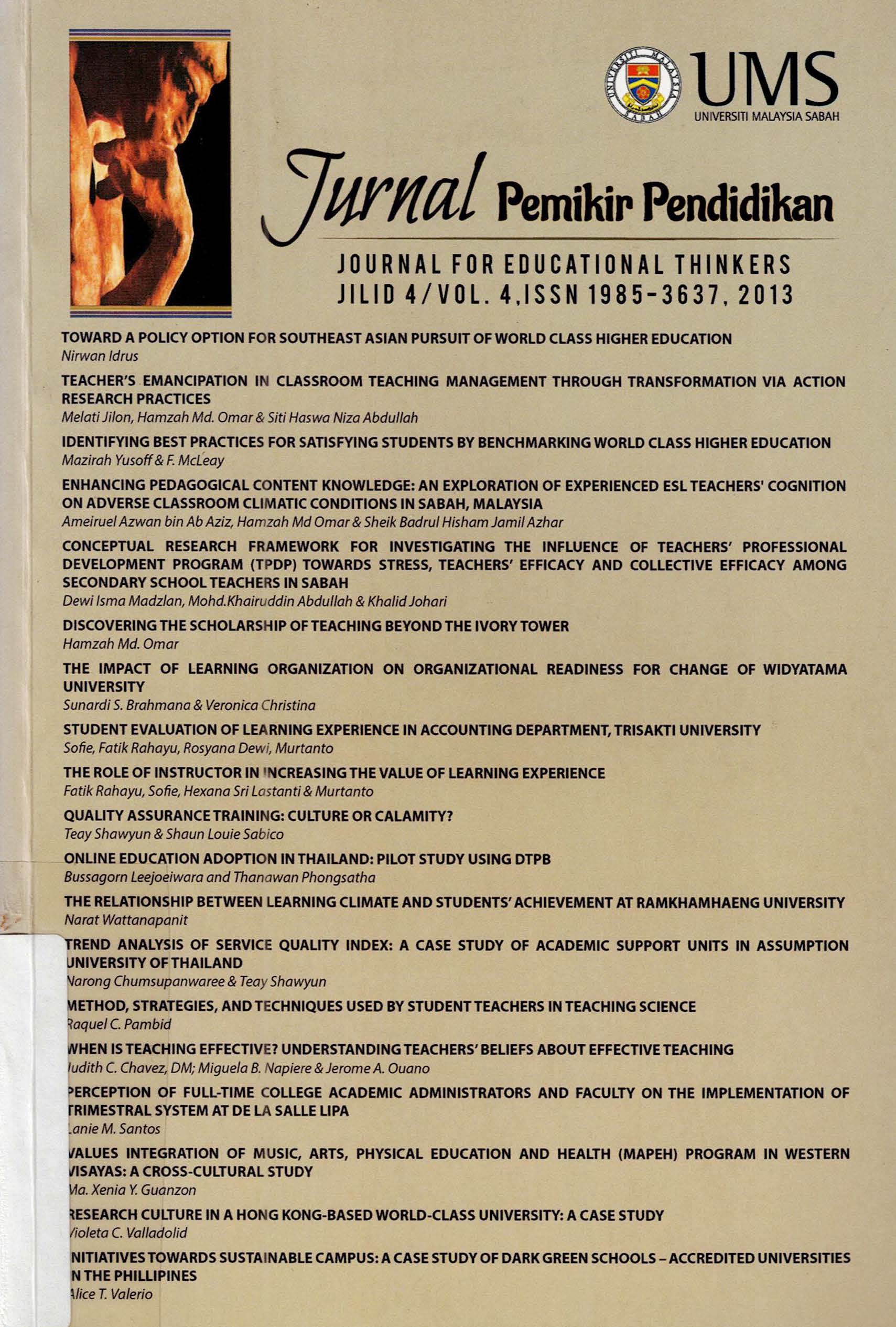
Online education adoption in Thailand: Pilot study using DPTB
DOI:
https://doi.org/10.51200/jpp.v4i1.8190Keywords:
online education, Diffusion of Innovation (DOI), Decomposed Theory of Planned Behavior (DPTB)Abstract
Online education has become strategic means for internationalization to educational institutions worldwide. Attributable to the forces of globalization and Information and Communication Technology, the technological innovations such as Internet, mobility, and social media tools have facilitated student-centered learning, enabling lifelong learning, and extending access to education more widely in the current borderless network, social computing paradigm. Online education is believed, has the power to transform the educational industry landscape globally. However, there is a lack of consumer's insight and empirical evidence with regards to the perception towards online education adoption especially in developing countries such as Thailand. This study aims to explore determinants of online education adoption based upon integrated model of Diffusion of Innovation and the Decomposed Theory of Planned Behavior. Quantitative research method is employed for data collection from a sample of 428 students in Thailand. Data was analyzed using Multiple Regression, and results are then discussed with implications.
References
Ajzen, I., & Fishbein, M. (1980). Understanding attitudes and predicting social behavior. Englewood Cliffs, NJ: Prentice-Hall.
Allen, E., & Seaman, J. (2007, October). Online nation: Five years of growth in online learning. Babson Survey Research Group, The Sloan Consortium.
Ashraf, B. (2009). Teaching the Google-eyed YouTube generation. Education + Training, 51(6), 343–352.
Assumption University Thailand. (2011). Assumption University of Thailand: College of Internet Distance Education. Retrieved on October 10, 2011, from http://www.elearning.au.edu
Bandura, A. (1977). Social Learning Theory. Prentice Hall, Englewood Cliffs, NJ.
Bhatiasevi, V. (2011). Acceptance of e-Learning for users in higher education: An extension of the technology acceptance model. The Social Science, 6(6), 513–520.
Bhattacharya, I., & Sharma, K. (2007). India in the knowledge economy – an electronic paradigm. International Journal of Educational Management, 21(6), 543–568.
Bray, E. (2004). Current issues in online distance education. Retrieved on March 5, 2011, from http://www.ericbray.com/Braydistancedpaper.pdf
Carnoy, M. (2005). Education and open society: A critical look at new perspectives and demands, Globalization, Educational Trends, and Open Society. Education Support Program, Open Society Institute.
Crossman, J. (2005). Work and learning: The implications for Thai transnational distance learners. International Education Journal, 6(1), 18–29.
Economist Intelligence Unit. (2008). The future of higher education: How technology will shape learning. The Economist, New Media Consortium. Retrieved from www.elearners.com/colleges/colleges.asp
Flight, R. L., D’Souza, G., & Allaway, A. W. (2011). Characteristics-based innovation adoption: Scale and model validation. Journal of Product & Brand Management, 20(5), 343–355.
Frost, & Sullivan. (2011, August 16). How to increase the success rate of new product launches. Retrieved on July 12, 2012, from http://www.slideshare.net/FrostandSullivan/how-to-increase-the-success-rate-of-new-product-launches
Gunasekaran, A., McNeil, R. D., & Shaul, D. (2002). E-learning: Research and applications. Industrial and Commercial Training, 34(2), 44–53.
Henshaw, R. (2008). A singular vision for a disparate future: Technology adoption patterns in higher learning through 2035. Innovate, 4(5).
Hiltz, S. R., & Turoff, M. (2005). Education goes digital: The evolution of online learning and the revolution of higher education. Communication of the ACM, 48(10), 59–64.
Jebeile, S., & Abeysekera, I. (2010). The spread of ICT innovation in accounting education. International Journal of Teaching and Learning in Higher Education, 22(2), 158–168.
Jebeile, S., & Reeve, R. (2003). The diffusion of e-Learning innovations in an Australian secondary college: Strategies and tactics for educational leaders. The Innovation Journal, 8(4), 1–18.
Khaopa, W. (2011, December 20). Focus on Thai educational strengths, government told. The Nation. Retrieved on January 10, 2012, from http://www.nationmultimedia.com/national/Focus-on-Thai-educational-strengths-govt-told-30172241.html
Lu, H-P., Liu, S-H., & Liao, H-H. (2005). Factors influencing the adoption of e-Learning websites: An empirical study. Issues in Information Systems, 5(1), 190–196.
Lu, J., Yu, C-S., Liu, C., & Yao, J. E. (2003). Technology Acceptance Model for Wireless Internet. Internet Research: Electronic Networking Applications and Policy, 13(3), 206–222.
Office of the Higher Education Commission. (2011). Office of the Higher Education Commission: Facts and figures. Retrieved on October 10, 2011, from www.mua.go.th
Osborne, M., & Oberski, I. (2004). University continuing education: The role of communications and information technology. Journal of European Industrial Training, 28(5), 414–428.
Ramkhamhaeng University. (2011). Ramkhamhaeng University. Retrieved on October 10, 2011, from http://www.ru.ac.th,
Rangsit University. (2011). RSU Cyber University. Retrieved on October 10, 2011, from http://www.rsu-cyberu.com
Rath, S., & Sekhar, S. F. C. (2010). E-Learning innovations at a B-School: An assessment of their diffusion. Retrieved 10 January 2012 from http://www.mainstay.in/e-learning.pdf
Rogers, E. M. (2003). The diffusion of innovations (5th ed.). New York: The Free Press.
Taylor, S., & Todd, P. A. (1995). Understanding Information Technology usage: A test of competing models. Information Systems Research, 6(2), 144–173.
Teo, T., Wong, S. L., Thammetar, T., & Chaiwat, W. (2011). Assessing e-Learning acceptance by university students in Thailand. In H. K. S., & Lai, K-W. (Eds.), ICT for accessible, effective, and efficient higher education: Experiences of Southeast Asia. Australasian Journal of Educational Technology, 27(Special Issue, 8), 1356–1368.
Tiene, D. (2002). Addressing the global digital divide and its impact on educational opportunity [Electronic version]. International Council for Educational Media, 211–222.
Tierney, W. G., & Findlay, C. C. (2009). The globalization of education: The next wave. The Pacific Economic Cooperation Council (PECC) and the Association of Pacific Rim Universities (ARPU). Retrieved on November 10, 2011, from www.pecc.org/resources/cat_view/96-education-market
Tino, V. L. (2008). ICT in education. United Nations Development Programme, Bureau for Development Policy, www.eprimers.org and www.adpip.net.
Thailand Cyber University. (2011). TCU: Thailand Cyber University. Retrieved on October 10, 2011, from http://www.thaicyberu.org.th
The Organisation for Economic Co-operation and Development. (2011). OECD: Statistics. Retrieved on October 10, 2011, from http://www.oecd.org
Tomatzky, L. G., & Klein, K. J. (1982). Innovation characteristics and innovation adoption implementation: A meta-analysis of findings. IEEE Transactions on Engineering Management, 29(1), 28–45.
Triandis, H. C. (1979). Values, attitudes, and interpersonal behavior. Nebraska Symposium on Motivation: Beliefs, Attitude, and Values, University of Nebraska Press, pp. 195–259.
University of Thai Chamber of Commerce. (2011). University of the Thai Chamber of Commerce. Retrieved on October 10, 2011, from http://www.utcc.ac.th
Van der Wende, M. (2002). The role of US higher education in the global e-Learning market. Research and Occasional Paper Series: CSHE.1.02, Center for Studies in Higher Education, University of California, Berkeley.
Vannoy, S. A., & Palvia, P. (2010). The social influence model of technology adoption. Communications of the ACM, 53(6), 149–153.
Vishwanath, A., & Goldhaber, G. M. (2003). An examination of the factors contributing to adoption decisions among late-diffused technology products. New Media & Society, 5(4), 547–572.
Vrasidas, C., & Zembylas, M. (2003). The nature of technology-mediated interaction in globalized distance education. International Journal of Training and Development, 7(4), 271–286.
Downloads
Published
How to Cite
Issue
Section
License
Copyright (c) 2013 Bussagorn Leejoeiwara, Thanawan Phongsatha

This work is licensed under a Creative Commons Attribution-NonCommercial-ShareAlike 4.0 International License.




 Total Views: 29
|
Total Views: 29
|  Total Downloads: 20