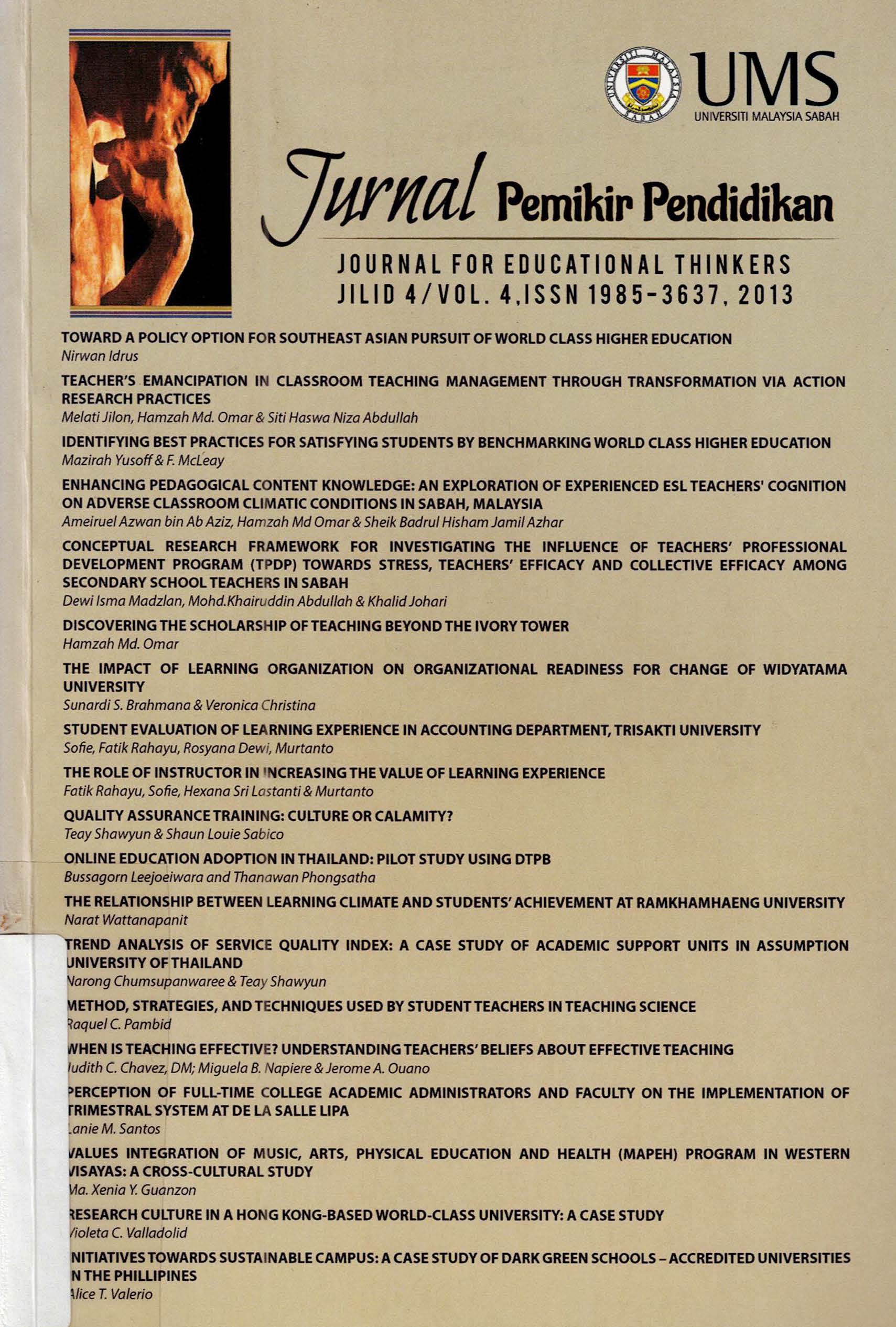
The relationship between learning climate and students’ achievement at Ramkhamhaeng University
DOI:
https://doi.org/10.51200/jpp.v4i1.8194Abstract
Learning climate is environment in the teaching and learning process. It can facility or obstruct the readiness to learning among students. Teachers should manage the class and create a climate that facilitates students' learning. An understanding of the contributions of learning climate toward students' achievement would benefit educators to organize appropriate learning climate for students. However, the research in this area is scarce. This research project aims to assess the perceived learning climate at Ramkhamhaeng University as well as the students' performance. The samples of the student consisted of 474 students in the MBA program at Ramkhamhaeng University: Learning climate in seven aspects was measured through a questionnaire. Students' grades, GPA in the bachelor level, and current GPA in the graduate level were used as the proxy for students' achievement. It was found that teachers' relationship with student, assessment and evaluation, and teaching process were rated at the highest level. Curriculum, relationship with colleagues, facility, and academic service were rated at the high level. Current GPA was found to be related to students learning climate.
References
Brown, W. B., & Moberg, D. J. (1980). Organization theory and management: A macro approach. New York: John Wiley and Sons, Inc.
Dessler, G. (1976). Organization and management: A contingency approach. Englewood Cliffs, New Jersey: Prentice-Hill.
Evans, I. M., Harvey, S. T., Buckley, L., & Yan, E. (2009). Differentiating classroom climate concepts: Academic, management, and emotional environments. Koutuihi: The New Zealand Journal of Social Science, 4, 131–146.
Freedman, J. (2007). The climate of success. Retrieved on August 2, 2012 from http://www.jmfreedman.com/cw-climate.html on August 15.
Gibson, J. L. (1991). Organizations: Structure processes behavior (7th ed.). Harewood: Irwin, Inc.
Hay Group. (2002). Managing performance: Achieving outstanding performance through a “culture of dialogue”. Retrieved on August 2, 2012 from http://www.haygroup.com/downloads/www/Managing_Performance.pdf
Janz, B. D., Prasarnphanich, P. (Spring, 2003). Understanding the antecedents of effective knowledge management: The importance of a knowledge-centered culture. Decision Sciences Journal, 34(2), 31–384.
Kast, F. E., & Rosenzweig, J. E. (1985). Organization: A system and contingency approach. Singapore: McGraw-Hill Singapore Nation Printer Ltd.
Litwin, G. H., & Strainger, R. A. (1968). Motivation and organizational climate. Boston: Harvard University.
Mathisen, G. E., & Einarsen, S. (2004). A review of instruments assessing creative and innovative environments within organizations. Creativity Research Journal, 16(1), 119–140.
Montes, F. J. L., Moreno, A. R., & Fernández, L. M. M. (2004). Assessing the organizational climate and contractual relationship for perceptions of support for innovation. International Journal of Manpower, 25(2), 167–180.
Paonil, P. (1992). Instructional climate of Srinakharinwirot University Prasarnmit as perceived by college students and instructors. A thesis submitted to Srinakharinwirot University Prasarnmit, Bangkok, Thailand.
Quality Values Research. (2003). Organizational climate. Retrieved on August 2, 2012 from http://www.Qualityvalues.com.
Stringer, R. (2002). Leadership and organizational climate: The cloud chamber effect. NJ: Prentice Hall.
Downloads
Published
How to Cite
Issue
Section
License
Copyright (c) 2013 Narat Wattanapanit

This work is licensed under a Creative Commons Attribution-NonCommercial-ShareAlike 4.0 International License.




 Total Views: 30
|
Total Views: 30
|  Total Downloads: 18