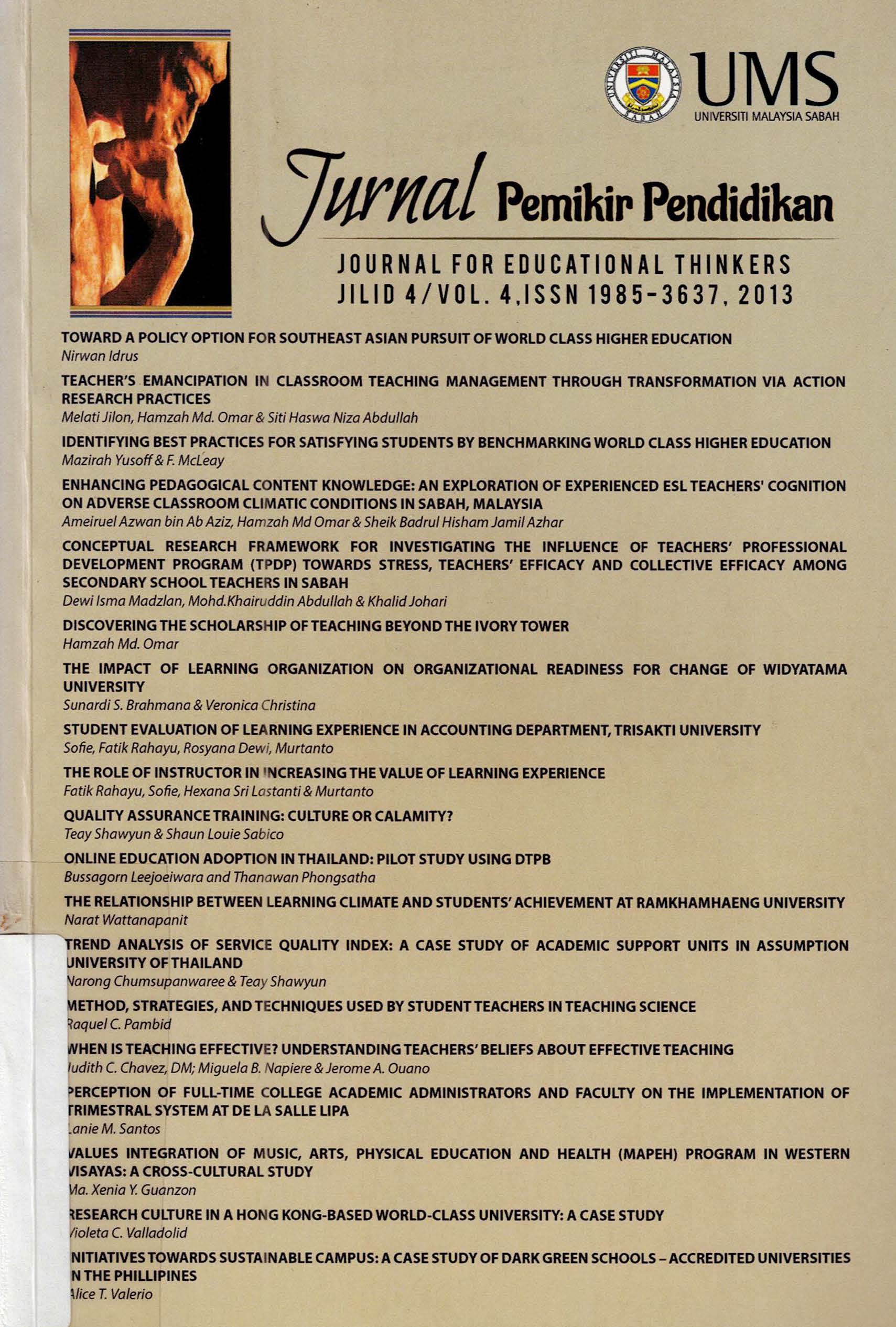
A conceptual research framework for investigating the influence of Teachers’ Professional Development Program (TPDP) towards stress, teachers’ efficacy and collective efficacy among secondary school teachers in Sabah
DOI:
https://doi.org/10.51200/jpp.v4i1.8182Keywords:
Teacher Professional Development Program (TPDP), stress, self-efficacy, collective efficacyAbstract
This concept paper is to investigate the influence of teachers' professional development program (TPDP) towards stress with teachers' efficacy and collective efficacy among secondary school teachers in Sabah. Respondents will be secondary school teachers from seven districts in five divisions in Sabah which includes the West Coast Zone (Kota Belud and Tuaran district), Rural Zone (Beaufort, Kuala Penyu and Sipitang district), and Kudat Zone (Kudat and Kota Marudu district). Purposive sampling design will be used in this research and instruments will be used to collect data. The TPDP instrument will be used to investigate teachers perception of the TPDP, and the teachers stress levels will be assessed using the Teacher Stress Inventory (TS) by Boyle et al. (1995) and questionnaires with 24 items Self Efficacy (TSES) Scale by Tschannen-Moran and Woolfolk-Hoy (2001) will also be used to assess the level of teachers" self-efficacy.
References
Ashton, P., & Webb, R. (1986). Teacher efficacy: A motivational paradigm for effective teacher education. Journal of Teacher Education, 35(5), 28–32.
Attridge, M., Bergmark, R., Parker, M., & Lapp, J. (2000). Trouble at the head of the class: Teachers say job stress impacts their students’ academic performance, but it’s a condition that can be reversed. http://www.optumanswers.com/
Bandura, A. (1986). Social foundations of thought and action: A social cognitive theory. Prentice Hall.
Bandura, A. (1993). Perceived self-efficacy in cognitive development and functioning. Educational Psychologist, 28(2), 117–148.
Bandura, A. (1997). Self-efficacy: The exercise of control. W. H. Freeman.
Boyle, G. J., Borg, M. G., Falzon, J. M., & Baglioni, A. J., Jr. (1995). A structural model of the dimensions of teacher stress. British Journal of Educational Psychology, 65, 49–67.
Dunham, J. (1992). Stress in teaching (2nd ed.). Routledge.
Fontana, D. (1989). Managing stress. The British Psychological Society.
Goddard, R. D., Hoy, W. K., & Woolfolk Hoy, A. (2000). Collective teacher efficacy: Its meaning, measure, and impact on student achievement. American Educational Research Journal, 37(2), 479–507.
Hoy, W. K. (2001). Wayne K. Hoy’s web site: Instruments. Retrieved July 14, 2001, from http://www.coe.ohio-state.edu/whoy
Kyriacou, C., & Sutcliffe, J. (1977). Teacher stress: A review. Educational Review, 29(4), 299–309.
Kyriacou, C., & Sutcliffe, J. (1978a). A model of teacher stress. Educational Studies, 4(1), 1–6.
Philips, Paulina. (2008). Professional development as a critical component of continuing teacher quality, 33(1).
Seyle, H. (1976). The stress of life. McGraw-Hill.
Tschannen-Moran, M., Woolfolk Hoy, A., & Hoy, W. K. (1998). Teacher efficacy: Its meaning and measure. Review of Educational Research, 68(2), 202–248.
Tschannen-Moran, M., & Woolfolk Hoy, A. (2001). Teacher efficacy: Capturing an elusive construct. Teaching and Teacher Education, 17, 783–805.
Utusan Malaysia. (2008). Beban tugas: Ramai guru terdedah risiko penyakit kritikal.
Warr, P., & Wall, T. (1975). Work and well-being. Penguin.
Downloads
Published
How to Cite
Issue
Section
License
Copyright (c) 2013 Dewi Isma Madzlan, Mohd. Khairuddin Abdullah, Khalid Johari

This work is licensed under a Creative Commons Attribution-NonCommercial-ShareAlike 4.0 International License.




 Total Views: 28
|
Total Views: 28
|  Total Downloads: 18