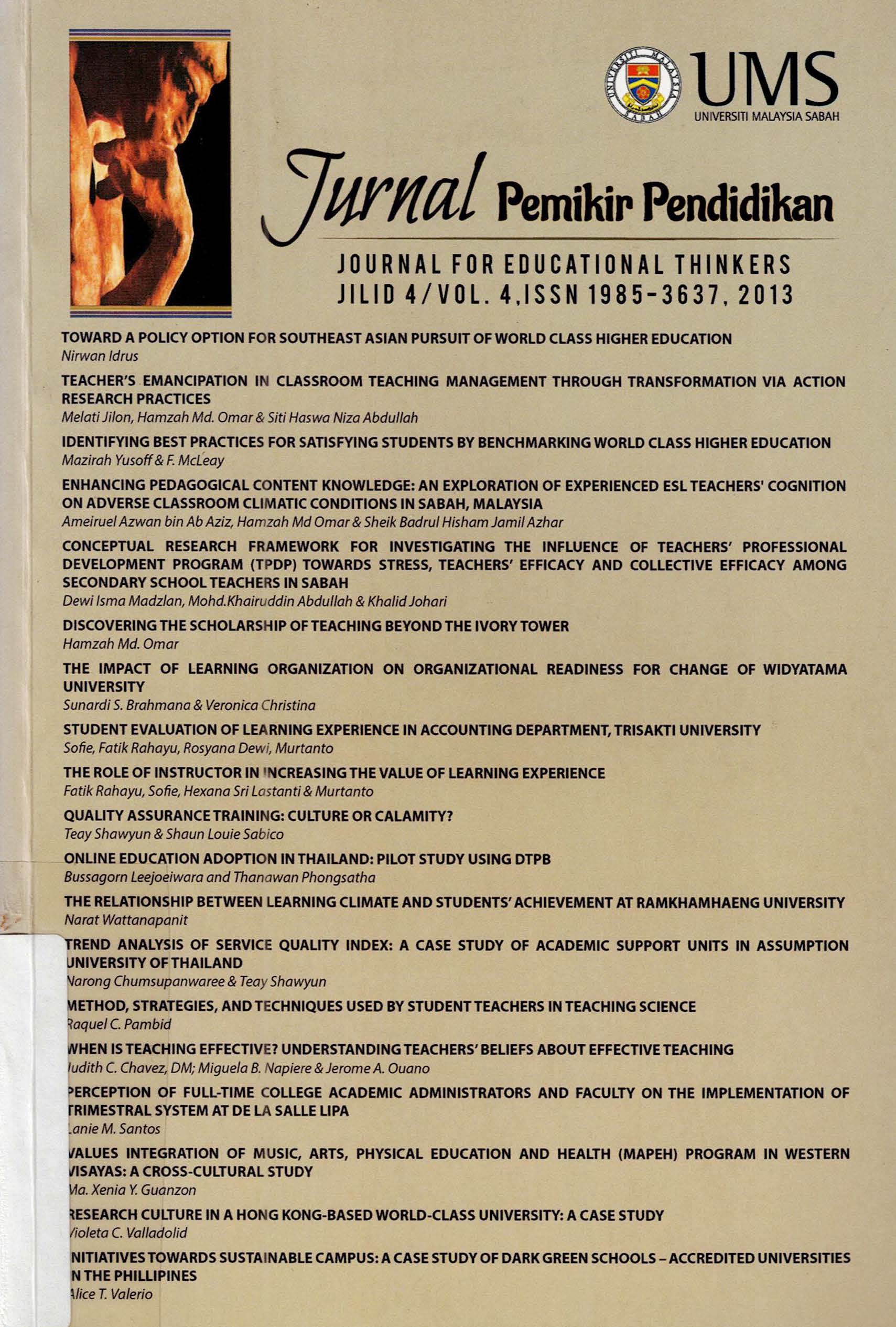
Student evaluation of learning experience in Accounting Department, Trisakti University
DOI:
https://doi.org/10.51200/jpp.v4i1.8186Keywords:
learning value, course instructor, studentAbstract
The quality of student services has been evaluated by university management. They have evaluated the student learning activity in the class related with the student satisfaction. The type of services based on the human services, where students as a user and lecturers as service providers. during learning activity. That is clear that the successful of learning activity in class depends on good interaction between them. The aim of this research was analysed the influence of the lecturers' role (which assessed students in the student evaluation sheet) to the Learning Value (which shows the success of the learning process of a course that perceived by students) by the students majoring Accounting from Economic Faculty of Trisakti University in Indonesia. The result from this research were the added value perceived by the students majoring Accounting from Economic Faculty of Trisakti University after following the learning process (Learning Value) is good. Permanent lecturers of accounting in Economic Faculty of Trisakti University have been doing its role properly. This showed from the evaluation of accounting students who show that the lecturers have done organizing course with good (Course Organization), have been involved in the learning process (Instructor Involvement), interact with students during the learning process with good (Student-Instructor Interaction) and give the task that does not overload the students (Course Demand). The role of lecturers is significantly influence on Learning Value (indicating the success of the learning process a course). The role of lecturers related with Student instructor Interaction, Instructor Involvement and Course Organization. Dimensions of the lecturer's roles that are considered most influence or earning Value sequentially from the largest to the smallest is the Cours Organization, Instructor Interaction, Student Instructor Interaction. Influence of Course Organization, Instructor Interaction and Student Instructor Interaction is positive. Thus the better the Course Organization, Instructor Interaction, Student Instructor Interaction it will also greater the added value perceived by the students from the learning process.
References
Abdullah, F. (2005). HedPERF versus SERVPERF: The quest for ideal measuring instrument of service quality in higher education sector. Quality Assurance in Education, 13(4), 305–328.
Ackerman, D. S., Gross, B. L., & Perner, L. (2003). Instructor, student and employer perceptions on preparing marketing students for changing business landscapes. Journal of Marketing Education, 25(1), 46–56.
Bailey, J., Sass, M., Swierez, P. M., Seal, C., & Kayes, D. C. (2005). Teaching with and through teams: Student-written, instructor-facilitated case writing and the signatory code. Journal of Management Education, 29(1), 39–59.
Bigelow, J. D. (2004). Using problem-based learning to develop skills in solving unstructured problems. Journal of Management Education, 28(5), 591–609.
Bryant, F. K. (2003). Determining the attributes that contribute to satisfaction among marketing students at the university level: An analysis of the traditional/lecture method versus the internet mode of instruction. Dissertation, New Mexico State University, Las Cruces-New Mexico.
Clarke III, I., Flaherty, T. B., & Mottner, S. (2001). Student perception of educational technology tools. Journal of Management Education, 23(3), 169–177.
Coffey, B. S., & Wang, J. (2006). Service learning in Master of Business Administration (MBA) integrative project course: An experience in China. Journal of Education for Business, 82, 119–124.
Dehler, G. E. (1996). Management education as intentional learning: A knowledge-transforming approach to written composition. Journal of Management Education, 20(2), 221–235.
Gremler, D. D., & McCollough, M. A. (2002). Student satisfaction guarantees: An empirical examination of attitudes, antecedents and consequences. Journal of Marketing Education, 24(2), 150–160.
Kwan, P. Y. K., & Ng, P. W. K. (1999). Quality indicators in higher education—Comparing Hongkong and China’s students. Managerial Auditing Journal, 14(1/2), 20–27.
Nguyen, N., & LeBlanc, G. (2001). Image and reputation of higher education institutions in students’ retention decisions. The International Journal of Education Management, 15(6), 303–311.
Pariseau, S. E., & McDaniel, J. R. (1997). Assessing service quality in schools of business. The International Journal of Quality & Reliability Management, 14(3), 204–215.
Paswan, A. K., & Young, J. A. (2002). Student evaluation of instructor: A nomological investigation using structural equation modeling. Journal of Marketing Education, 24(3), 193–202.
Peltier, J. W., Hay, A., & Drago, W. (2005). The reflective learning continuum: Reflecting on reflection. Journal of Marketing Education, 27(3), 250–263.
Rahayu, F., & Sofie. (2009). The role of instructor dalam meningkatkan the value of learning experience. Proseding Seminar Nasional, Maranatha, Bandung.
Rahayu, F. (2009). Peran dosen dan mahasiswa dalam proses pembelajaran di kelas. Laporan hasil penelitian, Dewan Riset FE Usakti.
Serva, M. A., & Fuller, M. A. (2004). Aligning what we do and what we measure in business schools: Incorporating active learning and effective media use in the assessment of instruction. Journal of Management Education, 28(1), 19–38.
Shank, M. D., Walker, M., & Hayes, T. (1995). Understanding professional service expectations: Do we know what our students expect in a quality education? Journal of Professional Services Marketing, 13(1), 71–89.
Shugan, S. M. (2006). Editorial: Save research—Abandon the case method of teaching. Marketing Science, 25(2), 109–115.
Tyler, C. L., & Tyler, J. M. (2006). Applying the transtheoretical model of change to the sequencing of ethics instruction in business education. Journal of Management Education, 30(1), 45–64.
Ulrich, T. A. (2005). The relationship of business major to pedagogical strategies. Journal of Education for Business, 80(5), 269–274.
Widrick, S. M., Mergen, E., & Grant, D. (2002). Measuring the dimensions of quality in higher education. Total Quality Management, 13(1), 123–131.
Zeithaml, V. A., Bitner, M. J., & Gremler, D. D. (2008). Services marketing: Integrating customer focus across the firm (4th ed.). McGraw-Hill.
Zhu, F. X., & McFarland, D. (2005). Toward assurance of learning in business programs: Component and measurements. Journal of American Academy of Business, 7(2), 69–72.
Downloads
Published
How to Cite
Issue
Section
License
Copyright (c) 2013 Sofie, Fatik Rahayu, Rosyana Dewi, Murtanto

This work is licensed under a Creative Commons Attribution-NonCommercial-ShareAlike 4.0 International License.




 Total Views: 27
|
Total Views: 27
|  Total Downloads: 18