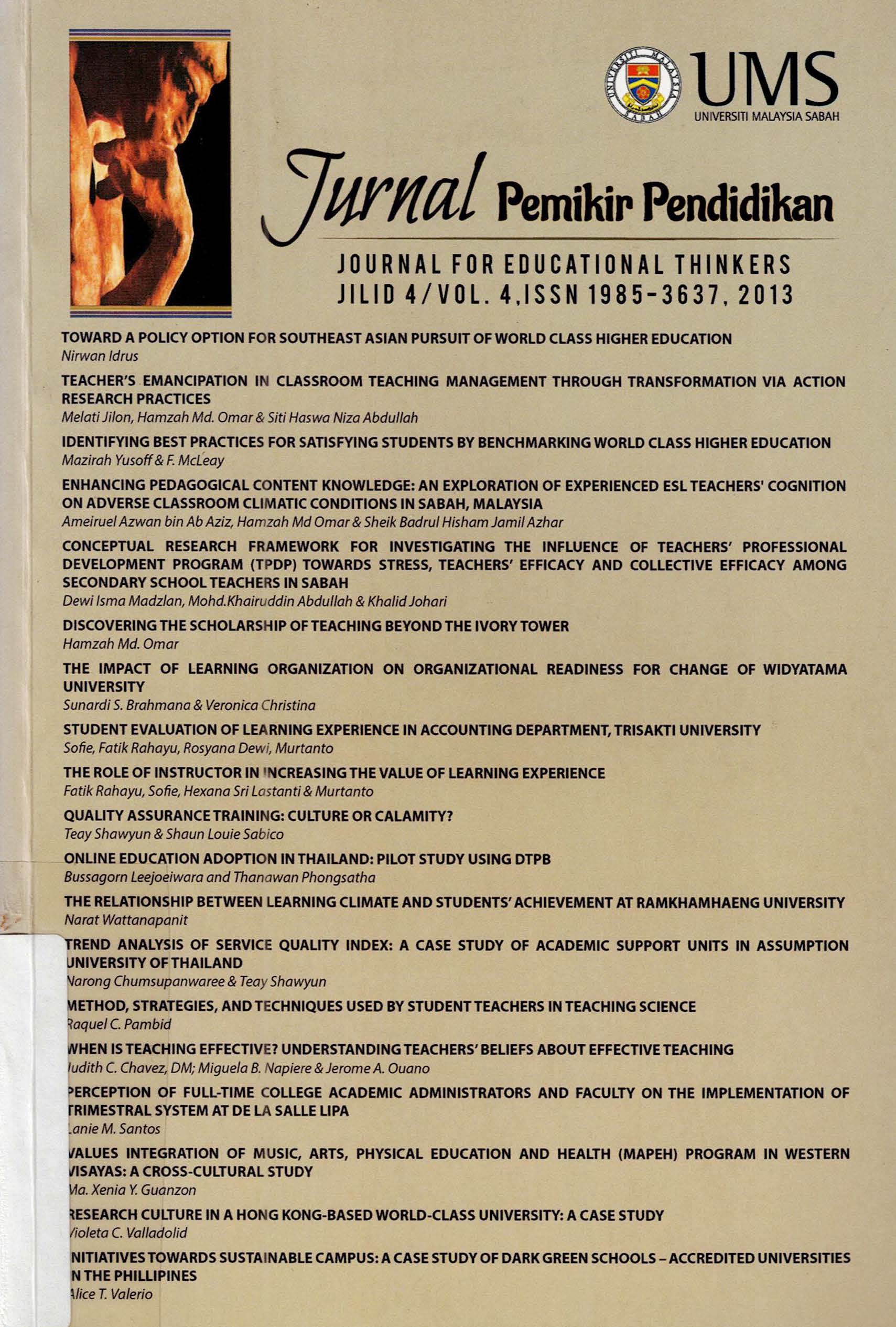
The role of instructor in increasing the value of learning experience
DOI:
https://doi.org/10.51200/jpp.v4i1.8187Keywords:
the role of instructor, the value of learning experience, higher education qualityAbstract
Educational literatures suggest that there is mounting pressure from customers of higher education to close the gap between their expectation of institutional performance and the actual performance (Widrick et al., 2002; Pariseau and Mc Daniel, 1997: Shank et al., 1995). Therefore, it is imperative that higher education actively monitor the quality of their service. The value of learning experience is one of the most significant trends in current higher education quality (Zhu and McFarland, 2005). This research concerns only with the impact of instructor role on the value of learning experience. The result showed that the instructor play a large role in explaining student perceptions of the value of learning experience. The sample unit that is an individual sample, which is students in Faculty of Economics in Trisakti University who are take Marketing Research class. The variables that become a focus in this research are The Value of Learning Experience and The Role of Instructor: The hypothesis which is tested in this study is using a regression. This technique is considered as an appropriate to test the proposed research model in this study.
References
Abdullah, F. (2005). HedPERF versus SERVPERF: The quest for ideal measuring instrument of service quality in higher education sector. Quality Assurance in Education, 13(4), 305–328.
Ackerman, D. S., Gross, B. L., & Perner, L. (2003). Instructor, student and employer perceptions on preparing marketing students for changing business landscapes. Journal of Marketing Education, 25(1), 46–56.
Bailey, J., Sass, M., Swierez, P. M., Seal, C., & Kayes, D. C. (2005). Teaching with and through teams: Student-written, instructor-facilitated case writing and the signatory code. Journal of Management Education, 29(1), 39–59.
Bigelow, J. D. (2004). Using problem-based learning to develop skills in solving unstructured problems. Journal of Management Education, 28(5), 591–609.
Bryant, F. K. (2003). Determining the attributes that contribute to satisfaction among marketing students at the university level: An analysis of the traditional/lecture method versus the internet mode of instruction. Dissertation, New Mexico State University, Las Cruces-New Mexico.
Clarke III, I., Flaherty, T. B., & Mottner, S. (2001). Student perception of educational technology tools. Journal of Management Education, 23(3), 169–177.
Coffey, B. S., & Wang, J. (2006). Service learning in Master of Business Administration (MBA) integrative project course: An experience in China. Journal of Education for Business, 82, 119–124.
Dehler, G. E. (1996). Management education as intentional learning: A knowledge-transforming approach to written composition. Journal of Management Education, 20(2), 221–235.
Gremler, D. D., & McCollough, M. A. (2002). Student satisfaction guarantees: An empirical examination of attitudes, antecedents and consequences. Journal of Marketing Education, 24(2), 150–160.
Helgesen, Ø., & Nesset, E. (2007). What accounts for students’ loyalty? Some field study evidence. International Journal of Educational Management, 21(2), 126–143.
Kwan, P. Y. K., & Ng, P. W. K. (1999). Quality indicators in higher education—Comparing Hongkong and China’s students. Managerial Auditing Journal, 14(1/2), 20–27.
Kotler, P., & Keller, K. L. (2006). Marketing management (12th ed.). Pearson Prentice Hall.
Nguyen, N., & LeBlanc, G. (2001). Image and reputation of higher education institutions in students’ retention decisions. The International Journal of Education Management, 15(6), 303–311.
Pariseau, S. E., & McDaniel, J. R. (1997). Assessing service quality in schools of business. The International Journal of Quality & Reliability Management, 14(3), 204–215.
Paswan, A. K., & Young, J. A. (2002). Student evaluation of instructor: A nomological investigation using structural equation modeling. Journal of Marketing Education, 24(3), 193–202.
Peltier, J. W., Hay, A., & Drago, W. (2003). The reflective learning continuum: Reflecting on reflection. Journal of Marketing Education, 27(3), 250–263.
Serva, M. A., & Fuller, M. A. (2004). Aligning what we do and what we measure in business schools: Incorporating active learning and effective media use in the assessment of instruction. Journal of Management Education, 28(1), 19–38.
Shank, M. D., Walker, M., & Hayes, T. (1995). Understanding professional service expectations: Do we know what our students expect in a quality education? Journal of Professional Services Marketing, 13(1), 71–89.
Shugan, S. M. (2006). Editorial: Save research—Abandon the case method of teaching. Marketing Science, 25(2), 109–115.
Tyler, C. L., & Tyler, J. M. (2006). Applying the transtheoretical model of change to the sequencing of ethics instruction in business education. Journal of Management Education, 30(1), 45–64.
Ulrich, T. A. (2005). The relationship of business major to pedagogical strategies. Journal of Education for Business, 80(5), 269–274.
Widrick, S. M., Mergen, E., & Grant, D. (2002). Measuring the dimensions of quality in higher education. Total Quality Management, 13(1), 123–131.
Zeithaml, V. A., Bitner, M. J., & Gremler, D. D. (2006). Services marketing: Integrating customer focus across the firm (4th ed.). McGraw-Hill.
Zhu, F. X., & McFarland, D. (2005). Toward assurance of learning in business programs: Component and measurements. Journal of American Academy of Business, 7(2), 69–72.
Downloads
Published
How to Cite
Issue
Section
License
Copyright (c) 2013 Fatik Rahayu, Sofie, Hexana Sri Lastanti, Murtanto

This work is licensed under a Creative Commons Attribution-NonCommercial-ShareAlike 4.0 International License.




 Total Views: 31
|
Total Views: 31
|  Total Downloads: 18