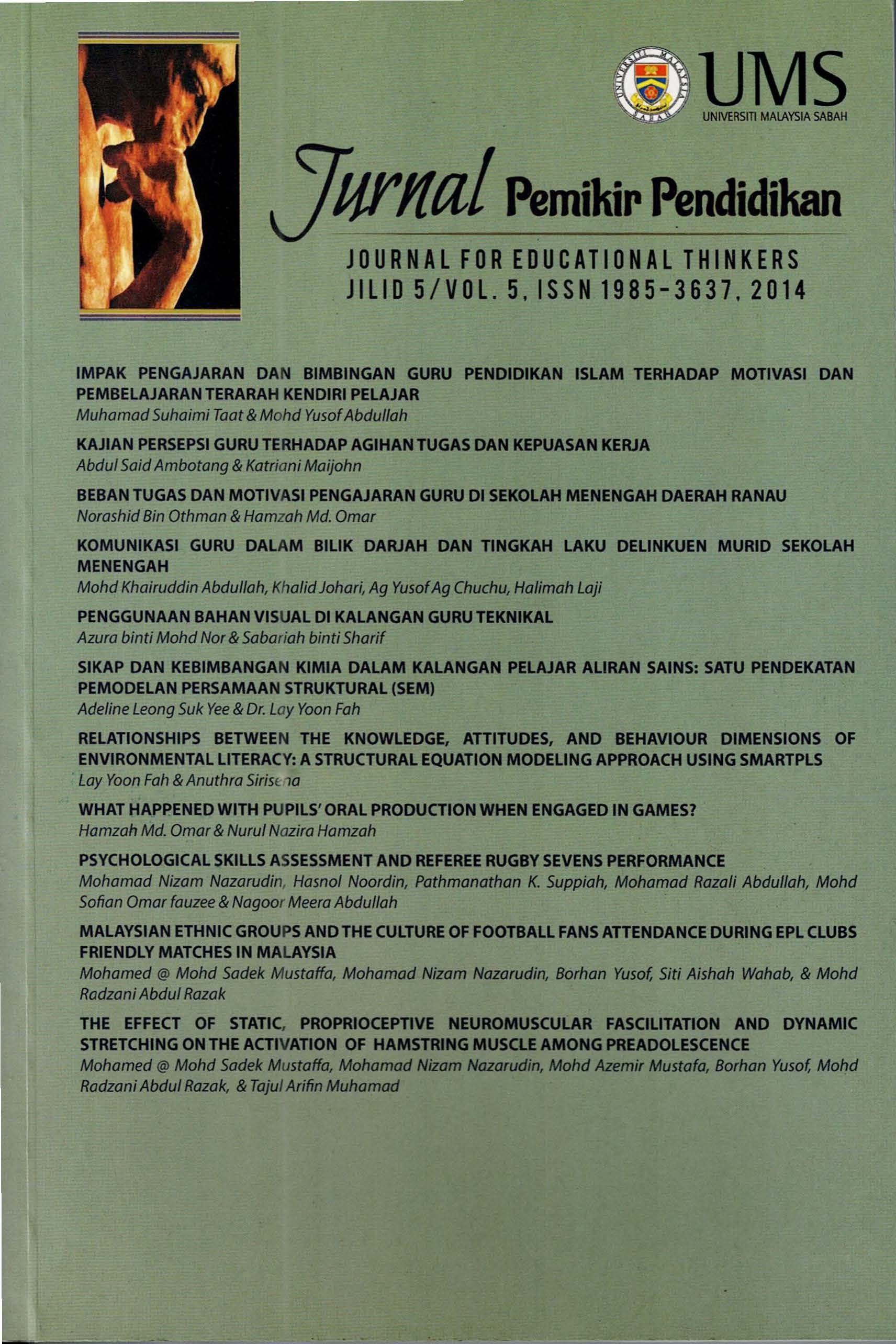
Psychological skills assessment and referee rugby sevens performance
DOI:
https://doi.org/10.51200/jpp.v5i1.8213Keywords:
sports, psychology, rugby refereeAbstract
This study aims to examine the psychological skills that are commonly used among referees rugby sevens and their relationship with referees’ performance. The Psychological Skills Inventory for Sports (Mahoney, Gabriel, & Perkins, 1987) was adapted and modified specifically for use by rugby sevens referees. It was administered to 132 rugby sevens referee (mean age 33.4 + 1.5 years; 132 males) of the Malaysian Rugby Union (MRU) which has been refereed in 10 rugby sevens tournament in Malaysia. The psychological skills variables employed in the questionnaire included confidence, anxiety management, mental preparation, motivation and concentration. The IRB Referee Sevens Performance Evaluation Form (r=0.94) was used to evaluate referee performance. These instruments measure the performance variable that contains the dimensions of control, communication, application of the law and the positioning. The descriptive statistics of the variables are Psychological skills (M= 120.14, SD= 6.97) and performance (M= 136.45, SD= 4.47) identified at a moderate level. Findings indicated no significant differences [F= (3, 72) =.636, p>0.05] in psychological skills across age levels but there are significant differences [F= (3, 128) =57.616, p<0.05] across experience levels. Highly experienced referees scored significantly higher in all psychological constructs compared to less experienced referees. Variables that showed strong and positive relationships with performance were anxiety management (r= .61), concentration (r= .57), confidence(r= .54) and motivation (r= .50). In conclusion, the psychological skills assessment can improve the efficacy of rugby referees and recommends that referee coaches increase the use of psychological skills in competitions and future training. Researchers should investigate the effectiveness of applied sport psychology interventions in enhancing referee performance in the future.
References
Adams, J. S. (1963). Toward an understanding of inequity. Journal of Abnormal and Social Psychology, 67, 422–463.
Alonso-Arbiol, Falcó, F., López, M., Ordaz, B., & Ramírez, A. (2005). Development of a questionnaire for the assessment of sources of stress in Spanish soccer referees. Ansiedad y Estres, 11(2–3), 175–188.
Anderson, M. A. (2000). Doing sport psychology. Champaign, IL: Human Kinetics.
Apter, M. J. (1982). The experience of motivation: The theory of psychological reversal. London: Academic Press.
Balch, M. J., & Scott, D. (2007). Contrary to popular belief, referees are people too! Personality and perceptions of officials. Journal of Sport Behavior, 30, 20–30.
Bandura, A. (1977b). Self-efficacy: Toward a unifying theory of behavioral change. Psychology Revision, 84, 191–215.
Broadhurst, P. L. (1957). Emotionality and the Yerkes-Dodson Law. Journal of Experimental Psychology, 54, 345–352.
Cain & Growden. (2006). Rugby Union for Dummies: UK Edition (2nd ed.). John Wiley & Sons.
Cox, R. H., Zhan, L., & Yi Jun, Q. (1996). Psychological skills of elite Chinese athletes. International Journal of Sport Psychology, 27(2), 123–132.
Crust, L. (2007). Mental toughness in sport: A review. International Journal of Sport and Exercise Psychology, 5(3), 270–290.
Daniel, F. (2008). Always lead with an open hand not a pointed finger. http://www.kidsfirstsoccer.com/referee.htm
Durand-Bush, N., Salmela, J. H., & Green-Demers, I. (2001). The Ottawa Mental Skills Assessment Tool (OMSAT-3*). The Sport Psychology, 15, 1–19.
Eklund, R. C. (1996). Preparing to compete: A season-long investigation with collegiate wrestlers. The Sport Psychology, 10, 111–131.
Fadil, P. A., Williams, R. J., Limpaphayom, W., & Smatt, C. (2005). Equity or equality? A conceptual examination of the influence of individualism/collectivism on the cross-cultural application of equity theory. Cross Cultural Management: An International Journal, 12(4), 17–35.
FIBA: Fédération Internationale de Basketball Federation. (2004). Official basketball rules (2004): Referees’ manual for two-person officiating. Paris, France: FIBA.
Fletcher, D., & Hanton, S. (2001). The relationship between mental skill usage and competitive anxiety responses. Psychology of Sport and Exercise, 2(2), 89–101.
Gill, D. L. (2000). Psychological dynamics of sport and exercise (2nd ed.). Champaign, IL: Human Kinetics.
Goldsmith, P. A., & Williams, J. (1992). Perceived stressors for football and volleyball officials from three rating levels. Journal of Sport Behavior, 15(2), 106–118.
Fox, K., Goudas, M., Biddle, S., Duda, J., & Armstrong, N. (1994). Children's task and ego goal profiles in sport. British Journal of Educational Psychology, 64(2), 253–261.
Goudas, M., Fox, K., Biddle, S., & Armstrong, N. (1992). Children’s task and ego goal profiles in sport: Relationship with perceived competence, enjoyment and participation. 10(6), 606–607.
Gould, D., Guinan, D., Greenleaf, C., Medbury, R., & Peterson, K. (1999). Factors affecting Olympic performance: Perceptions of athletes and coaches from more and less successful teams. Sport Psychologist, 13(4), 371–394.
Gould, D., Petchlikoff, L., & Weinberg, R. S. (1984). Antecedents of, temporal changes in, and relationships between CSAI-2 subcomponents. Journal of Sport Psychology, 6(3), 289–304.
Guillen, F. (2003a). Current overview of the study of refereeing and sports judging from a psychological approach. In F. Guillén (Ed.), Psicología del Arbitraje y el Juicio Deportivo (pp. 7–24). Barcelona: Inde.
Guillen, F. (2003b). Effectiveness characteristics required from referees and sports judges. In F. Guillén (Ed.), Psicología del Arbitraje y el Juicio Deportivo (pp. 55–75). Barcelona: Inde.
Guillen, F. (2006). The psychology of refereeing and judging in sports. In E. Garcés de los Fayos, A. Olmedilla, & P. Jara (Eds.), Deporte y Psicología (pp. 667–684). Murcia: Diego Marín.
Guillen, F., & Bara, M. (2004). Trait and state anxiety among referees of different sports and nonreferees. Revista de Entrenamiento Deportivo, 18, 19–25.
Grossarth-Maticek, R., Eysenck, H. J., Rieder, H., & Rakic, L. (1990). Psychological factors as determinants of success in football and boxing: The effects of behaviour therapy. International Journal of Sport Psychology, 21, 237–255.
Greensted, R. (2004). The RFU: Rugby Union Referee’s Manual (2nd ed.). London: A7C Balck Pub. Ltd.
Hardy, I., Jones, G., & Gould, D. (1996). Understanding psychological preparation for sports: Theory and practice of elite performers. Chichester: Wiley and Sons.
Hebb, D. O. (1955). Drives and the CNS (conceptual nervous system). Psychological Review, 62(4), 243.
Horn, T. H. (2002). Advance in sport psychology. Human Kinetics Pub. Inc.
Humara, M. (1999). The relationship between anxiety and performance: A cognitive-behavioral perspective. http://www.athleticinsight.com
IRB. (2008). IRB Sevens Referee Evaluation. Dublin: International Rugby Board.
IRB. (2009). http://www.irb.com/training/programmes/officials/index.html
IRB. (2010). Law of the Games Rugby Union. Dublin: International Rugby Board.
IRB. (2011). 2010/11 HSBC Statistical Review Wellington and Las Vegas Sevens World Series. IRB Game Analysis. Slaid 3 & 4.
Jones, G., & Hardy, L. (1990). Stress and performance in sport. Chichester: Wiley.
Kaissidis-Rodafinos, A., Anshel, M. H., & Porter, A. (1997). Personal and situational factors that predict coping strategies for acute stress among basketball referees. Journal of Sports Sciences, 15(4), 427–436.
Krejcie, R. V., & Morgan, D. W. (1970). Determining sample size for research activities. Educational and Psychological Measurement, 30(3), 607–610.
Malaysia Rugby Union. (2010). Referee MRU and Pathway Referee MRU. Slide IRB Educator.
Kroll, W. (1979). The stress of high performance athletics. In P. Kavora & J. V. Daniel (Eds.), Coach, athlete and sports psychologists (pp. 211–219). Champaign, IL: Human Kinetics.
Locke, E. A. (1984). Inside the criminal mind review. Objectivist Forum, 5(2), 8–15.
Locke, E. A., & Latham, G. P. (2002). Building a practically useful theory of goal setting and task motivation. Journal of American Psychologist, 57(9), 705–717.
Intyre, T. M., Mahoney, C., & Moran, A. (1998). Professional sport psychology in Ireland. The Irish Journal of Psychology, 19(4), 504–515.
MacIntyre, T., Mahoney, C., & Moran, A. (1998). Professional sport psychology in Ireland. Irish Journal of Psychology, 19, 504–515.
Mahoney, M. J. (1989). Psychological predictors of elite and non-elite performance in Olympic weightlifters. International Journal of Sport Psychology, 20(1), 1–12.
Mahoney, M. J., Gabriel, T. J., & Perkins, T. S. (1987). Psychological skills and exceptional athletic performance. The Sport Psychologist, 1(3), 181–189.
Martin, J., Smith, N., Tolfrey, K., & Jones, A. M. (2001). Activity analysis of English premiership rugby football union refereeing. Ergonomics, 44(12), 1069–1075.
Martens, R. (1977). Sport Competition Anxiety Test. Champaign, IL: Human Kinetics.
Mascarenhas, D. R., Collins, D., & Mortimer, P. (2002). The art of reason versus the exactness of science in elite refereeing: Comments on Plessner and Betsch. Journal of Sport & Exercise Psychology, 24(3), 328–333.
May, J. R., Veach, T. L., Reed, M. W., & Griffey, M. S. (1985). A psychological study of health, injury and performance in athletes on the US alpine ski team. Physician and Sports Medicine, 13(10), 111–115.
Meyers, M. C., LeUnes, A., & Bourgeois, A. E. (1996). Psychological skills assessment and athletic performance in collegiate rodeo athletes. Journal of Sport Behavior, 19(2), 132–145.
Mohamad Nizam Nazarudin, MSO-Fauzee, & Anuar Din. (2009). Malaysian rugby referees perception on the athletes, coaches, and spectators misconduct: A case study. European Journal of Social Sciences, 7(4), 102–106.
Morgan, W. P. (1979). Prediction of performance in athletes. In P. Klavora & J. V. Daniel (Eds.), Coach, athlete and the sport psychologist (pp. 172–186). Champaign, IL: Human Kinetics.
Morgan, W. P., & Pollock, M. L. (1977). Psychological characterization of the elite distance runner. Annals of the New York Academy of Sciences, 301(1), 382–403.
Murphy, S., & Tammen, V. (1998). In search of psychological skills. In J. L. Duda (Ed.), Advances in sport and exercise psychology measurement (pp. 195–209). Morgantown, WV: Fitness Information Technology.
Orlick, T., & Partington, J. (1988). Mental links to excellence. The Sport Psychologist, 2(2), 105–130.
Privette, G., & Bundrick, C. M. (1997). Psychological processes of peak, average, and failing performance in sport. International Journal of Sport Psychology, 28(4), 323–334.
Rainey, D., & Hardy, L. (1999). Sources of stress, burnout and intention to terminate among Rugby Union referees. Journal of Sports Sciences, 17, 797–806.
Rainey, D., Schweickert, G., Granito, V., & Pullella, J. (1990). Fans’ evaluations of major league baseball umpires’ performances and perceptions of appropriate behaviour toward umpires. Journal of Sport Behavior, 13(2), 122–129.
Salmela, J. H., Monfared, S. S., Mosayebi, F., & Durand-Bush, N. (2009). Mental skill profiles and expertise levels of elite Iranian athletes. International Journal of Sport Psychology, 40(3), 361–373.
Silva, J. M., & Stevens, D. E. (2002). Psychological foundations of sport. Boston, USA: Allyn and Bacon.
Starkes, J. L., & Lindley, S. (1994). Can we hasten expertise by video simulation? Quest, 46(2), 211–222.
Stone, M. (2007). Examination of psychological strengths and weaknesses of an elite rugby league referee. NSW: ARLRA.
Suarez-Arrones, L., Calvo-Lluch, Á., Portillo, J., Sánchez, F., & Mendez-Villanueva, A. (2013). Running demands and heart rate response in Rugby Sevens referees. The Journal of Strength & Conditioning Research, 27(6), 1618–1622.
Taylor, A. H., Daniel, J. V., Leith, L., & Burke, R. J. (1990). Perceived stress, psychological burnout and paths to turnover intentions among sport officials. Journal of Applied Sport Psychology, 2(1), 84–97.
Taylor, A. H., & Daniel, J. V. (1987, April). Sources of stress in soccer officiating: An empirical study. In Science and football: Proceedings of the first world congress of science and football (pp. 538–544).
Titlebaum, P. J., Haberlin, N., & Titlebaum, G. (2009). Recruitment and retention of sports officials. Recreational Sports Journal, 33(2).
VanYperen, N. W. (1998). Predicting stay/leave behavior among volleyball referees. Sport Psychologist, 12, 427–439.
Weinberg, R. S., & Richardson, P. A. (1990). Psychology of officiating. Champaign, IL: Leisure Press.
Williams, J. M., & Krane, V. (2001). Mental characteristics of peak performance. In J. M. Williams (Ed.), Applied sport psychology: Personal growth to peak performance (4th ed., pp. 162–178). Mountain View, CA: Mayfield.
Williams, A. M., & Davids, K. (1995). Declarative knowledge in sport: A by-product of experience or a characteristic of expertise. Journal of Sport and Exercise Psychology, 17, 259–273.
Yamnill, S., & McLean, G. N. (2001). Theories supporting transfer of training. Human Resource Development Quarterly, 12(2), 195–208.
Zaichowsky, L. D., & Baltzell, A. (2001). Arousal and performance. In R. N. Singer, H. A. Hausenblas, & C. M. Janelle (Eds.), Handbook of sport psychology (2nd ed., pp. 319–339). New York: John Wiley & Sons.
Downloads
Published
How to Cite
Issue
Section
License
Copyright (c) 2014 Mohamad Nizam Nazarudin, Hasnol Noordin, Pathmanathan K. Suppiah, Mohamad Razali Abdullah , Mohd Sofian Omar Fauzee, Nagoor Meera Abdullah

This work is licensed under a Creative Commons Attribution-NonCommercial-ShareAlike 4.0 International License.




 Total Views: 36
|
Total Views: 36
|  Total Downloads: 19