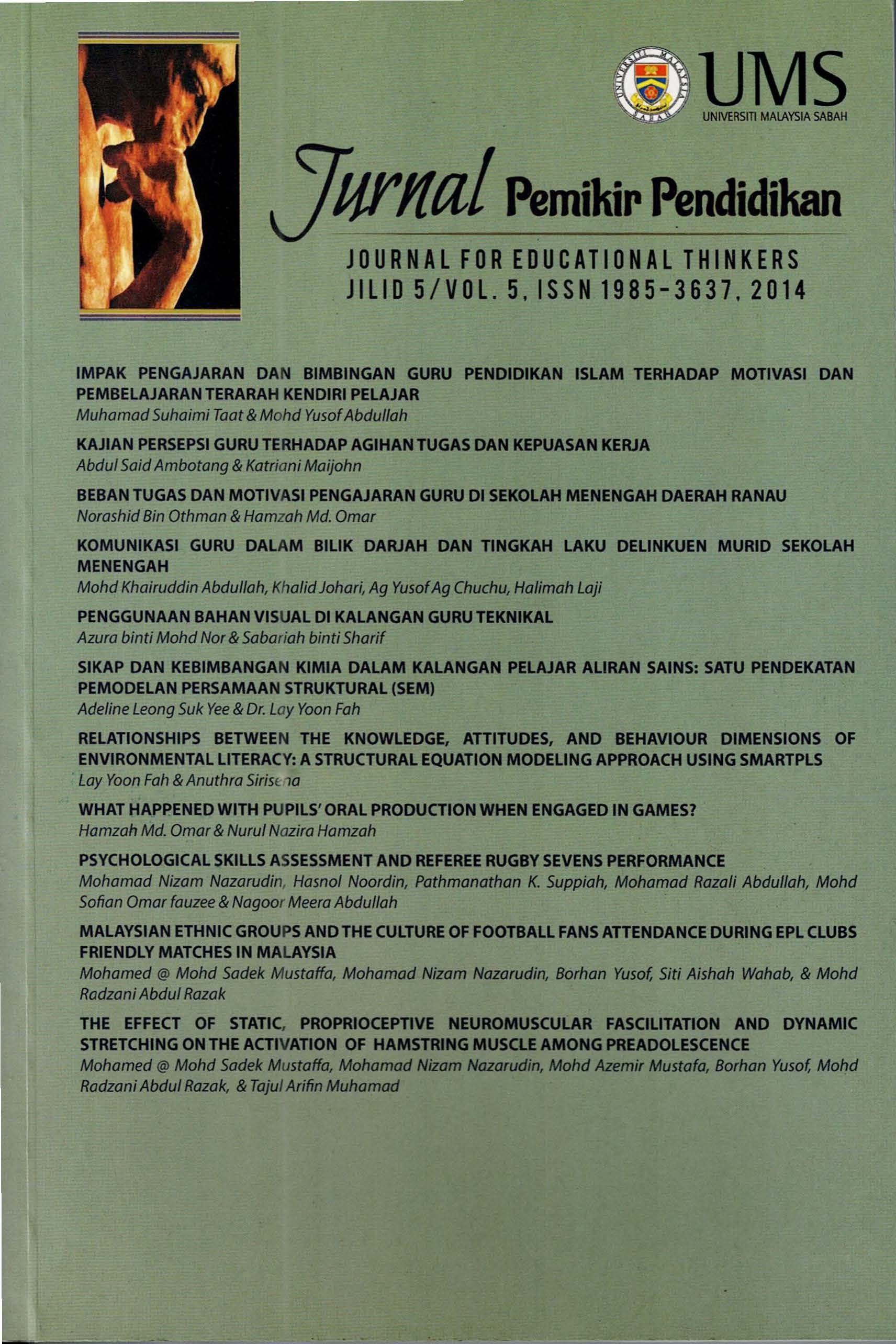
The effect of static, proprioceptive neuromuscular fascilitation and dynamic stretching on the activation of hamstring muscle among preadolescence
DOI:
https://doi.org/10.51200/jpp.v5i1.8216Keywords:
proprioceptive neuromuscular facilitation, dynamic streching, hamstrings activationAbstract
Flexibility of the hamstring muscle can enhance performance in sports through prevention of injury, muscular and postural imbalance, maintenance of full range of joint movement and optimal musculoskeletal function (Schuback, Hooper & Salisbury, 2004). Sullivan, Murray & Sainsbury (2009) stated that decreased hamstring flexibility was suggested to be one of the predisposing factors for hamstring strains and hamstring stretches were routinely used as part of an exercise routine. Purpose: The purpose of this study was to determine the more effective stretching method between static, PNF, and dynamic stretching on the activation of hamstring muscles among preadolescence and its relationship with power. Method: This research employed pre and post experimental design which comparing between and within subjects. Eighty subjects were assigned to four groups consist of static, PNF, dynamic and control group. Each participant exhibited tight hamstrings. Tight hamstrings were defined as a 30 degree knee extension deficit with the hip at 90 degree as described by Bandy et al (1997) & Gajdosik et al (1983). All of the participants was sedentary and not athletes. They were selected based on the low result from SEGAK (National Physical Fitness Standard).Each of the group followed six weeks intervention program except the control group. Outcome measures were measured using pre and post test. Statistical analyses used were mixed between-within subjects ANOVA and Pearson product moment correlation. Result & Discussion: Hamstring muscle activation following interventions with PNF was superior compared to other forms of stretching (p < 0.05). Sit and reach test, F (3, 76) = 25.57; p < 0.05, knee flexion test (dominant leg), F (3, 76) = 17.414; p < 0.05, knee flexion test (non dominant leg), F (3, 76) = 22.264; p < 0.05. Relationship between sit and reach test with vertical jump, r = -0.435, p < 0.05. Conclusion: PNF stretching was the effective treatment compared to static or dynamic stretching, however moderate and inverse relationship between flexibility and power.
References
Alpkaya, U., & Koceja, D. (2007). The effects of acute static stretching on reaction time & force. Journal of Sports Medicine & Physical Fitness, 47, 2.
Ballantyne, F., Fryer, G., & McLaughlin, P. (2003). The effect of muscle energy technique on hamstring extensibility: The mechanism of altered flexibility. Journal of Osteopathic Medicine.
Baltaci, G., Un, N., Tunay, V., Besler, A., & Gerceker, S. (2003). Comparison of three different sit and reach tests for measurement of hamstring flexibility. British Journal Sports Med.
Bandy, D. W., Irion, M. J., & Briggler, M. (1997). The effect of time and frequency of static stretching on flexibility of the hamstring muscles. Journal of ptjournal.apta.org.
Bonnar, B. P., Deivert, R. G., & Gould, T. E. (2004). The relationship between isometric contraction durations during hold relax stretching and improvement of hamstring flexibility. Journal of Sports Medicine Physical Fitness.
Chan, S. P., Hong, Y., & Robinson, P. D. (2001). Flexibility and passive resistance of the hamstring of young adults using two different static stretching protocol. Scandinavian Journal of Medicine & Science in Sports, 11, 81–86.
Cochrane, D. J., Legg, S. J., & Hooker, J. M. (2004). The short term effect of whole body vibration training on vertical jump, sprint and agility performance. Journal of Strength and Conditioning.
Cornbleet, S., & Woolsey, N. (1996). Assessment of hamstring muscle length in school-aged children using the sit-and-reach test and the inclinometer measure of hip joint angle. NCBI Journal.
Cote, M. S., Vaillancourt, T., LeBlanc, J. C., Nagin, D. S., & Tremblay, R. E. (2006). The development of physical aggression from toddlerhood to preadolescence: A nationwide longitudinal study of Asian children. Journal of Child Psychology.
David, M. (2002). Measurement by the physical educator. Canada: McGrawHill.
Decoster, L. C., Scanlon, R. L., Horn, K. D., & Cleland, J. (2004). Standing and supine hamstrings are equally effective. Journal of Athletic Training, 39(4), 330–334.
Duncan, M. J., & Woodfield, L. A. (2006). Acute effects of warm up protocol on flexibility and vertical jump in children. JEPonline, 9(3), 9–16.
Emiliano, C. E., Vittoria, M., Maurizio, C., & Veicsteinas, A. (2008). Effects of stretching on maximal anaerobic power: The roles of active and passive warm ups. Journal of Strength and Conditioning Research, 22(3), 794–800.
Feland, B. J., Myrer, J. W., & Merrill, R. M. (2001). Acute changes in hamstring flexibility: PNF versus static stretch in senior athletes. Journal of Physical Therapy in Sport, 2, 186–193.
Funk, D., Ann, S., Mikla, M., Fagan, T., & Faw, K. (2003). Impact of prior exercise on hamstring flexibility: A comparison of PNF & static stretching. Journal of Strength & Conditioning.
Gajdosik, R., & Lusin, G. (1983). Reliability of an active knee extension test. Journal of ptjournal.apta.org.
Herda, T. J., Cramer, J. T., Ryan, E. D., McHugh, M. P., & Stout, J. R. (2008). Acute effects of static versus dynamic stretching on isometric
peak torque, electromyography, and mechanomyography of the biceps femoris muscle. Journal of Strength and Conditioning Research, 22(3), 809–817.
Hutchison, T. A., & Stone, L. A. (2009). Validity of alternative field system for measuring vertical jump height. Journal of Exercise Physiologyonline, 12(3).
Jarlais, D. L., Gonstead, J., Lynch, T., Masbruch, L., Schuldt, R., & Zorn, D. (2007). Lower extremity performance with proprioceptive neuromuscular facilitation. Journal of Undergraduate Kinesiology Research.
Karemer, M., Vingren, J. W., Volek, L. J., Hartfield, S. J., Spiering, D., Barry, A., Ho Jen Yu, Fragala, T. S. M., Gwendoly A., Anderson, J.,
Hakkinen, M., Kijo, M., & Carl, M. (2008). Effect of stretching on upper body with muscular performance. Journal of Strength & Conditioning Research.
Koley, S., & Singh, A. (2008). Trends of active range of motion at three important joints in school going boys of Amritsar, Punjab. Journal of Anthropologist.
Nelson, R. T., & Bandyt, W. D. (2004). Eccentric training and static stretching improve hamstring flexibility of high school males. Journal of Athletic Training, 39(3), 254–258.
O’Connor, M. D., Crowe, M. J., & Spinks, W. L. (2006). Effects of static stretching on leg power during cycling. Journal of Sports Medicine and Physical Fitness, 46, 1.
Odunaiya, N. A., Hamzat, T. K., & Ajayi, O. F. (2005). The effects of static stretch duration on the flexibility of hamstring muscle. African Journal of Biomedical.
O’Sullivan, K., Murray, E., & Sainsbury, D. (2009). The effect of warm-up, static stretching and dynamic stretching on hamstring flexibility in previously injured subjects. Journal of BioMed Central, 1471–2474/10/3. https://doi.org/10.1186/1471-2474-10-37
Pallant, J. (2010). SPSS survival manual (4th ed.). England: McGraw Hill.
Pinero, J., Chillon, P., Ortega, F., Montesinos, J., Sjostrom, M., & Ruiz, J. (2009). Criterion related validity of sit-and-reach and modified sit-and-reach test for estimating hamstring flexibility in children and adolescents aged 6–17 years. NCBI Journal.
Richard, I., & Hudson, N. (2006). Stretching before exercise does not reduce the risk of local muscle injury: A critical review of the clinical and basic science literature. Clinical J. Sports Med., 9, 221–227.
Robbins, W. J., & Scheuermann, W. B. (2008). Varying amounts of acute static stretching and its effect on vertical jump performance. Journal of Strength and Conditioning Research, 22(3), 781–786.
Rowlands, V. A., Marginson, F. V., & Lee, J. (2003). Chronic flexibility gains: Effect of isometric contraction duration during proprioceptive neuromuscular facilitation stretching techniques. Research Quarterly for Exercise and Sport, 74(1), 47–51.
Schuback, B., Hooper, J., & Salisbury, L. (2004). A comparison of a self-stretch incorporating proprioceptive neuromuscular facilitation components and a therapist-applied PNF-technique on hamstring flexibility. Department of Physiotherapy, Queen Margaret University College, Edinburgh, UK, 90, 151–157.
Spernoga, S. G., Uhlt, T. L., Arnold, B. L., & Gansneder, B. M. (2001). Duration of maintained hamstring flexibility after one time, modified hold relax stretching protocol. Journal of Athletic Training, 36(1), 48.
Tudor, L. C., Johnson, W., & Katzmarzyk, P. (2010). Accelerometer-determined steps per day in US children and youth. Medicine & Science in Sports & Exercise, 42(12), 2244–2250.
Zakas, A., Grammatikopoulou, G. M., Zakas, N., Zahariadis, P., & Vamvakoudis, E. (2006). The effect of active warm-up and stretching on the flexibility of adolescent soccer player. Journal of Sports Medicine and Physical Fitness, 46, 57–61.
Zakas, A., & Vergou, A., Grammatikopoulou, G. M., Zakas, N., Sentelidis, T., & Vamvakoudis, S. (2003). The effect of stretching during warming-up on the flexibility of junior handball players. Journal of Sports Medicine and Physical Fitness, 43, 145–149.
Yamaguchi, T., & Ishii, K. (2005). Effects of static stretching for 30 seconds and dynamic stretching on leg extension power. Journal of Strength and Conditioning Research, 19(3), 677–683.
Young, W., Elias, G., & Power, J. (2006). Effects of static stretching volume and intensity on plantar explosive force production and range of motion. Journal of Sports Medicine and Physical Fitness, 46(3), 403–411.
Downloads
Published
How to Cite
Issue
Section
License
Copyright (c) 2014 Mohamed @ Mohd Sadek Mustaffa, Mohamad Nizam Nazarudin, Mohd Azemir Mustafa, Borhan Yusof, Mohd Radzani Abdul Razak, Tajul Arifin Muhamad

This work is licensed under a Creative Commons Attribution-NonCommercial-ShareAlike 4.0 International License.




 Total Views: 39
|
Total Views: 39
|  Total Downloads: 19