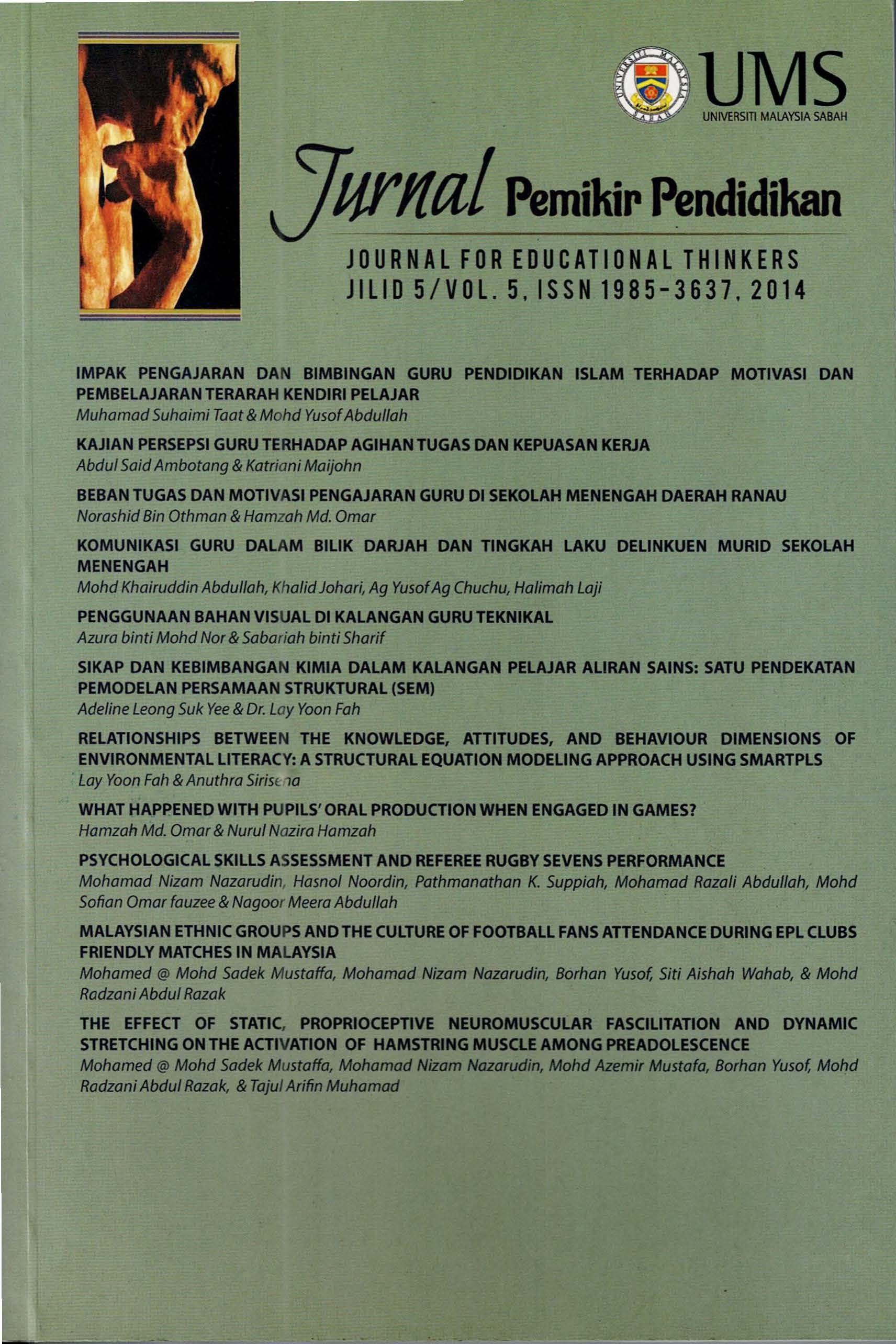
Malaysian ethnic groups and the culture of football fans attendance during EPL clubs friendly matches in Malaysia
DOI:
https://doi.org/10.51200/jpp.v5i1.8214Keywords:
culture, sport attendance, sport fans, EPL clubsAbstract
The involvement of Malaysian and the football fans in the English Premier League is real. Malaysia Airlines System (MAS) and Air Asia are the pure examples which involving in sponsoring EPL teams such as Manchester United, Liverpool and others. For the session year 2011-2012, they have moved another step further, where Malaysian not only sponsors the EPL team but they are the new owner of Queen Park Ranger and Cardiff City Club. Football is a team sport which is the most played and watched in the world, whether we actively participate as a player or simply attend as a fan or spectator. The popularity of football has increased especially in the 20th century. Recently, football is a lucrative industry through the authority of media broadcast income and ticket sales at stadiums. Millions of fans usually go to the football stadium to follow their favourite teams, while billions are watch football game on television. Malaysia's key issue is there are no consistencies in sport fans attendance which conducted in Malaysia. So, are better understandings of the culture of football attendance can increase fans attendance? And are the background of the fans can be part of influencing the attendance of fans to football friendly matches in Malaysia? The purpose of this study is to identify the culture of football fans attendance on English Premier League in Malaysia and to support for using the theory of planned behavior for selection of factors in conducting research regarding why people attend to watch EPL clubs in Malaysia. This study is a descriptive research, and the instrument that has been use is questionnaire which was adapted from Ketra L. Armstrong (2008). The sample size of this study is (n=815), and the participants of this research is from EPL sport fans club in Malaysia. The data was analyzed by using one-way ANOVA, and multiple regressions. Multiple regression shows that event attractiveness factor by getting experience of feeling while attending the match (β=.259) can increase the attendance of football fans. Simultaneously, event accessibility factor the researcher found that if the match held on appropriate day (β=.127) has influence to EPL fans attendance, although in this research the result shows that when the time and when the match will be held cannot influence them (β=.122) (β=.124). While event culture, when the organizer of the match provide a special giveaways and get the special merchandise from the match (β=.097) (β=.090) show significant on the attendance of sport fans. The results have the ability to provide much needed findings for event tournament, sponsors, and event organizer as they continue to develop methods to increase fans attendance.
References
Adcoft, A., & Teckman, J. (2009). Taking sport seriously. Management Decision, 47(1), 5–13.
Ajzen, I. (1991). The theory of planned behavior. Organizational Behavior and Human Decision Process, 50, 179–211.
Ajzen, I., & Driver, B. (1991). Prediction of leisure participation from behavioral, normative, and control beliefs: An application of the theory of planned behavior. Leisure Sciences, 73(3), 185–204.
Armstrong, K. (2002a). Race and sport consumption motivations: A preliminary investigation of a black consumers' sport motivation scale. Journal of Sport Behavior, 25(4), 309–330.
Armstrong, K. (2002b). An examination of the social psychology of blacks' consumption to sport Journal of Sport Management, 16(4), 267–288.
Armstrong, K., & Peretto-Stratta, T. (2004). Market analyses of race and sport consumption. Sport Marketing Quarterly, 73(1), 7–16.
Armstrong, K. (2008). Consumers of color and the “culture” of sport attendance: Explaratory insight. Sport Marketing Quarterly, 17(1), 218.
Bae, S. W. (2004). Attitudes, interests and sport spectator profiling: Variables affecting game attendance in NHL franchise [Unpublished doctoral dissertation]. The University of British Columbia.
Chatzisarantis, N., Hagger, M., Smith, B., & Sage, L. (2006). The influences of intrinsic motivation on execution of social behaviour within the theory of planned behaviour. European Journal of Social Psychology, 36(2), 229–237.
Collins, S. (2007). 'Samurai' politics: Japanese cultural identity in global sport – The Olympic Games as a representational strategy. International Journal of the History of Sport, 24(3), 357–374.
Cunningham, G. B., & Kwon, H. (2003). The theory of planned behaviour and intentions to attend a sport event. Sport Management Review, 6, 127–145.
Dale, B., Iwaarden, J., Wiele, T., & Wiliams, R. (2005). Service improvement in a sports environment: A study of spectator attendance. Managing Service Quality, 15(5), 470–484.
Ferreira, M., & Armstrong, K. L. (2004). An exploratory examination of attributes influencing students’ decisions to attend college sport events. Sport Marketing Quarterly, 13(3), 194–208.
Green, F. E. (1995). An examination of factors related to consumer behavior influencing attendance at professional sporting events [Unpublished doctoral dissertation]. The Florida State University, Tallahassee.
Greenwell, T. C. (2007). Expectations, industry standards, and customer satisfaction in the student ticketing process. Sport Marketing Quarterly, 16(1), 7–14.
Han, D. (2009). A cross-cultural approach for understanding motivation differences between American and Korean sport fans: The impact of individualism and collectivism. College of Education and Human Development, 1–75.
Israel, Glenn D. (1992). Sampling the evidence of extension program impact. Program Evaluation and Organizational Development, IFAS, University of Florida. PEOD-5.
James, J. D., & Ross, S. D. (2004). Comparing sport consumer motivations across multiple sports. Sport Marketing Quarterly, 13(1), 17–25.
Kacen, J. J., & Lee, J. A. (2002). The influence of culture on consumer impulsive buying behavior. Journal of Consumer Psychology, 12(2), 163–176.
Katovich, M. A., & Burns, R. (2008). The home run: A dramatuligical moment in time. Studies in Symbolic Interaction, 30, 337–359.
Kelley, S. W., & Turley, L. W. (2001). Consumer perceptions of service quality attributes at sporting events. Journal of Business Research, 54, 161–166.
Kudlaeek, M., Valkova, H., Sherrill, C., Myers, B., & French, R. (2002). An inclusion instrument based on planned behavior theory for prospective physical educators. Adapted Physical Activity Quarterly, 19(3), 280–299.
Lambrecht, K. W., Kaefer, F., & Ramenofsky, S. D. (2009). Sportscape factors influencing spectators attendance and satisfaction at a professional golf tournament. Sport Marketing Quarterly, 18(3), 165–172.
Laverie, D. A., & Arnett, D. B. (2000). Factors affecting fan attendance: The influence of identity salience and satisfaction. Journal of Leisure Research, 32(2), 225–246.
Ludlow, P. (2007). Racing for home: Culture, ethnicity, and sport in the athletic life of marathoner Ronald John MacDonald. Sport History Review, 38(2), 148–162.
Major League Baseball. (2008). Player profile: Chien-Ming Wang. Retrieved December 12, 2008, from http://newyork.yankees.mlb.com/team/player_career.jsp7player_id=425426
Macpherson, T., Garland, R., & Haughey, K. (2000). Attracting fans to the game. Visionary Marketing for the 21st Century: Facing the Challenge, 745–749.
McDonald, M. A., Milne, G. R., & Hong, J. (2002). Motivational factors for evaluating sport spectator and participant markets. Sport Marketing Quarterly, 11(2), 100–111.
Ng, S., Russell-Bennet, R., & Dagger, T. (2007). A typology of mass services: The role of service delivery and consumption purpose in classifying service experiences. Journal of Services Marketing, 21(7), 471–480.
Oldenboom, E., Gratton, C., & Arne, H. (2002). Summary: The economic impact of hosting Euro 2008 for the Nordic countries. Retrieved from www.meerwaarde.com/downloads/ek2008press.pdf.
Omar, A. H., Majid, N. A., & Puteh, F. (2006). Sports as an agent of integration in Malaysia society. Teluk Danga International Games Convention, 1–5.
Shank, M. D. (2005). Sports marketing: A strategic perspective (3rd ed.). Upper Saddle River, NJ: Prentice Hall.
Snipes, R. L., & Ingram, R. (2007). Motivators of collegiate sport attendance: A comparison across demographic groups. Innovative Marketing, 3(2), 61.
Sydnor, S. (2010). Mourning the mascot’s demise: On prehistoric origins and modern aftermath. Studies in Symbolic Interaction, 34, 15–31.
Theodorakis, N., Kambitsis, C., Laios, A., & Koustelios, A. (2001). Relationship between measures of service quality and satisfaction of spectators in professional sports. Managing Service Quality, 11(6), 431.
Thorne, S., & Bruner, G. C. (2006). An exploratory investigation of the characteristics of consumer fanaticism. Qualitative Market Research, 9(1), 51–72.
Trail, G. T., & James, J. D. (2001). The motivation scale for sport consumption: Assessment of the scale’s psychometric properties. Journal of Sport Behavior, 24(1), 108–127.
Tsuji, Y., Bennet, G., & Zhang, J. (2007). Consumer satisfaction with an action sports event. Sport Marketing Quarterly, 16(4), 199–208.
Wann, D. L., Schrader, M. P., & Wilson, A. M. (1999). Sport fan motivation: Questionnaire validation, comparisons by sport, and relationship to athletic motivation. Journal of Sport Behavior, 22(1), 114–139.
Wann, D. L., & Waddill, P. J. (2003). Predicting sport fan motivation using anatomical sex and gender role orientation. North American Journal of Psychology, 5(3), 485–498.
Wann, D. L., Grieve, F. G., Zapalac, R. K., & Pease, D. G. (2008). Motivational profiles of sport fans of different sports. Sport Marketing Quarterly, 17(1), 6–19.
Yusuf, A., & See, L. H. (2008). Spectator perceptions of physical facility and team quality: A study of a Malaysian Super League soccer match. Research Journal of International Studies, 132–140.
Zhang, J. J., Pease, D. D., Lam, E. T. C., Bellerive, L. M., Pham, U. L., Williamson, D. P., & Lee, J. T. (2001). Sociomotivational factors affecting spectator attendance at minor league hockey games. Sport Marketing Quarterly, 10(1), 43–54.
Harris, M., & Harrington, H. J. (2000). Service quality in the knowledge age: Huge opportunities for the twenty-first century. Measuring Business Excellence, 4(4), 31.
Downloads
Published
How to Cite
Issue
Section
License
Copyright (c) 2014 Mohamed @ Mohd Sadek Mustaffa, Mohamad Nizam Nazarudin, Borhan Yusof, Siti Aishah Wahab, Mohd Radzani Abdul Razak

This work is licensed under a Creative Commons Attribution-NonCommercial-ShareAlike 4.0 International License.




 Total Views: 33
|
Total Views: 33
|  Total Downloads: 47