
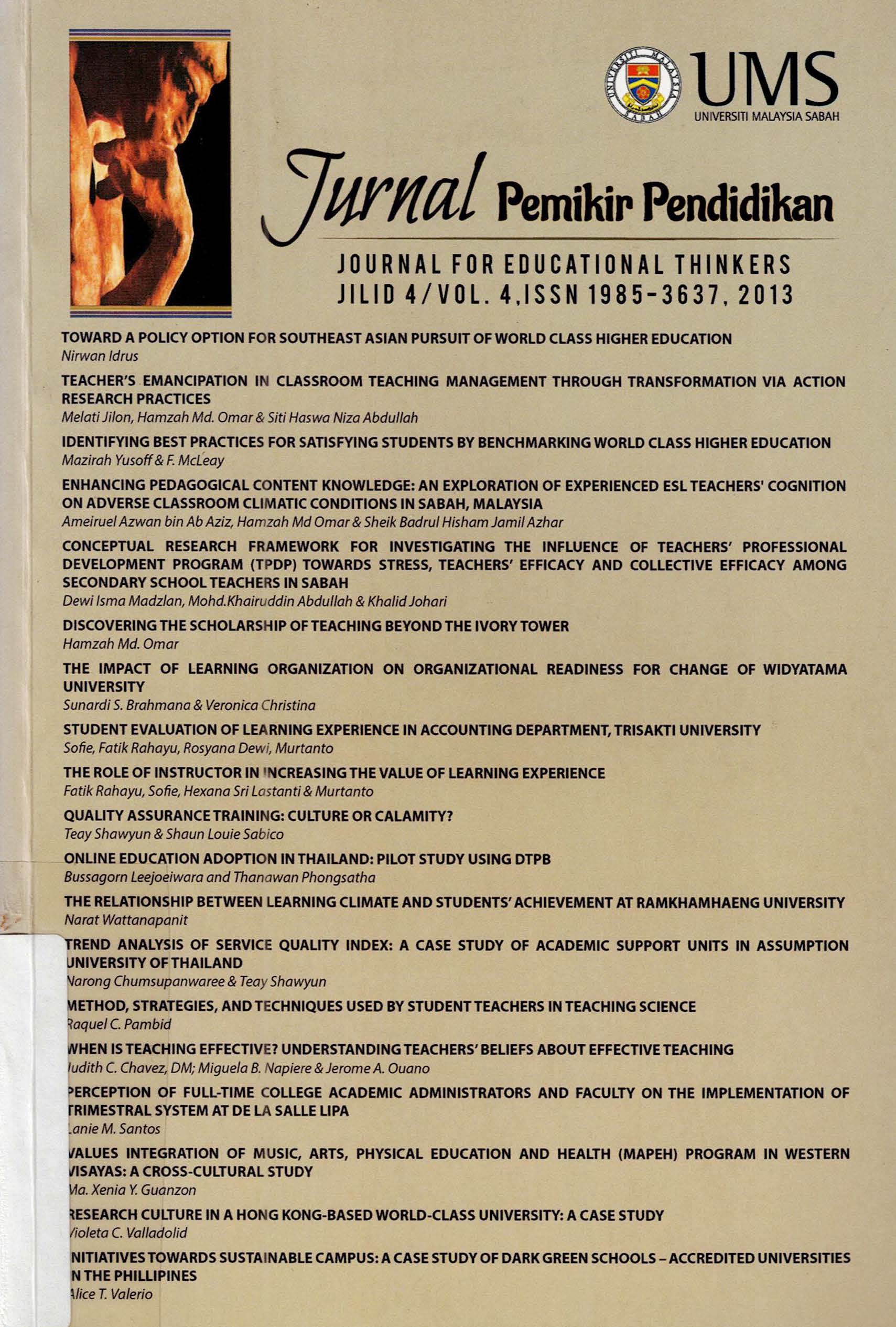
Teacher’s emancipation in classroom teaching management through transformation via action research practices
DOI:
https://doi.org/10.51200/jpp.v4i1.8173Keywords:
emancipation, transformation, action research practices, teaching practiceAbstract
This paper is concerned with teachers' emancipation through action research practices in transforming teachers' classroom management. Teacher's emancipation is teacher's freedom in making decision about the course of their teaching practice in school. Indeed, transformation of classroom management in school depends largely on teachers' readiness to effect change in their current practices. This posed a challenge to change their classroom norms. In this study, teachers' emancipation will be explored in three main domains of teaching professionalism development, namely; experiential skills, professional knowledge and practical skills. This interim study uses qualitative case study design. The data collected through interview method was carried out on two experienced teachers. These two teachers came from Kota Belud's district primary school. They' was purposively sampled. The data was analysed using Thematic Analysis. The interim findings showed the existence of teachers' emancipation traits as the result of their involvement in action research practices in school in term of teachers' empowerment and participatory from various parties at school.
References
Allan Feldman, & Tarin Weiss. (2010). Understanding change in teachers’ ways of being through collaborative action research: A cultural-historical activity theory analysis. Educational Action Research, 18(1), 29–55.
Ben W. M. Boog. (2003). The emancipatory character of action research, its history and the present state of the art. Journal of Community & Applied Social Psychology, 13, 426–438.
David Bargal. (2006). Personal and intellectual influences leading to Lewin’s paradigm of action research: Towards the 60th anniversary of Lewin’s “Action research and minority problems” (1946). Action Research, 4(4), 367–388.
Dewey, J. (1933). How we think: A restatement of the relation of reflective thinking to the education process. D.C. Heath and Company.
Feldman, A. (2002). Existential approaches to action research. Educational Action Research, 10(2), 233–252.
Freire, P. (1970/1993). Pedagogy of the oppressed. M. Ramos (Trans.). Continuum.
Fullan, M. G., & Miles, M. B. (1992). Getting reform right: What works and what doesn’t. Phi Delta Kappan.
Greenwood, D. J., & Levin, M. (1998). Introduction to action research: Social research for social change. Sage.
Habermas, J. (1984). The theory of communicative action (Vol. 1). T. McCarthy (Trans.). Beacon Press.
Habib Mat Som. (2005). Profil kesediaan guru sekolah menengah terhadap pelaksanaan perubahan kurikulum. Tesis Ph.D. Universiti Malaya, Kuala Lumpur.
Huberman, M., & Miles, M. B. (1984). Innovation up close: How school improvement works. Plenum.
Levin, M., & Greenwood, D. (2001). Pragmatic action research and the struggle to transform universities into learning communities. In P. Reason & H. Bradbury (Eds.), Handbook of action research. Sage.
Lewin, K. (1946/1948). Action research and minority problems. In G. W. Lewin (Ed.), Resolving social conflicts (pp. 201–216). Harper & Row.
Lomax, P. (1994). Management training for schools and colleges: Evaluating an action research approach. In P. Lomax & J. Darley (Eds.), Management research in the public sector. Bourne Press.
Smith, M. K. (2001). Kurt Lewin, groups. Experiential learning and action research. The Encyclopedia of Informal Education. Retrieved August 4, 2003, from http://www.infed.org/thinkers/et-lewin.htm
Syed Ismail, S. M., & Ahmad Subki, M. (2010). Asas kepimpinan & perkembangan profesional. Penerbitan Multimedia Sdn. Bhd.
Wiles, J., & Bondi, J. (1998). Curriculum development: A guide to practice (5th ed.). Upper Saddle River, New Jersey.
Zeichner, K., & Gore, J. (1995). Using action research as a vehicle for student teacher reflection: A social reconstructionist approach. In S. E. Noffke & R. Stevenson (Eds.), Education and action research: Becoming practically critical (pp. 13–130). Teachers College Press.
Zeus Leonardo. (2004). Critical social theory and transformative knowledge: The functions of criticism in quality education.
Downloads
Published
How to Cite
Issue
Section
License
Copyright (c) 2013 Melati Jilon, Hamzah Md. Omar, Siti Haswa Niza Abdullah

This work is licensed under a Creative Commons Attribution-NonCommercial-ShareAlike 4.0 International License.




 Total Views: 27
|
Total Views: 27
|  Total Downloads: 17


