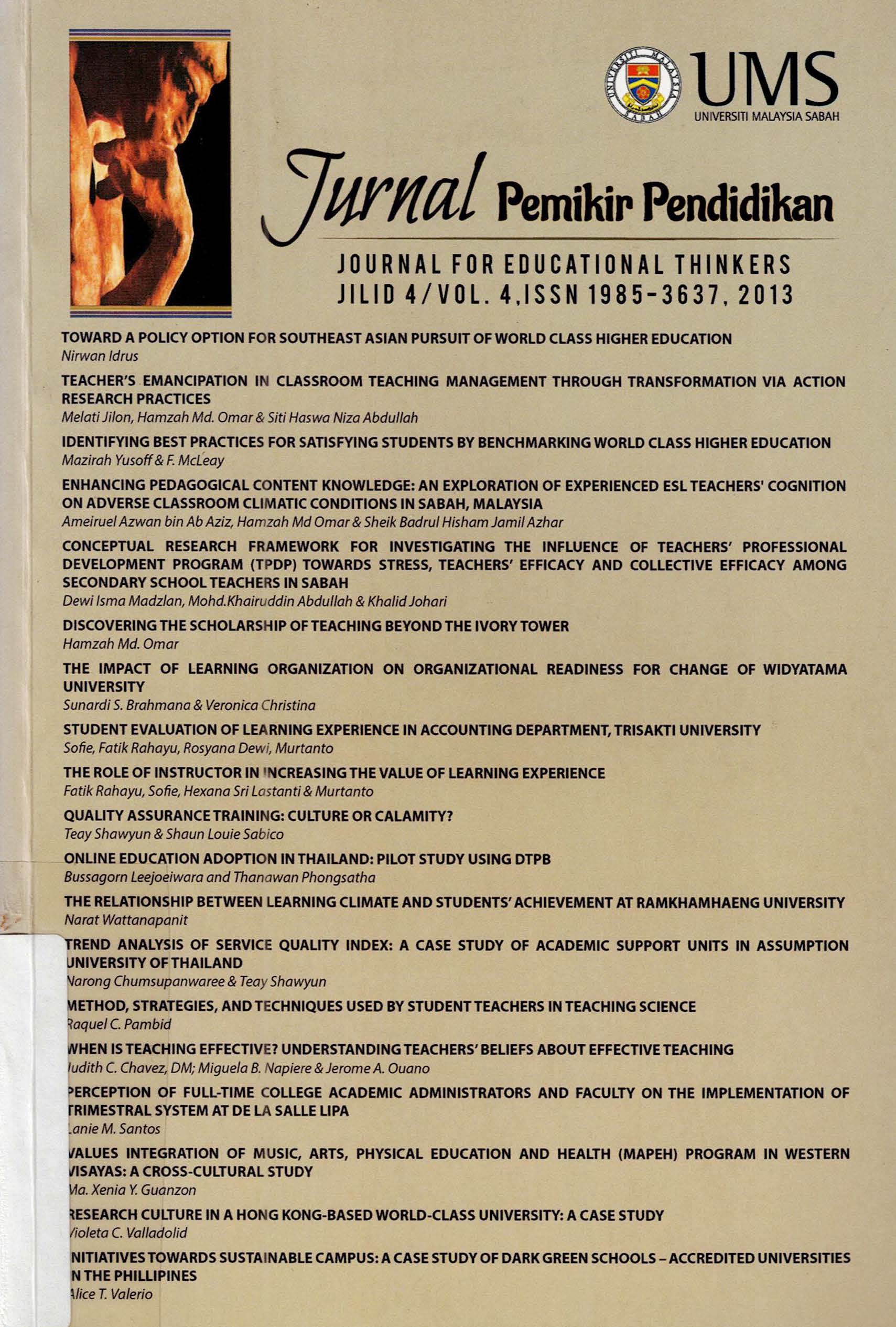
Discovering the scholarship of teaching beyond the ivory tower
DOI:
https://doi.org/10.51200/jpp.v4i1.8184Keywords:
case-based, School-based Teaching Program, teacher trainingAbstract
School administrators have often cited that beginning teachers graduating from the Institution of Higher Learning do not have the effective communication skills, higher order thinking skills, able to solve real-life problems and appreciate the art of teaching as comprehensive as those trained in teacher training colleges. In this paper, I will be looking at the generation, dissemination and communication of teaching knowledge in a university-school collaboration in a program known as School Based Teaching program (SBT) as a fulcrum in enhancing the scholarship teaching. I have conducted a case-based (Wilson, Shulman, & Richert,1987) study on the change in teaching knowledge of TESL (Teaching of English as A Second Language) undergraduates who had undergone three months School Based Teaching program (SBT). In the selected case study conducted on my TESL undergraduates, the professional growth of knowledge, teaching practice, attitudes, confidence, teamwork, and collegiality confirm to the need in equipping them with required macro and soft skills. Qualitative analyses revealed the presence of 19 themes: Caring; Communication; Creative; Fairness; Flexible; Friendly; Knowledgeable; Manages Classroom; Involving; Motivating; Organized; Passion for Teaching; Patience; Builds Relationships; Shows others respect; Challenges; Teaches Well; Good Personality; and Understanding. In addition, I will discuss the pedagogical issues arising from enacting change in scholarship of teaching beyond the ivory tower (i.e. Universities, via School Based Teaching program (SBT)).
References
Andresen, L. W., & Webb, C. A. (2000). Discovering the scholarship of teaching. University of Western Sydney Hawkesbury.
Bass, R. (1999). The scholarship of teaching: What is the problem? Creative Thinking about Learning and Teaching, 1(1).
Biggs, J. (1999). Teaching for quality learning at university. SRHE and Open University Press.
Biggs, J. B. (1996). Enhancing teaching through constructive alignment. Higher Education, 32, 1–18.
Boyer, E. L. (1990). Scholarship reconsidered: Priorities of the professoriate. The Carnegie Foundation for the Advancement of Teaching.
Creswell, J. W. (2007). Educational research: Planning, conducting, and evaluating quantitative and qualitative research. Pearson Merrill Prentice Hall.
Evers, F. T., Rush, J. C., & Berdrow, I. (1998). The bases of competence: Skills for lifelong learning and employability. Jossey-Bass.
Glaser, B. G., & Strauss, A. L. (1967). The discovery of grounded theory: Strategies for qualitative research. Aldine Publishing Company.
Glassick, C., Huber, M., & Maeroff, G. (1997). Scholarship assessed: Evaluation of the professoriate. Jossey-Bass.
Goodlad, J. (1984). A place called school: Prospects for the future. McGraw-Hill.
Guskey, A. (1986). The model of the process of teacher change. Open University Press.
Healey, M. (2000). Developing the scholarship of teaching geography in higher education. Higher Education Research and Development.
Hutchings, P. (2000). Approaching the scholarship of teaching and learning. Opening Lines: Approaches to the Scholarship of Teaching and Learning.
Johnson, E. B. (2002). Contextual teaching and learning: What it is and why it’s here to stay. Corwin Press.
Kreber, C. (2002). Teaching excellence, teaching expertise, and the scholarship of teaching. Innovative Higher Education, 27, 5–23.
McKinney, K. (2004). The scholarship of teaching and learning: Past lessons, current challenges, and future visions. To Improve the Academy, 22, 3–19.
Onwuegbuzie, A. J., & Daniel, L. G. (2003). Typology of analytical and interpretational errors in quantitative and qualitative educational research. Current Issues in Education, 6(2). http://cie.ed.asu.edu/volume6/number2/
Onwuegbuzie, A. J., & Teddlie, C. (2003). A framework for analyzing data in mixed methods research. In Handbook of mixed methods in social and behavioral research (pp. 351–383). Sage.
Prosser, M., & Trigwell, K. (1999). Understanding learning and teaching: The experience in higher education. SRHE and Open University Press.
Ramsden, P. (1992). Learning to teach in higher education. Routledge.
Ramsden, P., Margetson, D., Martin, E., & Clarke, S. (1995). Recognising and rewarding good teaching in Australian higher education. Australian Government Publishing Service.
Rice, R. E. (1992). Towards a broader conception of scholarship: The American context. In T. Whiston & R. Geiger (Eds.), Research and higher education: The United Kingdom and the United States.
Schön, D. A. (1995). The new scholarship requires a new epistemology. Change, November/December, 27–34.
Shulman, L. S. (1993). Teaching as community property. Change, November/December, 6–7.
Shulman, L. S. (1999). Taking learning seriously. Change, July/August, 11–17.
Tashakkori, A. K., & Teddlie, C. (1998). Mixed methodology: Combining qualitative and quantitative approaches. Sage.
Wilson, S. M., Shulman, L. S., & Richert, A. E. (1987). 150 different ways of knowing: Representations of knowledge in teaching. In J. Calderhead (Ed.), Exploring teachers’ thinking. Holt, Rinehart, & Winston.
Downloads
Published
How to Cite
Issue
Section
License
Copyright (c) 2013 Hamzah Md. Omar

This work is licensed under a Creative Commons Attribution-NonCommercial-ShareAlike 4.0 International License.




 Total Views: 30
|
Total Views: 30
|  Total Downloads: 17