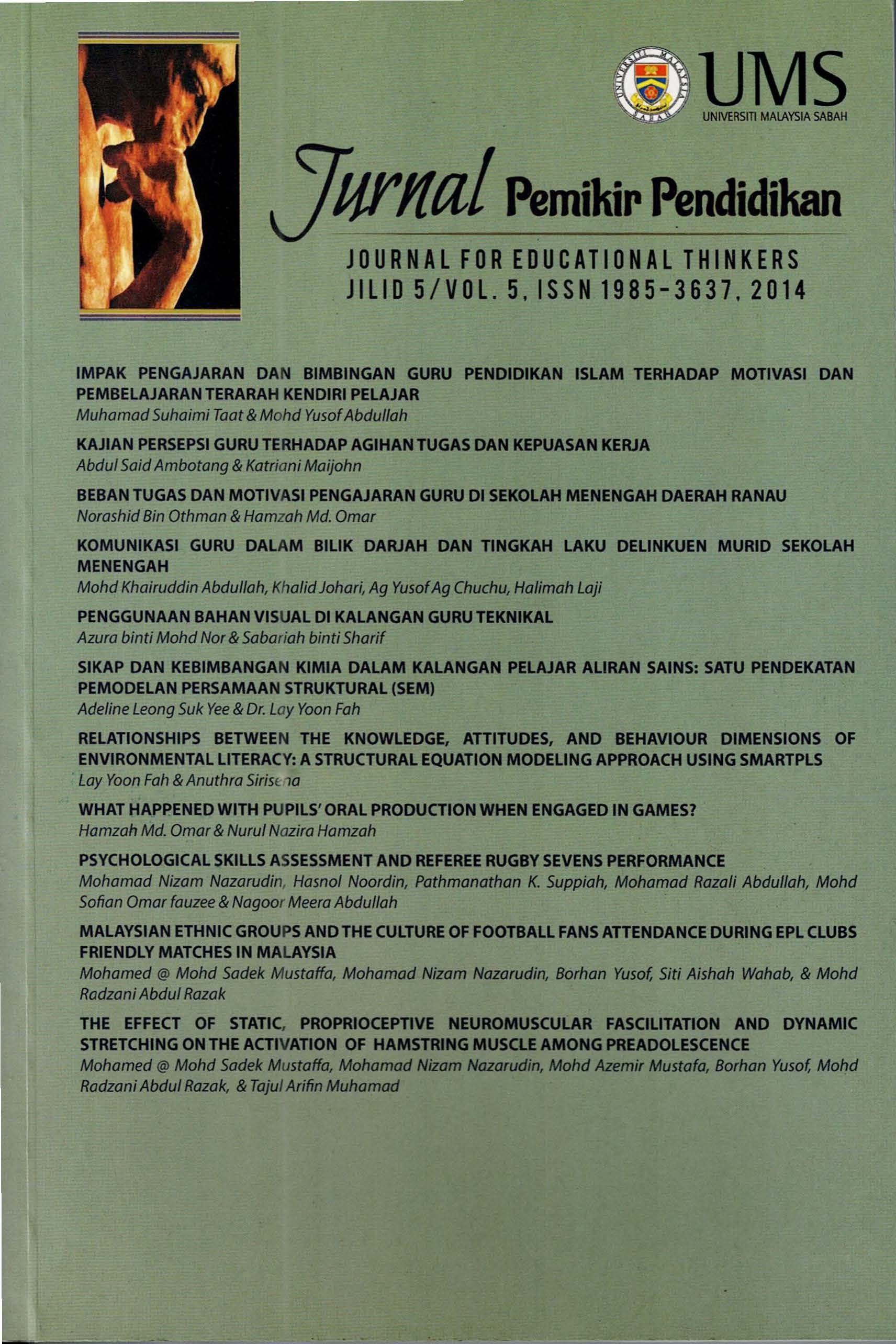
What happened with pupils’ oral production when engaged in games?
DOI:
https://doi.org/10.51200/jpp.v5i1.8212Abstract
This study reports on the trends and concerns of ESL teacher trainees in using game strategy to improve speaking skill in a rural and remote primary schoolThis study was conducted over three weeks with five remote areas primary schools pupils under the Malubang Outreach Programme, in Malubang, Pitas in Sabah. This study involved 22 TESL (Teaching of English as A Second Language) education undergraduates in the School of Education and Social Development at University of Malaysia Sabah, Malaysia. Teacher trainees used game strategy throughout to improve pupils‟ oral skills. Data were collected through observation, questionnaires, and reflective essays. In sum, this study revealed the concerns of teacher trainees using game strategy comprised of restructuring teacher trainees‟ instructional techniques based on the following: The internal and external environment conditions that influenced the effectiveness of various language games used, for example, instructional setting; group dynamics; communication patterns and modes; organization, cultural factors and distance/time factors and management of the learning environment and technology.
References
Ariza, E. (2001). Interacting in English through games. PROFILE, Issues in Teachers’ Professional Development, 2, 6–8.
Bygate, M. (1987). Speaking. Oxford: Oxford University Press.
Collier, V. F. (1995). Acquiring a second language for school: Directions in language and education. National Clearinghouse for Bilingual Education, 1, 4–16.
Cortez, E. G. (1978). Language-teaching games: What about them? 32(3), 204–207.
El-Shamy, S. (2001). Training games: Everything you need to know about using games to reinforce learning. Virginia: Stylus.
Ersoz, A. (2000). Six games for EFL/ESL classroom. The Internet TESL Journal, 6(6). Retrieved February 11, 2005, from http://iteslj.org/Lessons/Ersoz-Games.html
Kayi, H. (2006). Teaching speaking: Activities to promote speaking in a second language. The Internet TESL Journal, XII(11), November 2006.
Leigh, E., & Kinder, J. (1999). Learning through fun and games. Australia: McGraw-Hill.
Liu, S., & Vittitow, M. L. (1985). Learning games without losers. Nashville, TN: Incentive Publications.
Ludewig, A., & Swan, A. (2007). Ph.D. 101 great classroom games. Chicago, IL: McGraw Hill.
Onwuegbuzie, A. J., & Leech, N. L. (2007b). Validity and qualitative research: An oxymoron? Quality & Quantity: International Journal of Methodology, 41, 233–249.
Piller, B., & Skillings, M. J. (2005). English language teaching strategies used by primary teachers in one New Delhi, India school. TESL-EJ, 9(3).
Pivec, M., & Dziabenko, O. (2010). Game-based learning framework for collaborative learning and student e-teamwork. www.ementor.edu.pl/_xml/wydania/4/42.pdf.
Saricoban, A., & Metin, E. (2000). Songs, verse and games for teaching grammar. The Internet TESL Journal, 6(10). http://iteslj.org/Techniques/Saricoban-Songs.html
Thirumalai, M. S. (2002). Teaching English to speakers of other languages. Language in India, 2(4). [Online]. Available: http://www.languageinindia.com/april2002/tesolbook.html#chapter2
Thompson, L. W. (2004). Literacy development for English language learners: Classroom challenges in the NCLB age. Monterey, CA: CTB/McGraw Hill. [online]. Available: http://www.ctb.com/media/articles/pdfs/LanguageProficienc/English_Language_Learners
Downloads
Published
How to Cite
Issue
Section
License
Copyright (c) 2014 Hamzah Md. Omar, Nurul Nazira Hamzah

This work is licensed under a Creative Commons Attribution-NonCommercial-ShareAlike 4.0 International License.




 Total Views: 32
|
Total Views: 32
|  Total Downloads: 18