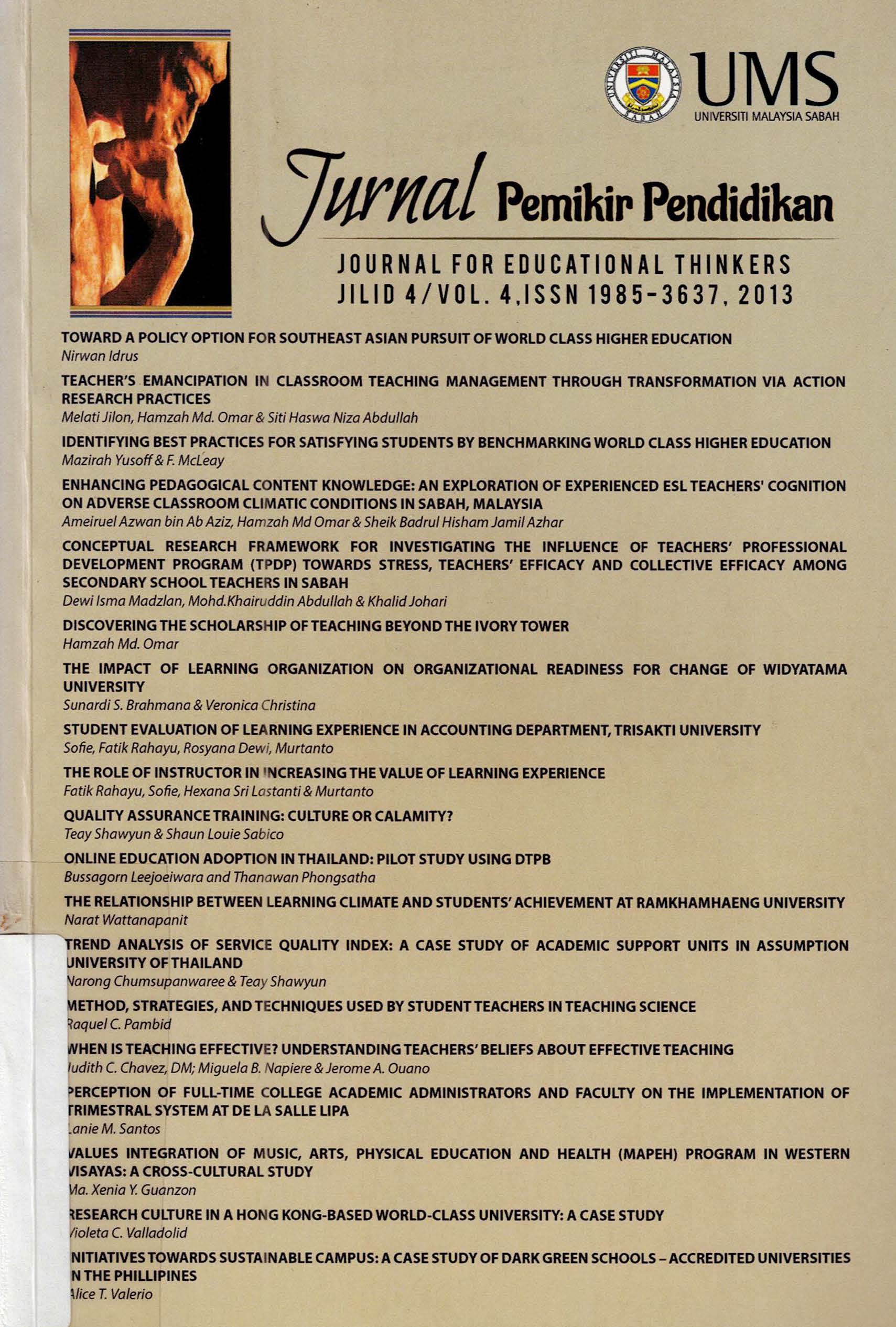
Enhancing pedagogical content knowledge: An exploration of experienced esl teachers’ cognition on adverse classroom climatic conditions in Sabah, Malaysia
DOI:
https://doi.org/10.51200/jpp.v4i1.8177Keywords:
Pedagogical Content Knowledge (PCK), English Language Teaching (ELT), climatic conditions, English as a Second Language (ESL)Abstract
The effects of global warming and climate change are well known to human activities. The classroom's climatic conditions in which teachers work have a significant impact on their cognition and practices in second language education. The decisions about content, curriculum and pedagogy are made based on their pedagogical content knowledge (PCK) enhanced by the teaching experiences gained in classroom practices. The purpose of this study is to explore experienced teachers' cognition on adverse classroom climatic conditions which influence their decision making for teaching practices. The primary goal is to enhance ESL teachers' PCK base in deciding appropriate content, curriculum and pedagogical Strategies under specific climatic condition. Interpretative Phenomenological Analysis (IPA) is used to analyse the lived experience of three experienced EL teachers in secondary schools located in coastal areas of Sabah, Malaysia. Data collection methods and sources included field notes, interviews and document analysis. The findings revealed that thermal comfort and mental efficiency are the vital factors besides other classroom milieu that need to he considered when deciding appropriate content and pedagogical strategies for a specific lesson. Furthermore, the findings suggested three aspects of PCK; the knowledge of students' affective needs, conceptions of content and curriculum, and knowledge of instructions and appropriate teaching strategies; are also influenced by the climatic conditions surrounding the classroom.
References
Bogdan, R. C., & Biklen, S. K. (2006). Qualitative research for education: An introduction to theories and methods. Pearson Education, Inc.
Borg, S. (2006). Teacher cognition and language education: Research and practice. Continuum.
Breen, M., Hird, B., Milton, M., Oliver, & Thwaite, A. (2001). Making sense of language teaching: Teachers’ principles and classroom practices. Applied Linguistics, 22(4), 470–501.
Calderhead, J. (1987). Exploring teachers’ thinking. Cassel.
Clark, C. M., & Peterson, P. L. (1986). Teachers’ thought process. In M. C. Wittrock (Ed.), Handbook of research on teaching (3rd ed., pp. 255–296). Macmillan.
Creswell, J. W. (2007). Qualitative inquiry and research design. Sage Publications.
Dérnyei, Z. (2010). The psychology of second language acquisition. Oford Univeristy Press.
Fennema, E., & Franke, M. (1992). Teachers’ knowledge and its impact. In D. Grouws, Handbook of research on mathematics teaching and learning (p. 153). McMillan.
Freeman, D. L., & Long, M. H. (1994). An introduction to second language acquisition research. Longman Group UK Limited.
Goodlad, J. I. (2004). A place called school (20th ed.). McGraw-Hill.
Johnson, K. E. (1999). Understanding language teaching. Heinle & Heinle Publishers.
Kumar, S. (2012, January 12). Creating conducive classroom climate. Articlebase.com. http://articlebase.com/education-articlescreating-conducive-classroom-climate-256406.htm!
Landsberg, H. E. (1987). Bio-meteorology: Human response to weather. New York University Education Quarterly, 8–13.
McBer, H. (2000). Research into teacher effectiveness: A model of teacher effectiveness. Department for Education and Employment, UK.
McCaughtry, N. (2005). Elaborating pedagogical content knowledge: What it means to know students and think about teaching. Teachers and Teaching: Theory and Practice, 379–395.
Merriam, S. (1998). Qualitative research and case study applications in education. Jossey-Bass.
Miles, M., & Huberman, A. (1994). Qualitative data analysis. Sage.
Mullock, B. (2006). The pedagogical knowledge base of four TESOL teachers. The Modern Language Journal, 90(1), 48–66.
Ng, W. M., Camerlengo, A., & Ahmad, Wahab. K. (2005). A study of global warming in Malaysia. Jurnal Teknologi, 42(F), 1–10.
Rowan, B., Schiling, S. G., Ball, D. L., Miller, R., Atkins-Burnett, S., Camburn, E., & Phelps, G. (2001). Measuring teachers’ pedagogical content knowledge in surveys: An exploratory study. CPRE.
Schram, T. H. (2003). Conceptualizing qualitative inquiry: Mindwork for fieldwork in education and the social sciences. Merrill/Prentice Hall.
Sharma, V. M., Pichan, G., & Panwar, M. R. (1983). Differential effects of hot-humid and hot-dry environments on mental functions. International Archives of Occupational and Environmental Health, 315–327.
Shulman, L. (1987). Knowledge and teaching: Foundations of the new reform. Harvard Educational Review, 57, 1–27.
Shulman, L. (2002). Truth and consequences: Inquiry and policy in research on teacher education. Journal of Teacher Education, 53(3), 248–253.
Sindhu, G. K., Fook, C. Y., & Kaur, S. (2011). Assessing teacher trainees’ content, pedagogical, and professional knowledge base. The Assessment Handbook, 4(2).
Smith, J. A. (2004). Reflecting on the development of interpretative phenomenological analysis and its contribution to qualitative research in psychology. Qualitative Research in Psychology, 39–54.
Smith, J. A., & Osborn, M. (2008). Interpretative phenomenological analysis. In J. A. Smith, A practical guide to research methods (pp. 53–79). Sage Publications.
Smith, R., & Bradley, G. (1994). The influence of thermal conditions on teachers’ work and students performance. Journal of Educational Administration, 32, 34–42.
South, L. (1990). The effects of specific natural phenomena on the behaviour of elementary school children. Northern Arizona University.
Stokols, D., & Altman, I. (1991). Handbook of environmental psychology. Krieger Publishing.
Wang, J., & Wang, Z. (2006). Field studies of subjective effects on thermal comfort in a university classroom. Sixth International Conference for Enhanced Building Operations. Shenzhen: ICEBO2006.
Williams, M., & Burden, R. L. (1997). Psychology for language teachers: A social constructivist approach. Cambridge University Press.
Widdowson, H. (2010). Defining issues in language teaching. Oxford University Press.
Downloads
Published
How to Cite
Issue
Section
License
Copyright (c) 2013 Ameiruel Azwan Ab Aziz, Hamzah Md. Omar, Sheik Badrul Hisham Jamil Azhar

This work is licensed under a Creative Commons Attribution-NonCommercial-ShareAlike 4.0 International License.




 Total Views: 32
|
Total Views: 32
|  Total Downloads: 15