Human academic ghostwriting after ChatGPT: Academic labour outsourcing and process ownership in higher education
DOI:
https://doi.org/10.51200/bije.v8i1.8397Keywords:
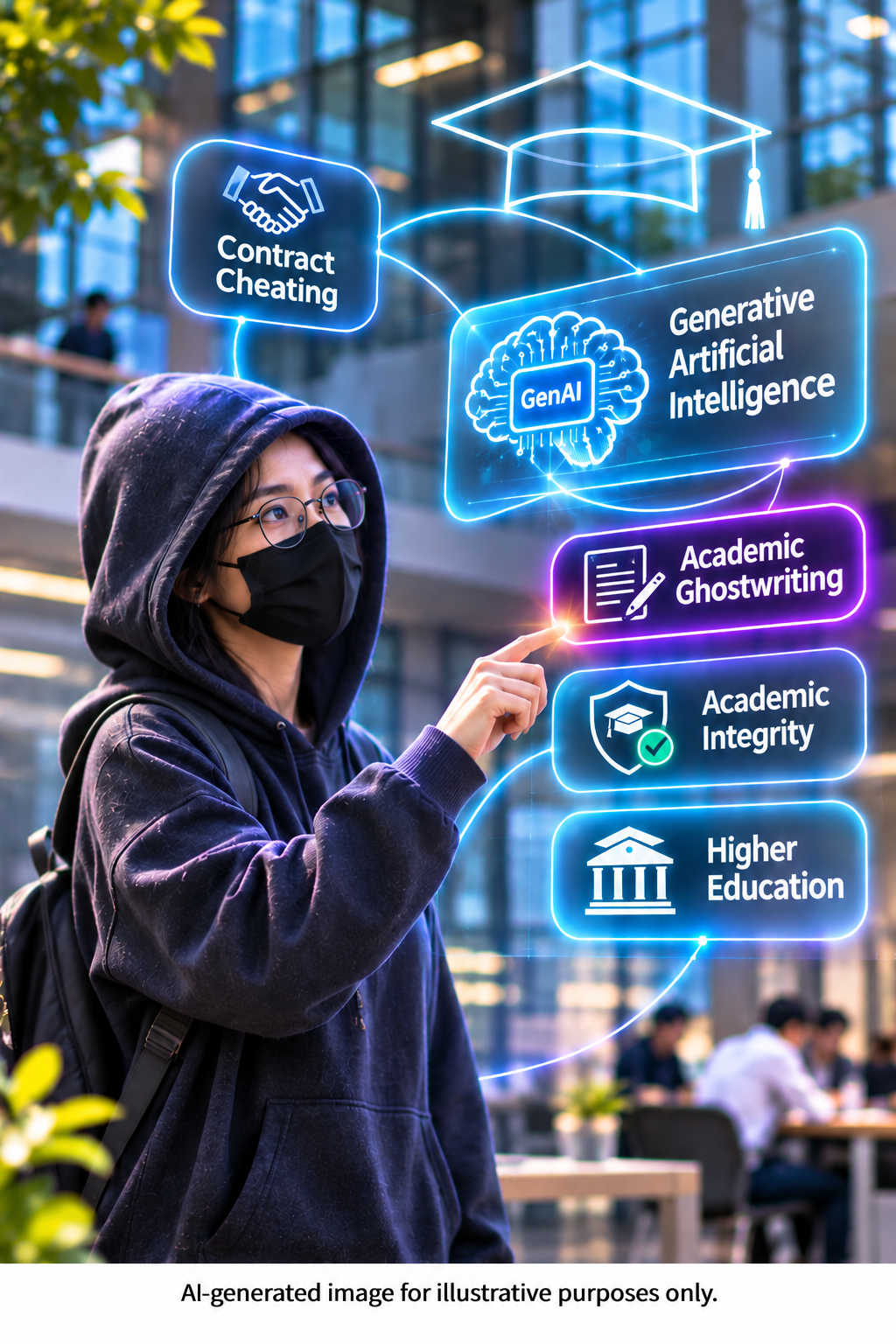
generative artificial intelligence, contract cheating, academic ghostwriting, academic integrity, higher educationAbstract
Academic ghostwriting is a form of contract cheating in which assessed work is produced by a third party, creating an academic-integrity problem that cannot be reduced to textual similarity. This qualitative single-case study examines how an experienced Malaysian academic ghostwriter adapted to the emergence and subsequent diffusion of generative artificial intelligence (GenAI) between 2022 and 2026. The participant, “Xiaofen”, is a doctoral graduate who provided paid academic writing services before ChatGPT and continued operating after its widespread adoption. The data comprise two published investigative reports, a newly conducted asynchronous semi-structured written interview, and six purposively sampled public Facebook advertisements. Reflexive thematic analysis indicates that, in this case, GenAI devalued routine undergraduate writing but complemented the provider’s higher-order work. She shifted her focus towards postgraduate and time-poor clients, incorporated several paid GenAI tools, and expanded from text production to end-to-end academic labour outsourcing involving topic formulation, revision management, data-related support, and viva preparation. The case does not establish the prevalence or direction of Malaysia’s wider ghostwriting market. Instead, it offers a task-based explanation: automation substitutes for routine drafting while complementing non-routine coordination, verification, judgement, and client management. Higher education institutions should therefore supplement text detection with staged, dialogic, and verifiable assessment practices that make students’ ownership of the academic process visible.
Penulisan akademik secara upahan ialah satu bentuk penipuan kontrak akademik apabila tugasan yang dinilai dihasilkan oleh pihak ketiga. Amalan ini menimbulkan masalah integriti akademik yang tidak dapat dikenal pasti melalui pemeriksaan persamaan teks semata-mata. Kajian kes kualitatif ini meneliti bagaimana seorang penulis akademik upahan berpengalaman di Malaysia menyesuaikan perkhidmatannya dengan kemunculan dan penggunaan meluas kecerdasan buatan generatif (GenAI) antara tahun 2022 hingga 2026. Peserta kajian, “Xiaofen”, ialah pemegang ijazah kedoktoran yang menawarkan perkhidmatan penulisan akademik berbayar sebelum kemunculan ChatGPT dan terus beroperasi selepas teknologi tersebut digunakan secara meluas. Data kajian terdiri daripada dua laporan penyiasatan yang diterbitkan, satu temu bual bertulis separa berstruktur secara tidak segerak, dan enam iklan Facebook awam yang dipilih melalui persampelan bertujuan. Analisis tematik refleksif menunjukkan bahawa, dalam kes ini, GenAI mengurangkan nilai penulisan rutin pada peringkat prasiswazah tetapi melengkapi kerja aras tinggi penyedia perkhidmatan tersebut. Beliau beralih kepada pelanggan pascasiswazah dan pelanggan yang menghadapi kekangan masa, menggunakan beberapa alat GenAI berbayar, serta memperluas perkhidmatannya daripada penghasilan teks kepada penyumberluaran tenaga kerja akademik secara menyeluruh yang merangkumi perumusan tajuk, pengurusan semakan, sokongan berkaitan data dan persediaan peperiksaan lisan (viva). Kes ini tidak membuktikan kelaziman atau hala tuju pasaran penulisan akademik upahan di Malaysia secara keseluruhan. Sebaliknya, kajian ini menawarkan penjelasan berasaskan tugas: automasi menggantikan penulisan rutin sambil melengkapi koordinasi, pengesahan, pertimbangan dan pengurusan pelanggan yang tidak rutin. Oleh itu, institusi pendidikan tinggi disarankan supaya melengkapi pengesanan teks dengan amalan pentaksiran berperingkat, dialogik dan boleh disahkan yang memperlihatkan pemilikan pelajar terhadap proses akademik.
References
Acemoglu, D., & Restrepo, P. (2019). Automation and new tasks: How technology displaces and reinstates labor. Journal of Economic Perspectives, 33(2), 3–30. https://doi.org/10.1257/jep.33.2.3
Ahsan, K., Akbar, S., & Kam, B. (2022). Contract cheating in higher education: A systematic literature review and future research agenda. Assessment & Evaluation in Higher Education, 47(4), 523–539. https://doi.org/10.1080/02602938.2021.1931660
Amigud, A., & Lancaster, T. (2019). 246 reasons to cheat: An analysis of students’ reasons for seeking to outsource academic work. Computers & Education, 134, 98–107. https://doi.org/10.1016/j.compedu.2019.01.017
Autor, D. H. (2015). Why are there still so many jobs? The history and future of workplace automation. Journal of Economic Perspectives, 29(3), 3–30. https://doi.org/10.1257/jep.29.3.3
Autor, D. H., Levy, F., & Murnane, R. J. (2003). The skill content of recent technological change: An empirical exploration. The Quarterly Journal of Economics, 118(4), 1279–1333. https://doi.org/10.1162/003355303322552801
Bendo, M. C. D. (2026). False positives in AI writing detection: A small-scale empirical study using authentic Filipino student essays. ASEAN Journal of Open and Distance Learning, 18(1), 12–19. https://doi.org/10.64233/VYVI9613
Berger, R. (2015). Now I see it, now I don’t: Researcher’s position and reflexivity in qualitative research. Qualitative Research, 15(2), 219–234. https://doi.org/10.1177/1468794112468475
Boud, D., & Molloy, E. (2013). Rethinking models of feedback for learning: The challenge of design. Assessment & Evaluation in Higher Education, 38(6), 698–712. https://doi.org/10.1080/02602938.2012.691462
Bowden, C., & Galindo-Gonzalez, S. (2015). Interviewing when you’re not face-to-face: The use of email interviews in a phenomenological study. International Journal of Doctoral Studies, 10, 79–92. https://doi.org/10.28945/2104
Bowen, G. A. (2009). Document analysis as a qualitative research method. Qualitative Research Journal, 9(2), 27–40. https://doi.org/10.3316/QRJ0902027
Braun, V., & Clarke, V. (2006). Using thematic analysis in psychology. Qualitative Research in Psychology, 3(2), 77–101. https://doi.org/10.1191/1478088706qp063oa
Braun, V., & Clarke, V. (2021). One size fits all? What counts as quality practice in (reflexive) thematic analysis? Qualitative Research in Psychology, 18(3), 328–352. https://doi.org/10.1080/14780887.2020.1769238
Carter, N., Bryant-Lukosius, D., DiCenso, A., Blythe, J., & Neville, A. J. (2014). The use of triangulation in qualitative research. Oncology Nursing Forum, 41(5), 545–547. https://doi.org/10.1188/14.ONF.545-547
Clarke, R., & Lancaster, T. (2006, June 19–21). Eliminating the successor to plagiarism? Identifying the usage of contract cheating sites [Paper presentation]. 2nd International Plagiarism Conference, Gateshead, United Kingdom.
Comas Forgas, R., Vallespir Adillón, M., Lancaster, T., & Mainardes, J. (2026). Contract cheating websites in Spain (2019–2024): Web traffic trends during COVID-19 and the rise of generative AI. International Journal for Educational Integrity, 22, Article 10. https://doi.org/10.1007/s40979-026-00221-1
Cotton, D. R. E., Cotton, P. A., & Shipway, J. R. (2024). Chatting and cheating: Ensuring academic integrity in the era of ChatGPT. Innovations in Education and Teaching International, 61(2), 228–239. https://doi.org/10.1080/14703297.2023.2190148
Dawson, P., Bearman, M., Dollinger, M., & Boud, D. (2024). Validity matters more than cheating. Assessment & Evaluation in Higher Education, 49(7), 1005–1016. https://doi.org/10.1080/02602938.2024.2386662
Dwyer, S. C., & Buckle, J. L. (2009). The space between: On being an insider-outsider in qualitative research. International Journal of Qualitative Methods, 8(1), 54–63. https://doi.org/10.1177/160940690900800105
Eke, D. O. (2023). ChatGPT and the rise of generative AI: Threat to academic integrity? Journal of Responsible Technology, 13, Article 100060. https://doi.org/10.1016/j.jrt.2023.100060
Ellis, C., Zucker, I. M., & Randall, D. (2018). The infernal business of contract cheating: Understanding the business processes and models of academic custom writing sites. International Journal for Educational Integrity, 14, Article 1. https://doi.org/10.1007/s40979-017-0024-3
Franzke, A. S., Bechmann, A., Zimmer, M., Ess, C., & Association of Internet Researchers. (2020). Internet research: Ethical guidelines 3.0. Association of Internet Researchers. https://aoir.org/reports/ethics3.pdf
Jeyaraj, J. J. (2020). Academic writing needs of postgraduate research students in Malaysia. Malaysian Journal of Learning and Instruction, 17(2), 1–23. https://doi.org/10.32890/mjli2020.17.2.1
Lee, Y. S. (2022a, December 6). 博士学霸暗捞盆满砵满 “职业枪手团”渗入教育圈 [Doctoral high achievers quietly make a fortune: “Professional ghostwriting groups” infiltrate education]. Sin Chew Daily. https://www.sinchew.com.my/news/20221206/nation/4319008
Lee, Y. S. (2022b, December 7). 比价格看评语 找“枪手”像买菜 高教大崩坏 [Comparing prices and reviews to hire a “ghostwriter” like grocery shopping: The collapse of higher education]. Sin Chew Daily. https://www.sinchew.com.my/news/20221207/nation/4321332
Lincoln, Y. S., & Guba, E. G. (1985). Naturalistic inquiry. SAGE.
Meho, L. I. (2006). E-mail interviewing in qualitative research: A methodological discussion. Journal of the American Society for Information Science and Technology, 57(10), 1284–1295. https://doi.org/10.1002/asi.20416
Mehar Singh, M. K., & Phan, J. K. J. (2024). Examining exemplar elements of selected Malaysian higher education institutions’ academic integrity policy: Document analysis-based evidence. Journal of Nusantara Studies, 9(1), 269–293. https://doi.org/10.24200/jonus.vol9iss1pp269-293
Mustapha, R., Hussin, Z., Siraj, S., & Darusalam, G. (2017). Academic dishonesty among higher education students: The Malaysian evidence (2014 to 2016). KATHA—The Official Journal of the Centre for Civilisational Dialogue, 13(1), 73–93. https://doi.org/10.22452/KATHA.vol13no1.4
Newton, P. M. (2018). How common is commercial contract cheating in higher education and is it increasing? A systematic review. Frontiers in Education, 3, Article 67. https://doi.org/10.3389/feduc.2018.00067
Ong, P. (2026). Challenges of university students in negotiating academic integrity in the age of artificial intelligence in open and distance learning assessment. ASEAN Journal of Open and Distance Learning, 18(1), 94–106. https://doi.org/10.64233/MUPU4330
Patton, M. Q. (2015). Qualitative research & evaluation methods: Integrating theory and practice (4th ed.). SAGE.
Perkins, M., Furze, L., Roe, J., & MacVaugh, J. (2024). The Artificial Intelligence Assessment Scale (AIAS): A framework for ethical integration of generative AI in educational assessment. Journal of University Teaching & Learning Practice, 21(6). https://doi.org/10.53761/q3azde36
Rowland, S., Slade, C., Wong, K.-S., & Whiting, B. (2018). “Just turn to us”: The persuasive features of contract cheating websites. Assessment & Evaluation in Higher Education, 43(4), 652–665. https://doi.org/10.1080/02602938.2017.1391948
Sivasubramaniam, S., Kostelidou, K., & Ramachandran, S. (2016). A close encounter with ghost-writers: An initial exploration study on background, strategies and attitudes of independent essay providers. International Journal for Educational Integrity, 12, Article 1. https://doi.org/10.1007/s40979-016-0007-9
Stake, R. E. (1995). The art of case study research. SAGE.
Talib, N. (2016). Masalah plagiarisme dan amalan penggunaan Turnitin dalam kalangan pelajar siswazah Universiti Kebangsaan Malaysia. ASEAN Journal of Teaching and Learning in Higher Education, 8(2), 1–15. https://ejournal.ukm.my/ajtlhe/article/view/17932
Tai, J., Ajjawi, R., Boud, D., Dawson, P., & Panadero, E. (2018). Developing evaluative judgement: Enabling students to make decisions about the quality of work. Higher Education, 76(3), 467–481. https://doi.org/10.1007/s10734-017-0220-3
Villarroel, V., Bloxham, S., Bruna, D., Bruna, C., & Herrera-Seda, C. (2018). Authentic assessment: Creating a blueprint for course design. Assessment & Evaluation in Higher Education, 43(5), 840–854. https://doi.org/10.1080/02602938.2017.1412396
Wan Osman, W. S., Senom, F., & Sharatol Ahmad Shah, S. (2024). Exploring the manifestations of second language writing anxiety in master’s level dissertation writing: A multiple-case study. Journal of Nusantara Studies, 9(2), 57–79. https://doi.org/10.24200/jonus.vol9iss2pp57-79
Weber-Wulff, D., Anohina-Naumeca, A., Bjelobaba, S., Foltýnek, T., Guerrero-Dib, J., Popoola, O., Šigut, P., & Waddington, L. (2023). Testing of detection tools for AI-generated text. International Journal for Educational Integrity, 19, Article 26. https://doi.org/10.1007/s40979-023-00146-z
Yin, R. K. (2018). Case study research and applications: Design and methods (6th ed.). SAGE.
Downloads
Published
How to Cite
Issue
Section
License
Copyright (c) 2026 Borneo International Journal of Education (BIJE)

This work is licensed under a Creative Commons Attribution 4.0 International License.
Copyright and Disclaimer
Copyright of all articles published in the Borneo International Journal of Education (BIJE) is held by the journal. The views, interpretations, and conclusions expressed in published articles are solely those of the authors and do not necessarily reflect the views or positions of the Editorial Board, Editorial Advisory Board, publisher, or journal management.
Open Access and Licensing Policy
The Borneo International Journal of Education (BIJE) is an open-access journal. All articles are freely available to the public immediately upon publication without subscription or access charges.
Articles are published under the Creative Commons Attribution 4.0 International License (CC BY 4.0). This license permits users to read, download, copy, distribute, share, adapt, and build upon the published material in any medium or format, provided that appropriate credit is given to the original author(s) and source, a link to the license is provided, and any changes made are indicated.
BIJE's open-access policy supports the principles of the Budapest Open Access Initiative (BOAI) and promotes the widest possible dissemination and responsible reuse of scholarly research.




 Total Views: 31
|
 Total Downloads: 25