Integrasi 3P dalam pembentukan kepimpinan pendidikan holistik
Integrating the 3P framework in developing holistic educational leadership
DOI:
https://doi.org/10.51200/bije.v8i1.8520Keywords:
educational leadership, organizational management, human resource management, khalifah human development, kepimpinan pendidikan, pengurusan organisasi, pengurusan sumber manusia, pembangunan insan khalifahAbstract
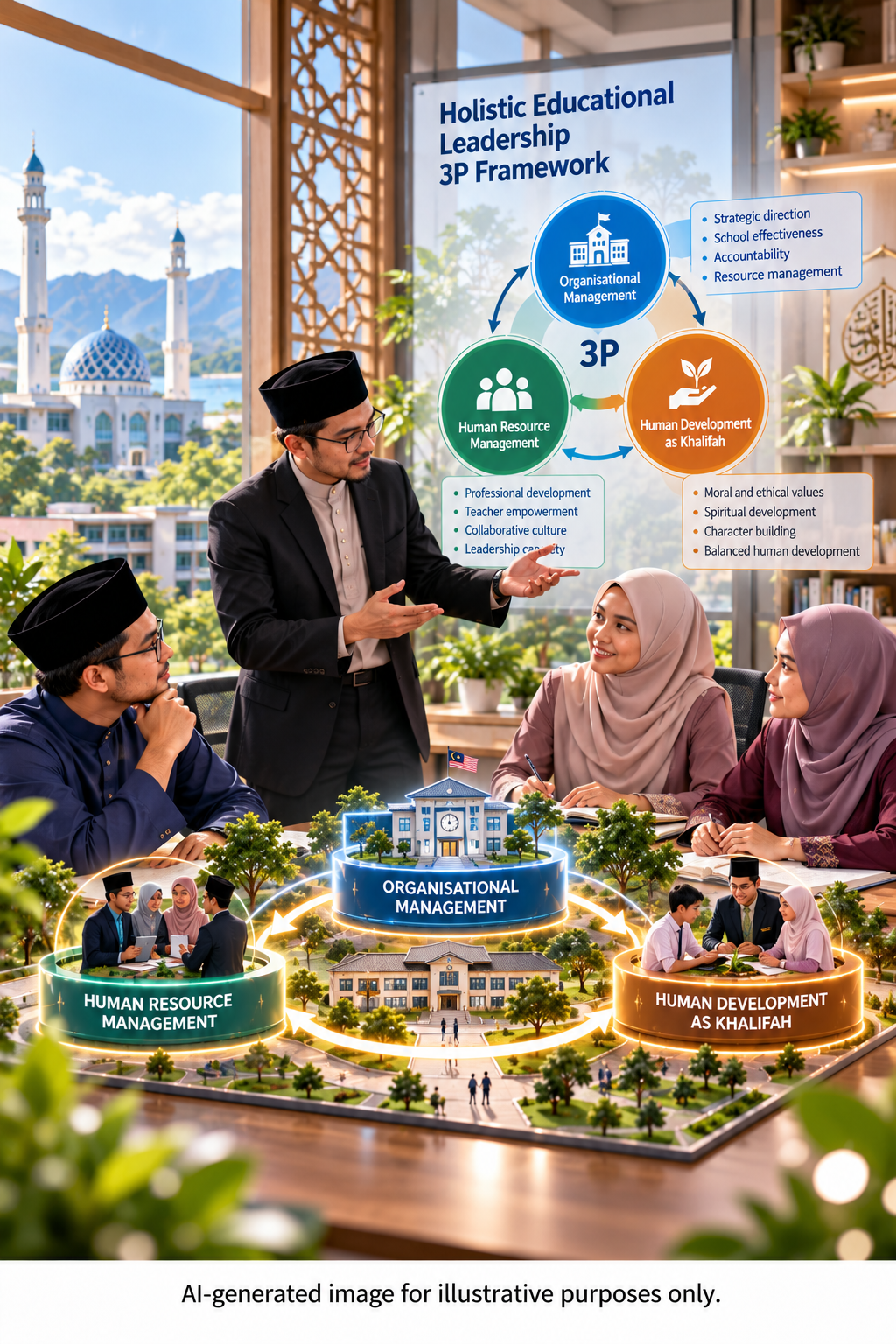
Educational leadership in the digital era requires a holistic approach to ensure school effectiveness and balanced human development, as envisioned in the National Education Philosophy (NEP). However, many educational leadership models currently in use are rooted in Western secular paradigms that place greater emphasis on technical aspects, such as organizational structure, accountability, and human resource development. Reliance on such models creates a gap between managerial efficiency and the need to cultivate an educational culture grounded in moral, ethical, and spiritual values. This article aims to develop a conceptual framework for holistic educational leadership through a synthesis of policy documents, leadership standards, empirical literature, and the perspectives of Islamic scholars. Inductive and deductive conceptual approaches were employed to identify and categorize 21 leadership tasks into three main dimensions: organizational management, human resource management, and human development management based on the concept of khalifah. The analysis indicates that Western theories contribute to organizational structure and efficiency but require the integration of value-based and spiritual dimensions to achieve comprehensive effectiveness within the Malaysian educational context. The proposed 3P Holistic Educational Leadership Model integrates technical efficiency, professional development, and a spiritual value orientation, thereby offering a more balanced and contextually relevant approach to educational leadership. The implications of this study encompass school leadership development, policy design, and future research agendas aimed at developing schools that are resilient, ethical, and grounded in Rabbani (God-centred) values.
Kepimpinan pendidikan dalam era digital menuntut pendekatan yang holistik bagi memastikan keberkesanan sekolah serta pembangunan insan yang seimbang sebagaimana yang dihasratkan dalam Falsafah Pendidikan Kebangsaan (FPK). Namun demikian, banyak model kepimpinan pendidikan yang digunakan pada masa kini berakar daripada paradigma Barat yang bersifat sekular dan lebih menekankan aspek teknikal, seperti struktur organisasi, akauntabiliti dan pembangunan sumber manusia. Kebergantungan pada model sedemikian mewujudkan jurang antara kecekapan pengurusan dengan keperluan untuk membina budaya pendidikan yang berteraskan nilai moral, etika dan kerohanian. Artikel ini bertujuan untuk membangunkan suatu kerangka konseptual kepimpinan pendidikan holistik melalui sintesis dokumen dasar, piawaian kepimpinan, literatur empirikal dan pandangan sarjana Islam. Pendekatan konseptual secara induktif dan deduktif digunakan untuk mengenal pasti serta mengelompokkan 21 tugas kepimpinan kepada tiga dimensi utama, iaitu pengurusan organisasi, pengurusan sumber manusia dan pengurusan pembangunan insan sebagai khalifah. Analisis menunjukkan bahawa teori Barat memberikan sumbangan dari segi struktur dan kecekapan, namun memerlukan pengintegrasian dimensi nilai dan kerohanian untuk mencapai keberkesanan yang menyeluruh dalam konteks pendidikan di Malaysia. Model Kepimpinan Pendidikan Holistik 3P yang dicadangkan menyepadukan kecekapan teknikal, pembangunan profesional dan orientasi nilai kerohanian, sekali gus menawarkan pendekatan kepimpinan yang lebih seimbang dan kontekstual. Implikasi kajian ini merangkumi pembangunan pemimpin sekolah, reka bentuk dasar dan agenda penyelidikan pada masa hadapan ke arah pembinaan sekolah yang berdaya tahan, beretika dan berteraskan nilai Rabbani.
References
Al-Attas, S. M. N. (1991). The concept of education in Islam: A framework for an Islamic philosophy of education. International Institute of Islamic Thought and Civilization, International Islamic University.
Al-Ghazali. (2005). Iḥyā ulūm al-dīn. Dar al-Bayan al-Arabi.
Bajunid, I. A. (1996). Preliminary explorations of indigenous perspectives of educa¬tional management: The evolving Malaysian experience. Journal of Educational Administration, 34 (5), 50–73. https://doi.org/10.1108/09578239610148278
Brooks, M. C., & Mutohar, A. (2018). Islamic school leadership: A conceptual framework. Journal of Educational Administration and History, 50 (2), 54–68. https://doi.org/10.1080/00220620.2018.1426558
Bryson, J. (2018). Strategic planning for public and nonprofit organizations (5th ed.). San Francisco: Jossey-Bass.
Bush, T. (2018). Transformational leadership: Exploring common conceptions. Educational Management Administration & Leadership, 46 (6), 883-887. https://doi.org/10.1177/1741143218795731
Bush, T., & Glover, D. (2014). School leadership models: What do we know? School Leadership & Management, 34(5), 553–571. https://doi.org/10.1080/13632434.2014.928680
Bush, T., Abdul Hamid, S., Ng, A. Y. M., & Kaparou, M. (2018). School leadership theories and the Malaysia Education Blueprint: Findings from a systematic literature review. International Journal of Educational Management, 32 (7), 1245–1265. https://doi.org/10.1108/IJEM-06-2017-0158
Creagh, S., Thompson, G., Mockler, N., Stacey, M., & Hogan, A. (2025). Workload, work intensification and time poverty for teachers and school leaders: A systematic research synthesis. Educational Review, 77 (2), 661–680. https://doi.org/10.1080/00131911.2023.2196607
Daniel, G. J., & Lei, H. (2020). The effect of principal’s distributed leadership practice on students’ academic achievement: A systematic review of the literature. International Journal of Higher Education, 9(1), 189–198. https://doi.org/10.5430/ijhe.v9n1p189
Dantley, M. E. (2003). Purpose-driven leadership: The spiritual imperative to guiding schools beyond high-stakes testing and minimum proficiency. Education and Urban Society, 35(3), 273–291. https://doi.org/10.1177/0013124503035003002
Day, C., Gu, Q., & Sammons, P. (2016). The impact of leadership on student outcomes: How successful school leaders use transformational and instructional strategies to make a difference. Educational Administration Quarterly, 52(2), 221–258. https://doi.org/10.1177/0013161X15616863
Goh, S. Y., Yeap, S. B., & Thien, L. M. (2023). Enhancing teacher leadership in Malaysian secondary schools: Do collaborative school culture and principal support matter? Asia Pacific Journal of Educators and Education, 38 (2), 175–202. https://doi.org/10.21315/apjee2023.38.2.10
Hallinger, P. (2011). Leadership for learning: Lessons from 40 years of empirical research. Journal of Educational Administration, 49(2), 125–142. https://doi.org/10.1108/09578231111116699
Hallinger, P., & Heck, R. H. (2010). Leadership for learning: Does collaborative leadership make a difference in school improvement? Educational Management Administration & Leadership, 38(6), 654–678. https://doi.org/10.1177/1741143210379060
Hallinger, P., & Murphy, J. (1985). Assessing instructional leadership. Elementary School Journal, 86 (2), 217–247. https://doi.org/10.1086/461445
Hallinger, P., & Wang, W.C. (2015). Assessing instructional leadership with the Principal Instructional Management Rating Scale. Springer. https://doi.org/10.1007/978-3-319-15533-3
Hargreaves, A., & Fullan, M. (2012). Professional capital: Transforming teaching in every school. Teachers College Press. https://doi.org/10.65528/9780807771709
Hoy, W. K., & Miskel, C. (2013). Educational administration: Theory, research, and practice (9th ed.). New York: McGraw-Hill.
Huang, T., & Benoliel, P. (2023). Principal time use and student academic achievement in Singapore. International Journal of Educational Management, 37(6–7), 1401–1424. https://doi.org/10.1108/IJEM-08-2023-0427
Ibn Khaldun. (1967). The Muqaddimah: An introduction to history (F. Rosenthal, Trans.; 2nd ed., with corrections and augmented bibliography). Princeton University Press.
Ibn Miskawayh. (1968). The refinement of character: A translation from the Arabic of Aḥmad Ibn-Muḥammad Miskawayh’s Tahdhīb al-Akhlāq (C. K. Zurayk, Trans.). American University of Beirut.
Institut Aminuddin Baki. (2015). NPQEL competency framework. Kementerian Pendidikan Malaysia.
Ja’afar, J., & Adnan, A. A. Z. (2025). Leading to lead: Principals’ situational leadership and its influence on teacher leadership. International Journal of Education, Psychology and Counseling, 10 (60), 591–600. https://doi.org/10.35631/IJEPC.1060042
Jaakkola, E. (2020). Designing conceptual articles: Four approaches. AMS Review, 10 (1–2), 18–26. https://doi.org/10.1007/s13162-020-00161-0
Kementerian Pendidikan Malaysia. (2013). Pelan Pembangunan Pendidikan Malaysia 2013–2025. Putrajaya: KPM.
Kementerian Pendidikan Malaysia. (2017). Standard Kualiti Pendidikan Malaysia Gelombang 2 (SKPMg2). Putrajaya: KPM.
Kementerian Pendidikan Malaysia. (2020). Standard Guru Malaysia 2.0. Putrajaya: KPM.
Leithwood, K., Harris, A., & Hopkins, D. (2008). Seven strong claims about successful school leadership. School Leadership & Management, 28 (1), 27–42. https://doi.org/10.1080/13632430701800060
Leithwood, K., Sun, J., & Schumacker, R. (2020). How school leadership influences student learning: A test of “the four paths model.” Educational Administration Quarterly, 56 (4), 570–599. https://doi.org/10.1177/0013161X19878772
Mintzberg, H. (2013). Simply managing: What managers do—and can do better. San Francisco: Berrett-Koehler.
Mohd Nawi, N., Abdul Razak, A. Z., & Omar, I. M. (2026). Amalan kepimpinan lestari pentadbir dan hubungannya dengan pengetahuan guru terhadap pendidikan alam sekitar. JuPiDi: Jurnal Kepimpinan Pendidikan, 13 (1), 27–60. https://doi.org/10.22452/jupidi.vol13no1.2
Msila, V. (2021). Rethinking education leadership through self-reflection: Examining the TURNS model. Research in Educational Administration & Leadership, 6(3), 662–690. https://doi.org/10.30828/real/2021.3.5
OECD. (2020). Curriculum analysis of the OECD Future of Education and Skills 2030: Technical report. OECD Publishing. https://doi.org/10.1787/fec47a82-en
Othman, S. A., Ibrahim, M. B., Salleh, M. J., & Md Sidek, S. S. (2024). School leaders’ leadership practices and their influence on crisis-related problem-solving and decision-making: A multi-site case study. IIUM Journal of Educational Studies, 12 (1), 50–73. https://doi.org/10.31436/ijes.v12i1.515
Özdoğru, M., & Sarıer, Y. (2024). The relationship of ethical leadership with teachers’ organizational behavior, attitudes, and perceptions: a meta-analysis study. Humanities and Social Sciences Communications, 11. https://doi.org/10.1057/s41599-024-04070-6
Rodrigues, H. P. C., & Ávila de Lima, J. (2024). Instructional leadership and student achievement: School leaders’ perspectives. International Journal of Leadership in Education, 27 (2), 360–384. https://doi.org/10.1080/13603124.2020.1869312
Samichan, A., Yunus, J. @ N., & Awang, M. (2021). Indigenous element on school instructional leaderships model in Malaysia: A literature review. Jurnal Pendidikan Bitara UPSI, 14 (2), 96–106. https://doi.org/10.37134/bitara.vol14.2.9.2021
Shahjahan, R. A. (2013). Coloniality and a global testing regime in higher education: Unpacking the OECD’s AHELO initiative. Journal of Education Policy, 28 (5), 676–694. https://doi.org/10.1080/02680939.2012.758831
Spillane, J. (2006). Distributed leadership. San Francisco: Jossey-Bass.
Thomas, D. R. (2006). A General Inductive Approach for Analyzing Qualitative Evaluation Data. American Journal of Evaluation, 27 (2), 237-246. https://doi.org/10.1177/1098214005283748
Trinidad, J. E. (2024). An organizational sociology of education: Using structural, network, and ecological perspectives to study schools. Sociological Inquiry, 94(4), 968–993. https://doi.org/10.1111/soin.12583
Wan Daud, W. M. N. (1998). The educational philosophy and practice of Syed Muhammad Naquib al-Attas: An exposition of the original concept of Islamization. International Institute of Islamic Thought and Civilization.
Downloads
Published
How to Cite
Issue
Section
License
Copyright (c) 2026 Borneo International Journal of Education (BIJE)

This work is licensed under a Creative Commons Attribution 4.0 International License.
Copyright and Disclaimer
Copyright of all articles published in the Borneo International Journal of Education (BIJE) is held by the journal. The views, interpretations, and conclusions expressed in published articles are solely those of the authors and do not necessarily reflect the views or positions of the Editorial Board, Editorial Advisory Board, publisher, or journal management.
Open Access and Licensing Policy
The Borneo International Journal of Education (BIJE) is an open-access journal. All articles are freely available to the public immediately upon publication without subscription or access charges.
Articles are published under the Creative Commons Attribution 4.0 International License (CC BY 4.0). This license permits users to read, download, copy, distribute, share, adapt, and build upon the published material in any medium or format, provided that appropriate credit is given to the original author(s) and source, a link to the license is provided, and any changes made are indicated.
BIJE's open-access policy supports the principles of the Budapest Open Access Initiative (BOAI) and promotes the widest possible dissemination and responsible reuse of scholarly research.




 Total Views: 30
|
 Total Downloads: 24