Factor analysis in mediating effect of cognitive reappraisal on relationship between perceived autonomy support and subjective well-being of vocational college students in Malaysia
DOI:
https://doi.org/10.51200/bije.v8i1.8525Keywords:
Cognitive reappraisal, perceived autonomy support, subjective well-being, vocational college students, Penilaian semula kognitif, persepsi sokongan autonomi, kesejahteraan subjektif, pelajar kolej vokasionalAbstract
This study investigates the mediating role of cognitive reappraisal in the relationship between perceived autonomy support and subjective well-being among Malaysian vocational college students. A total of 185 students participated through simple random sampling and completed validated questionnaires measuring perceived autonomy support, cognitive reappraisal, and subjective well-being. Data were analyzed using SPSS, including reliability analysis, Exploratory Factor Analysis (EFA) to explore the factor structure, and mediation analysis to examine hypothesized relationships. Results showed that perceived autonomy support significantly predicts cognitive reappraisal, which in turn positively influences subjective well-being. The mediation analysis revealed that cognitive reappraisal (CR) partially mediates the relationship between perceived autonomy support (PAS) and subjective well-being (SWB), indicating that supportive learning environments enhance students’ well-being both directly and indirectly through emotion regulation strategies. These findings underscore the importance of fostering autonomy-supportive educational environments and promoting adaptive emotion regulation skills among vocational students. Practically, educators and policymakers should provide opportunities for student autonomy and offer guidance in cognitive reappraisal to improve mental health outcomes. The study contributes to understanding the psychological mechanisms linking autonomy support, emotion regulation, and well-being, providing a foundation for interventions aimed at enhancing the mental health and resilience of vocational college students.
Kajian ini bertujuan untuk meneliti peranan pengantaraan penilaian semula kognitif dalam hubungan antara persepsi sokongan autonomi dengan kesejahteraan subjektif dalam kalangan pelajar kolej vokasional di Malaysia. Seramai 185 orang pelajar telah terlibat dalam kajian ini melalui kaedah persampelan rawak mudah dan melengkapkan soal selidik yang telah disahkan bagi mengukur persepsi sokongan autonomi, penilaian semula kognitif dan kesejahteraan subjektif. Data dianalisis menggunakan SPSS, merangkumi analisis kebolehpercayaan, Analisis Faktor Penerokaan (Exploratory Factor Analysis, EFA) untuk meneroka struktur faktor instrumen, serta analisis pengantaraan bagi menguji hubungan yang dihipotesiskan. Dapatan kajian menunjukkan bahawa persepsi sokongan autonomi merupakan peramal yang signifikan terhadap penilaian semula kognitif, yang seterusnya mempunyai hubungan positif dengan kesejahteraan subjektif. Analisis pengantaraan turut menunjukkan bahawa penilaian semula kognitif (CR) mengantara secara separa hubungan antara persepsi sokongan autonomi (PAS) dengan kesejahteraan subjektif (SWB). Dapatan ini menunjukkan bahawa persekitaran pembelajaran yang menyokong autonomi berpotensi meningkatkan kesejahteraan pelajar secara langsung dan secara tidak langsung melalui strategi pengawalan emosi. Penemuan ini menekankan kepentingan mewujudkan persekitaran pendidikan yang menyokong autonomi serta memupuk kemahiran pengawalan emosi yang adaptif dalam kalangan pelajar kolej vokasional. Dari sudut amalan, pendidik dan pembuat dasar disarankan untuk menyediakan peluang kepada pelajar membuat pilihan dan mengambil bahagian secara aktif dalam pembelajaran, di samping memberikan bimbingan tentang penggunaan strategi penilaian semula kognitif bagi menyokong kesejahteraan psikologi mereka. Kajian ini menyumbang kepada pemahaman tentang mekanisme psikologi yang menghubungkan sokongan autonomi, pengawalan emosi dan kesejahteraan, sekali gus menyediakan asas bagi pembangunan intervensi untuk meningkatkan kesihatan mental dan daya tahan psikologi pelajar kolej vokasional.
References
Ahmad, N., Shahar, S., Aris, T., & Azhar, M. (2022). Depression, anxiety, and stress among Malaysian TVET students during online learning: A cross-sectional study. Asian Journal of Education and Training, 8(3), 91–99.
Brockman, R., Ciarrochi, J., & Kashdan, T. B. (2023). Emotion regulation strategies and subjective well-being in adolescents: The role of cognitive reappraisal. Journal of Positive Psychology, 18(2), 145–158.
Cutuli, D. (2014). Cognitive reappraisal and expressive suppression strategies role in the emotion regulation: An overview on their modulatory effects and neural correlates. Frontiers in Systems Neuroscience, 8, 175. https://doi.org/10.3389/fnsys.2014.00175
De France, K., & Hollenstein, T. (2022). Emotion regulation and autonomy support: A developmental systems perspective. Developmental Psychology, 58(2), 243–256. https://doi.org/10.1037/dev0001304
Deci, E. L., & Ryan, R. M. (1985). Intrinsic motivation and self-determination in human behavior. Springer.
Deci, E. L., & Ryan, R. M. (2000). The “what” and “why” of goal pursuits: Human needs and the self-determination of behavior. Psychological Inquiry, 11(4), 227–268.
Diener, E., Emmons, R. A., Larsen, R. J., & Griffin, S. (1985). The Satisfaction With Life Scale. Journal of Personality Assessment, 49(1), 71–75.
Diener, E., Suh, E., Lucas, R. E., & Smith, H. L. (1999). Subjective well-being: Three decades of progress. Psychological Bulletin, 125(2), 276–302.
Fredrickson, B. L. (2001). The role of positive emotions in positive psychology: The broaden-and-build theory of positive emotions. American Psychologist, 56(3), 218–226.
Grolnick, W. S. (2003). The psychology of parental control: How well-meant parenting backfires. Lawrence Erlbaum Associates.
Gross, J. J. (1998). The emerging field of emotion regulation: An integrative review. Review of General Psychology, 2(3), 271–299. https://doi.org/10.1037/1089-2680.2.3.271
Hayes, A. F. (2018). Introduction to mediation, moderation, and conditional process analysis: A regression-based approach (2nd ed.). Guilford Press.
Jang, H., Reeve, J., & Deci, E. L. (2010). Engaging students in learning activities: A self-determination theory perspective. Journal of Educational Psychology, 102(3), 588–600.
Joussemet, M., Landry, R., & Koestner, R. (2008). A self-determination theory perspective on parenting. Canadian Psychology, 49(3), 194–200.
Ku, C., & Ahn, H. (2015). The influence of parental autonomy support on adolescents’ psychological well-being: A cross-cultural study. Journal of Child and Family Studies, 24(9), 2849–2861.
Ma, H., Yasin, R. M., & Othman, N. (2022). Perceived autonomy support and well-being among Malaysian vocational students. Malaysian Journal of Learning and Instruction, 19(1), 115–136.
MacKinnon, D. P., Lockwood, C. M., & Williams, J. (2004). Confidence limits for the indirect effect: Distribution of the product and resampling methods. Multivariate Behavioral Research, 39(1), 99–128.
Ochsner, K. N., & Gross, J. J. (2005). The cognitive control of emotion. Trends in Cognitive Sciences, 9(5), 242–249.
Preacher, K. J., & Hayes, A. F. (2008). Asymptotic and resampling strategies for assessing and comparing indirect effects in multiple mediator models. Behavior Research Methods, 40(3), 879–891.
Reeve, J. (2009). Why teachers adopt a controlling motivating style: A self-determination theory explanation. Educational Psychologist, 44(3), 159–175.
Reeve, J. (2012). A self-determination theory perspective on student engagement. In S. L. Christenson, A. L. Reschly, & C. Wylie (Eds.), Handbook of research on student engagement (pp. 149–172). Springer.
Ryan, R. M., & Deci, E. L. (2000). Self-determination theory and the facilitation of intrinsic motivation, social development, and well-being. American Psychologist, 55(1), 68–78. https://doi.org/10.1037/0003-066X.55.1.68
Ryan, R. M., & Deci, E. L. (2002). Overview of self-determination theory: An organismic-dialectical perspective. In E. L. Deci & R. M. Ryan (Eds.), Handbook of self-determination research (pp. 3–33). University of Rochester Press.
Schweizer, S., & Blakemore, S.-J. (2020). The development of emotion regulation: Neural mechanisms and implications for education. Nature Reviews Neuroscience, 21(9), 537–550. https://doi.org/10.1038/s41583-020-0340-2
Tang, M., Wang, L., & Cheng, C. (2013). Teacher autonomy support and student engagement in learning activities: A cross-cultural study. Asia-Pacific Education Researcher, 22(3), 367–375.
Vansteenkiste, M., & Ryan, R. M. (2013). On psychological growth and vulnerability: Basic psychological need satisfaction and need frustration as a unifying principle. Journal of Psychotherapy Integration, 23(3), 263–280.
Yasin, R. M., Othman, N., & Ahmad, N. (2024). The strategic role of TVET in Malaysia: Enhancing future employability. Journal of Technical Education and Training, 16(1), 1–14.
Zhang, X., & Li, J. (2023). Cognitive reappraisal and life satisfaction among Malaysian university students: The mediating role of emotion regulation. Asian Journal of Education and Social Studies, 42(2), 45–58.

Downloads
Published
How to Cite
Issue
Section
License
Copyright (c) 2026 Borneo International Journal of Education (BIJE)

This work is licensed under a Creative Commons Attribution 4.0 International License.
Copyright and Disclaimer
Copyright of all articles published in the Borneo International Journal of Education (BIJE) is held by the journal. The views, interpretations, and conclusions expressed in published articles are solely those of the authors and do not necessarily reflect the views or positions of the Editorial Board, Editorial Advisory Board, publisher, or journal management.
Open Access and Licensing Policy
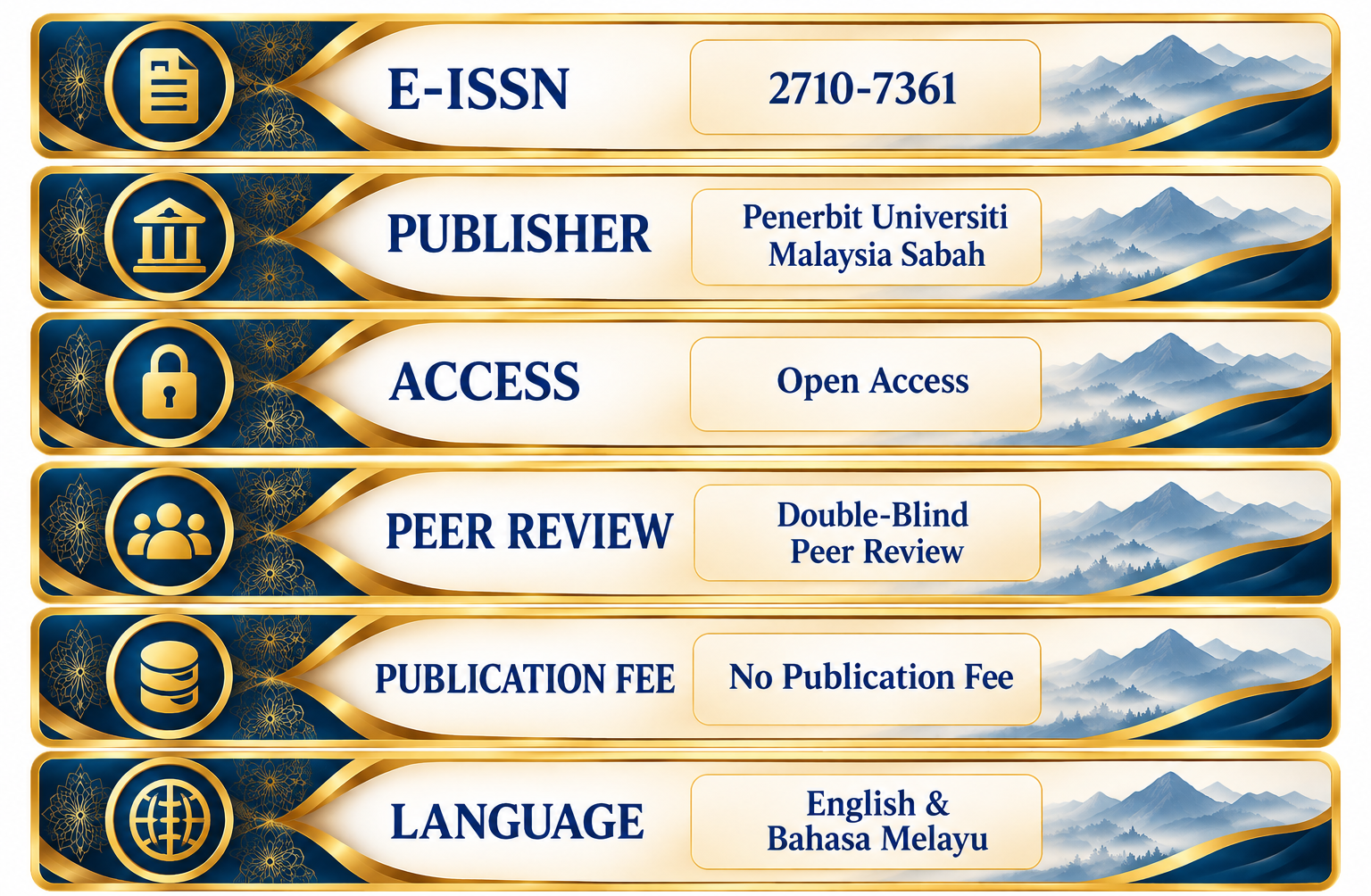
The Borneo International Journal of Education (BIJE) is an open-access journal. All articles are freely available to the public immediately upon publication without subscription or access charges.
Articles are published under the Creative Commons Attribution 4.0 International License (CC BY 4.0). This license permits users to read, download, copy, distribute, share, adapt, and build upon the published material in any medium or format, provided that appropriate credit is given to the original author(s) and source, a link to the license is provided, and any changes made are indicated.
BIJE's open-access policy supports the principles of the Budapest Open Access Initiative (BOAI) and promotes the widest possible dissemination and responsible reuse of scholarly research.




 Total Views: 23
|
 Total Downloads: 35